Chemists cram two million nanorods into single cancer cell

November 16, 2011

Chemists cram two million nanorods into single cancer cell

Enlarge

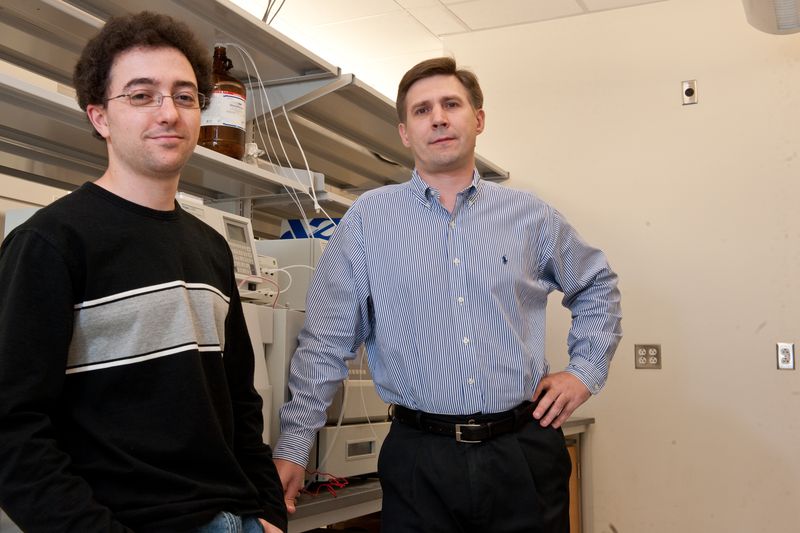
Rice University's Leonid Vigderman (left) and Eugene Zubarev have found a way to load more than 2 million tiny gold particles called nanorods into a single cancer cell. CREDIT: Jeff Fitlow/Rice University

(PhysOrg.com) -- Rice University chemists have found a way to load more than 2 million tiny gold particles called nanorods into a single cancer cell. The breakthrough could speed development of cancer treatments that would use nanorods like tiny heating elements to cook tumors from the inside.

The research appears online this week in the chemical journal .

"The that we studied were so laden with gold nanorods that their masses increased by an average of about 13 percent," said study leader Eugene Zubarev, associate professor of chemistry at Rice. "Remarkably, the cells continued to function normally, even with all of this gold inside them."

This video is not supported by your browser at this time.

Though the ultimate goal is to kill cancer, Zubarev said the strategy is to deliver nontoxic particles that become deadly only when they are activated by a laser. The nanorods, which are about the size of a small virus, can harvest and convert otherwise harmless light into heat. But because each nanorod radiates miniscule heat, many are needed to kill a cell.

"Ideally, you'd like to use a low-power laser to minimize the risks to healthy tissue, and the more particles you can load inside the cell, the lower you can set the power level and irradiation time," said Zubarev, an investigator at Rice's BioScience Research Collaborative (BRC).

Unfortunately, scientists who study gold nanorods have found it difficult to load large numbers of particles into living cells. For starters, nanorods are pure gold, which means they won't dissolve in solution unless they are combined with some kind of polymer or . The most commonly used of these is cetyltrimethylammonium bromide, or CTAB, a soapy chemical often used in hair conditioner.

CTAB is a key ingredient in the production of nanorods, so scientists have often relied upon it to make nanorods soluble in water. CTAB does this job by coating the surface of the nanorods in much the same way that soap envelopes and dissolves droplets of grease in dishwater. CTAB-encased nanorods also have a positive charge on their surfaces, which encourages cells to ingest them. Unfortunately, CTAB is also toxic, which makes it problematic for biomedical applications.

In the new research, Zubarev, Rice graduate student Leonid Vigderman and former graduate student Pramit Manna, now at Applied Materials Inc., describe a method to completely replace CTAB with a closely related molecule called MTAB that has two additional atoms attached at one end.

The additional atoms -- one sulfur and one hydrogen -- allow MTAB to form a permanent chemical bond with gold nanorods. In contrast, CTAB binds more weakly to nanorods and has a tendency to leak into surrounding media from time to time, which is believed to be the underlying cause of CTAB-encased nanorod toxicity.

It took Zubarev, Vigderman and Manna several years to identify the optimal strategy to synthesize MTAB and substitute it for CTAB on the surface of the nanorods. In addition, they developed a purification process that can completely remove all traces of CTAB from a solution of nanorods.

More information: The report in Angewandte Chemie is available at: http://onlinelibra … 304/abstract

Journal reference: Angewandte Chemie search and more info website

Provided by Rice University search and more info website

4.4 /5 (10 votes)  

Filter


Move the slider to adjust rank threshold, so that you can hide some of the comments.


Display comments: newest first

that_guy
Nov 16, 2011

Rank: 3 / 5 (2)
Scientist 1: "Screw Cancer. I wish we had a better way to kill it."
Scientist 2: "hmmmm...Cancer...screw...f***...wait...rod...Rods! That's it! What if we just shove a bunch of nanorods into it?"

and a new cancer therapy is born.
ABSOLUTEKNOWLEDGE
Nov 16, 2011

Rank: 1 / 5 (5)
Scientist 1: "Screw Cancer. I wish we had a better way to kill it."
Scientist 2: "hmmmm...Cancer...screw...f***...wait...rod...Rods! That's it! What if we just shove a bunch of nanorods into it?"

and a new cancer therapy is born.


lol i see a naive sheep up there

cancer cures exist for decades but the pharma cartel wont alow it to come to you, they buy up the firm and barie the project

so u wont see it at a clinic near u in ur lifetime

u see the diference between knowing how the world is run

and geting wet over a positive news article

is the difrence between a brain washed sleeping sheep

and a scientific minded realist
that_guy
Nov 16, 2011

Rank: 5 / 5 (3)
lol i see a naive sheep up there

cancer cures exist for decades but the pharma cartel wont alow it to come to you, they buy up the firm and barie the project

so u wont see it at a clinic near u in ur lifetime

u see the diference between knowing how the world is run

and geting wet over a positive news article

is the difrence between a brain washed sleeping sheep

and a scientific minded realist

From your terrible spelling, inability to comprehend a joke, use of insults over evidence, and generally idiotic attitude, I doubt that you would qualify as a 'scientific minded realist'

I suspect more along the lines of conspiracy theorist who lives in his parent's basement.
Jaeherys
Nov 16, 2011

Rank: 5 / 5 (1)
And what would this treatment be that the pharmaceutical "cartel" has suppressed?

If that_guy is a naive sheep, what are you?

But if you want to see some amazing cancer research look up receptor mediated gold nanoparticles.
thuber
Nov 20, 2011

Rank: 3 / 5 (2)
This would be much more impressive if they achieved this feat by hand one nanorod at a time with a tweezers. All kidding aside, I wish them continued success.
Rank 4.4 /5 (10 votes)
Relevant PhysicsForums posts

More news stories

'Unzipped' carbon nanotubes could help energize fuel cells, batteries

Multi-walled carbon nanotubes riddled with defects and impurities on the outside could replace some of the expensive platinum catalysts used in fuel cells and metal-air batteries, according to scientists at ...

Nanotechnology / Nanomaterials

created 3 hours ago | popularity not rated yet | comments 0 | with audio podcast

Dopant gives graphene solar cells highest efficiency yet

(Phys.org) -- By taking advantage of graphene’s favorable electrical and optical properties, and then adding an organic dopant, researchers have achieved the highest power conversion efficiency yet for ...

Nanotechnology / Nanophysics

created May 21, 2012 | popularity 5 / 5 (10) | comments 14 | with audio podcast feature

In nanorod crystal growth, nanoparticles seen as artificial atoms

In the growth of crystals, do nanoparticles act as "artificial atoms" forming molecular-type building blocks that can assemble into complex structures? This is the contention of a major but controversial theory ...

Nanotechnology / Nanophysics

created May 24, 2012 | popularity 4.8 / 5 (6) | comments 0 | with audio podcast

First direct observation of oriented attachment in nanocrystal growth

Berkeley Lab researchers have reported the first direct observation of nanoparticles undergoing oriented attachment, the critical step in biomineralization and the growth of nanocrystals. A better understanding ...

Nanotechnology / Nanophysics

created May 24, 2012 | popularity 4.7 / 5 (3) | comments 0 | with audio podcast

Synthetic nano-waste does not disappear

(Phys.org) -- Tiny particles of cerium oxide do not burn or change in the heat of a waste incineration plant. They remain intact on combustion residues or in the incineration system, as a new study by Swiss ...

Nanotechnology / Bio & Medicine

created May 25, 2012 | popularity 5 / 5 (2) | comments 1 | with audio podcast


Land and sea species differ in climate change response: study

(Phys.org) -- Marine and terrestrial species will likely differ in their responses to climate warming, new research by Simon Fraser University and Australia’s University of Tasmania has found.

T cells 'hunt' parasites like animal predators seek prey, study shows

By pairing an intimate knowledge of immune-system function with a deep understanding of statistical physics, a cross-disciplinary team at the University of Pennsylvania has arrived at a surprising finding: T cells use a movement ...

Computer model used to pinpoint prime materials for efficient carbon capture

When power plants begin capturing their carbon emissions to reduce greenhouse gases – and to most in the electric power industry, it's a question of when, not if – it will be an expensive undertaking.

Change in developmental timing was crucial in the evolutionary shift from dinosaurs to birds: study

At first glance, it's hard to see how a common house sparrow and a Tyrannosaurus Rex might have anything in common. After all, one is a bird that weighs less than an ounce, and the other is a dinosaur that ...

Nvidia trumpets Tegra 3 phone design wins for 2012

(Phys.org) -- Nvidia’s competitive war paint has a name, Tegra 3. On the heels of Nvidia announcements about lowering costs of its Tegra 3 processors and Nvidia-enabled tablets running Android Ice Cream ...

Yale study concludes public apathy over climate change unrelated to science literacy

Are members of the public divided about climate change because they don't understand the science behind it? If Americans knew more basic science and were more proficient in technical reasoning, would public consensus match ...