Robotics team finds artificial fingerprints improve tactile abilities

September 21, 2011 by Bob Yirka report

Robotics team finds artificial fingerprints improve tactile abilities

Enlarge

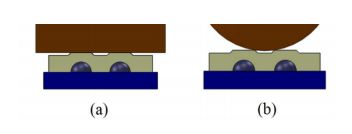
Schematic of the indentation process. (a) Flat surface being applied to the ridged skin cover. (b) Curved surface being applied to the ridged skin cover. Image credit: DOI:10.3390/s110908626

(PhysOrg.com) -- Over the past couple of decades, many people in and out of the science community have watched the steady progress being made in robotics. It’s an exceptionally interesting field due to the anthropomorphic nature of the results. Each new step brings such machines closer to emulating us even as we look forward to the next step. One interesting thing about robotics is that certain areas seem to be advancing faster than others. Robot arms for example are old news, new research is focused more on hand movements. And has advances in hand movements have been made, more research has come to focus on finger movements and finally tactile sensations. Now new work by a trio of researches from the National University of Singapore describe in their paper published on the preprint server arXiv, how affixing artificial fingerprints to robot fingers can increase tactile "sensation" allowing such a robot to discern the differences in curvature of objects.

As with many areas of science, even the seemingly simple stuff turns out to be quite complicated on closer view. The human fingertip for example, covered with skin unlike that of any other body part, has raised ridges that allow people to feel the difference in texture between wood and metal or silk and linen. It can also detect temperature, and as it turns out, is also involved in figuring out the curvature of objects that are touched. Consider for example, the keys on a cell phone, or a television remote control. It’s these kinds of abilities that Saba Salehi, John-John Cabibihan and Shuzhi Sam Ge are trying to emulate in their lab in Singapore. To begin, they’ve started with the easiest of the bunch, trying to figure out if artificial fitted on a hand can tell how roundish an object is.

To find out they built a touch sensor comprised of a base plate, embedded sensors and a raised ridged surface; all on a 4mm square. They then set about testing the simple sensor in a variety ways to see if they were able to sense things with it in different ways, specifically as it was applied to flat, edged and curved objects. They also built an identical sensor except that the raised portion was flat instead of ridged, to serve as a control.

They found that the raised sensor did indeed provide more feedback (resonance) information than the one with the flat surface, so much so that they were able to tell the difference in the three types of objects with 95.7% accuracy.

Undoubtedly, more research will be done in this area by this group and others, and perhaps very soon, robot fingertips will become just as sensitive, if not more, than our own, leading to a whole new generation of gentler robots, able to perform tasks with both dexterity and a deft touch.

More information: Artificial Skin Ridges Enhance Local Tactile Shape Discrimination, Saba Salehi, John-John Cabibihan, Shuzhi Sam Ge, arXiv:1109.3688v1 [physics.med-ph] DOI:10.3390/s110908626

Abstract
One of the fundamental requirements for an artificial hand to successfully grasp and manipulate an object is to be able to distinguish different objects' shapes and, more specifically, the objects' surface curvatures. In this study, we investigate the possibility of enhancing the curvature detection of embedded tactile sensors by proposing a ridged fingertip structure, simulating human fingerprints. In addition, a curvature detection approach based on machine learning methods is proposed to provide the embedded sensors with the ability to discriminate the surface curvature of different objects. For this purpose, a set of experiments were carried out to collect tactile signals from a 2 times 2 tactile sensor array, then the signals were processed and used for learning algorithms. To achieve the best possible performance for our machine learning approach, three different learning algorithms of Na"ive Bayes (NB), Artificial Neural Networks (ANN), and Support Vector Machines (SVM) were implemented and compared for various parameters. Finally, the most accurate method was selected to evaluate the proposed skin structure in recognition of three different curvatures. The results showed an accuracy rate of 97.5% in surface curvature discrimination.

via ArXiv Blog

© 2011 PhysOrg.com

Filter


Move the slider to adjust rank threshold, so that you can hide some of the comments.


Display comments: newest first

bkas
Sep 21, 2011

Rank: not rated yet
The more I learn about sensors, the more I wonder whether they can lead of a world in which common sense prevails. To see what I mean, Google: common sensor directory
Isaacsname
Sep 21, 2011

Rank: not rated yet
I wonder if they will find an optimum topology ? Would it be like patterns in human fingerprints, or..
BradynStanaway
Sep 21, 2011

Rank: not rated yet
I wonder if they will find an optimum topology ? Would it be like patterns in human fingerprints, or..


If they did it would shoot any sort of 'intelligent design' argument in the foot.
CHollman82
Sep 21, 2011

Rank: not rated yet
I wonder if they will find an optimum topology ? Would it be like patterns in human fingerprints, or..


If they did it would shoot any sort of 'intelligent design' argument in the foot.


How so?
Rank 4 /5 (1 vote)
Relevant PhysicsForums posts

More news stories

Browser wars flare in mobile space

The browser wars are heating up again, but this time the fight is for dominance of the mobile Internet.

Technology / Software

created 9 hours ago | popularity 5 / 5 (1) | comments 3

Probability of contamination from severe nuclear reactor accidents is higher than expected: study

Catastrophic nuclear accidents such as the core meltdowns in Chernobyl and Fukushima are more likely to happen than previously assumed. Based on the operating hours of all civil nuclear reactors and the number ...

Technology / Energy & Green Tech

created May 22, 2012 | popularity 3.6 / 5 (22) | comments 56 | with audio podcast

SpotterRF debuts Radar Backpack Kit (w/ Video)

(Phys.org) -- SpotterRF has announced a special radar backpack kit designed to enhance situational awareness for soldiers on the ground. The company says its special radar is designed for warfighters as part ...

Technology / Hi Tech & Innovation

created May 26, 2012 | popularity 5 / 5 (5) | comments 13 | with audio podcast report

HyperSolar shows dirty water no barrier to power world

(Phys.org) -- The Santa Barbara, California, company, HyperSolar, is set to transparently share the ups and downs of its research experiences toward the company’s ultimate vision, successfully producing ...

Technology / Energy & Green Tech

created May 24, 2012 | popularity 4.8 / 5 (16) | comments 17 | with audio podcast report

Tesla to launch electric sedan in US on June 22

Tesla Motors said Tuesday it would begin deliveries of "the world's first premium electric sedan" on June 22, slightly ahead of schedule.

Technology / Energy & Green Tech

created May 22, 2012 | popularity 4.5 / 5 (12) | comments 18


Land and sea species differ in climate change response: study

(Phys.org) -- Marine and terrestrial species will likely differ in their responses to climate warming, new research by Simon Fraser University and Australia’s University of Tasmania has found.

Almost half of new vets seek disability

(AP) -- America's newest veterans are filing for disability benefits at a historic rate, claiming to be the most medically and mentally troubled generation of former troops the nation has ever seen.

'Unzipped' carbon nanotubes could help energize fuel cells, batteries

Multi-walled carbon nanotubes riddled with defects and impurities on the outside could replace some of the expensive platinum catalysts used in fuel cells and metal-air batteries, according to scientists at ...

T cells 'hunt' parasites like animal predators seek prey, study shows

By pairing an intimate knowledge of immune-system function with a deep understanding of statistical physics, a cross-disciplinary team at the University of Pennsylvania has arrived at a surprising finding: T cells use a movement ...

Computer model used to pinpoint prime materials for efficient carbon capture

When power plants begin capturing their carbon emissions to reduce greenhouse gases – and to most in the electric power industry, it's a question of when, not if – it will be an expensive undertaking.

Change in developmental timing was crucial in the evolutionary shift from dinosaurs to birds: study

At first glance, it's hard to see how a common house sparrow and a Tyrannosaurus Rex might have anything in common. After all, one is a bird that weighs less than an ounce, and the other is a dinosaur that ...