Chemists turn gold to purple -- on purpose
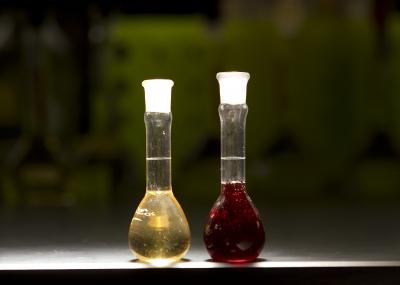
BYU chemists developed a method of artificial photosynthesis, and proved it by turning gold atoms (left) into purple-colored nanoparticles (right). Credit: Mark Philbrick/BYU
Professor Richard Watt and his chemistry students suspected that a common protein could potentially react with sunlight and harvest its energy similar to what chlorophyll does during photosynthesis.
The story of how they proved it sounds as colorful as the legend of the leprechaun who hid his pot of gold at the end of the rainbow.
They started with citric acid from oranges and mixed it with the protein. Next they dissolved gold powder into the solution. Then they put vials of the yellow-colored mixture in direct sunlight and crossed their fingers in the hope that it would turn purple.
Here's the reason why: If it turned purple, that would signal that the gold atoms had received electrons and used the donated energy to bunch together as small, purple-colored nanoparticles. And that would mean that the protein used the sunlight to excite the citric acid and trigger a transfer of energy.
While direct sunlight did the trick in about 20 minutes, a high-powered tungsten mercury lamp worked much faster.
"We set the system up, turned on the light, and the solution turned purple," Watt said. "We knew that we'd proved the concept."
The beauty of this experiment lies not in its colors unless, of course, you're thinking of it as a potential "green" energy source that keeps the environment clean.
The BYU researchers published their experiments in the Journal of Nanoparticle Research. The final step of this project will involve connecting the protein to an electrode to channel the energy into a battery or fuel cell. The BYU chemists will partner with Jae-Woo Kim of the National Institute of Aerospace for this next stage of the work.
Professor Watt's pedigree includes a post-doc at Princeton, a father who developed a fuel cell that runs on sugar and weed-killer and a more distant ancestor credited with inventing the first practical steam engine. That ancestor is also the Scottish engineer for whom the unit of power "watt" is named.
Provided by
Brigham Young University
-
From lemons to lemonade: Reaction uses carbon dioxide to make carbon-based semiconductor,
28 comments
-
Thioridazine kills cancer stem cells in human while avoiding toxic side-effects of conventional cancer treatments,
3 comments
-
SpaceX private rocket blasts off for space station (Update),
41 comments
-
Climate scientists say they have solved riddle of rising sea,
30 comments
-
Scotland passes turbine test to harness tidal power,
40 comments
-
Steam in My Espresso Machine
3 hours ago
-
Density question
May 24, 2012
-
Mass transport originating from a point source at a solid gas interface
May 22, 2012
-
Ammonia dispersion in Air
May 22, 2012
-
Multi Choice Help
May 21, 2012
-
index of refraction and thickness of materials
May 18, 2012
- More from Physics Forums - Materials & Chemical Engineering
More news stories
Dopant gives graphene solar cells highest efficiency yet
(Phys.org) -- By taking advantage of graphenes favorable electrical and optical properties, and then adding an organic dopant, researchers have achieved the highest power conversion efficiency yet for ...
Nanomedicine: Quantum dots appear safe in pioneering study on primates
A pioneering study to gauge the toxicity of quantum dots in primates has found the tiny crystals to be safe over a one-year period, a hopeful outcome for doctors and scientists seeking new ways to battle diseases ...
Nanotechnology / Bio & Medicine
May 20, 2012 |
4.3 / 5 (3) |
8
|
In nanorod crystal growth, nanoparticles seen as artificial atoms
In the growth of crystals, do nanoparticles act as "artificial atoms" forming molecular-type building blocks that can assemble into complex structures? This is the contention of a major but controversial theory ...
May 24, 2012 |
4.8 / 5 (6) |
0
|
Synthetic nano-waste does not disappear
(Phys.org) -- Tiny particles of cerium oxide do not burn or change in the heat of a waste incineration plant. They remain intact on combustion residues or in the incineration system, as a new study by Swiss ...
Nanotechnology / Bio & Medicine
May 25, 2012 |
5 / 5 (2) |
1
|
First direct observation of oriented attachment in nanocrystal growth
Berkeley Lab researchers have reported the first direct observation of nanoparticles undergoing oriented attachment, the critical step in biomineralization and the growth of nanocrystals. A better understanding ...
May 24, 2012 |
4.7 / 5 (3) |
0
|
SpotterRF debuts Radar Backpack Kit (w/ Video)
(Phys.org) -- SpotterRF has announced a special radar backpack kit designed to enhance situational awareness for soldiers on the ground. The company says its special radar is designed for warfighters as part ...
Australia hails surprise super-telescope decision
Australia has hailed a surprise decision giving it a role in a radio telescope project aimed at revolutionising astronomy, vowing to draw on its decades of experience in space science.
Astronomers seize last chance in lifetime for Venus Transit
Astronomers are gearing for one the rarest events in the Solar System: an alignment of Earth, Venus and the Sun that will not be seen for another 105 years.
SpaceX capsule has 'new car' smell, astronauts say
SpaceX's Dragon cargo vessel smells like a new car, said astronauts at the International Space Station after opening the hatches Saturday following the spacecraft's landmark mission to the orbiting lab.
Family history of Alzheimer's affects functional connectivity
(HealthDay) -- Cognitively normal individuals with a family history of late-onset Alzheimer's disease (AD) may display lower resting state functional connectivity in the default mode network (DMN) of the brain, ...
Thousands of shellfish found dead in Peru
Thousands of crustaceans were found dead off the coast of Lima following the mystery mass death of dolphins and pelicans, the Peruvian Navy said Friday.
Jan 26, 2011
Rank: 1.8 / 5 (10)
Gold costs $1300 per ounce.
Jan 26, 2011
Rank: 5 / 5 (9)
The gold was there to show that the energy was created, the protein and the citric acid plus the sunlight created the energy that was then transferred to the gold, which clumped together to show the energy was created.
I hope that helps clear things up for you.
Jan 26, 2011
Rank: not rated yet
edit: That makes much more sense, J-n, thanks for explaining that.
Jan 26, 2011
Rank: 5 / 5 (2)
Copper maybe? Also one wandering electron in the valence shell.
Jan 26, 2011
Rank: 1 / 5 (5)
Gold is chemically inert in most situations.
I'm not sure what you are going on about here.
Jan 26, 2011
Rank: 5 / 5 (5)
Quantum Conundrum, did you actually bother to read the article? It describes how the team tested whether a common protein could capture solar energy by seeing whether it could give energy to citric acid molecules which would in turn clump gold atoms to form purple nanoparticles. The gold was not part of the reaction being tested, it was just used to signal the result. This was what the majority of the article was actually about.
Jan 27, 2011
Rank: not rated yet
So which protein is this, or are they not mentioning it on purpose? Can anybody find out? I bet you it is readily obtainable since it is so common and we can build these things ourselves without their help.
Jan 27, 2011
Rank: not rated yet
"ferritin protein shell".
I would expect that this publication not withhold the information, but then again, you wouldn't want ordinary people to start ordering the stuff themselves as this might make it possible to build such a device easily at home. That is your common protein.
Jan 27, 2011
Rank: not rated yet
theregister dot co dot uk/2011/01/27/watt_gold_purple/
a better article in my books. Any feed back guys, how can we take this and build our own cheap solar cells ? Would appreciate your input on this.....
Jan 27, 2011
Rank: 5 / 5 (1)
Jan 27, 2011
Rank: 5 / 5 (1)
As others have said, the Gold isn't a reactant. But, just for fun, we can see what would happen if they were going to make panels out of Gold. You are comparing the area of a solar panel to the mass of Gold. We need to compare area to area. 1oz of Gold is 28.3 grams of Gold. Due to it's ductility, a gram of Gold can be worked into one square meter. So 1oz of Gold can make 28.3 square meters. 1300 dollars/28 square meters is 46 dollars per panel for the Gold. So it wouldn't be that bad if that is what they were doing anyway.
Jan 28, 2011
Rank: 1 / 5 (1)