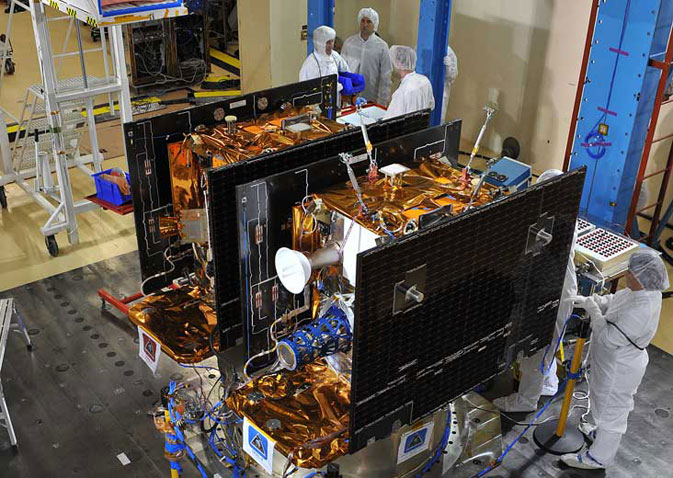
NASA twin spacecraft GRAIL on final approach for moon orbit
The twin GRAIL spacecraft are prepared for launch. Image credit: NASA/JPL-Caltech/LMSS
(PhysOrg.com) -- NASA's twin spacecraft to study the moon from crust to core are nearing their New Year's Eve and New Year's Day main-engine burns to place the duo in lunar orbit.
Named Gravity Recovery And Interior Laboratory (GRAIL), the spacecraft are scheduled to be placed in orbit beginning at 1:21 p.m. PST (4:21 p.m. EST) for GRAIL-A on Dec. 31, and 2:05 p.m. PST (5:05 p.m. EST) on Jan. 1 for GRAIL-B.
"Our team may not get to partake in a traditional New Year's celebration, but I expect seeing our two spacecraft safely in lunar orbit should give us all the excitement and feeling of euphoria anyone in this line of work would ever need," said David Lehman, project manager for GRAIL at NASA's Jet Propulsion Laboratory (JPL) in Pasadena, Calif.
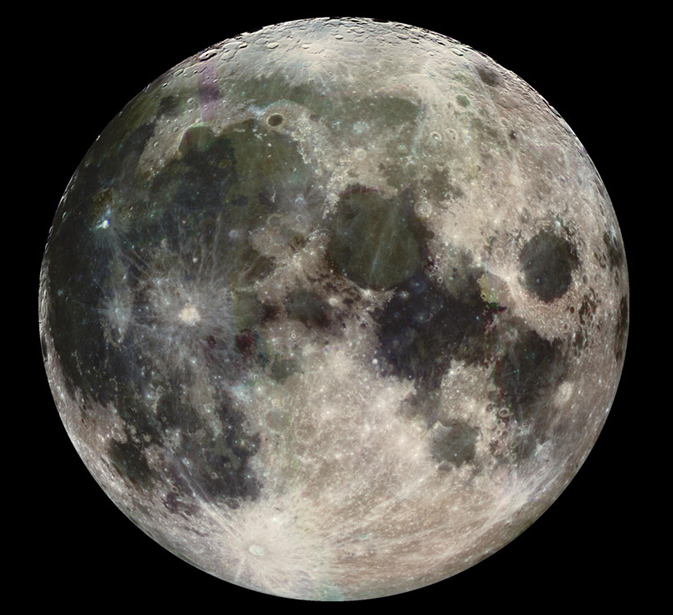
Moon. Image credit: NASA
The distance from Earth to the moon is approximately 250,000 miles (402,336 kilometers). NASA's Apollo crews took about three days to travel to the moon. Launched from Cape Canaveral Air Force Station Sept. 10, 2011, the GRAIL spacecraft are taking about 30 times that long and covering more than 2.5 million miles (4 million kilometers) to get there.This low-energy, long-duration trajectory has given mission planners and controllers more time to assess the spacecraft's health. The path also allowed a vital component of the spacecraft's single science instrument, the Ultra Stable Oscillator, to be continuously powered for several months. This will allow it to reach a stable operating temperature long before it begins making science measurements in lunar orbit.
"This mission will rewrite the textbooks on the evolution of the moon," said Maria Zuber, GRAIL principal investigator from the Massachusetts Institute of Technology (MIT) in Cambridge. "Our two spacecraft are operating so well during their journey that we have performed a full test of our science instrument and confirmed the performance required to meet our science objectives."
As of Dec. 28, GRAIL-A is 65,860 miles (106,000 kilometers) from the moon and closing at a speed of 745 mph (1,200 kph). GRAIL-B is 79,540 miles (128,000 kilometers) from the moon and closing at a speed of 763 mph (1,228 kph).
Artist's concept of lunar interior and exterior. Image credit: NASA
During their final approaches to the moon, both orbiters move toward it from the south, flying nearly over the lunar south pole. The lunar orbit insertion burn for GRAIL-A will take approximately 40 minutes and change the spacecraft's velocity by about 427 mph (688 kph). GRAIL-B's insertion burn 25 hours later will last about 39 minutes and is expected to change the probe's velocity by 430 mph (691 kph).The insertion maneuvers will place each orbiter into a near-polar, elliptical orbit with a period of 11.5 hours. Over the following weeks, the GRAIL team will execute a series of burns with each spacecraft to reduce their orbital period from 11.5 hours down to just under two hours. At the start of the science phase in March 2012, the two GRAILs will be in a near-polar, near-circular orbit with an altitude of about 34 miles (55 kilometers).
When science collection begins, the spacecraft will transmit radio signals precisely defining the distance between them as they orbit the moon. As they fly over areas of greater and lesser gravity, caused both by visible features such as mountains and craters and by masses hidden beneath the lunar surface. they will move slightly toward and away from each other. An instrument aboard each spacecraft will measure the changes in their relative velocity very precisely, and scientists will translate this information into a high-resolution map of the Moon's gravitational field. The data will allow mission scientists to understand what goes on below the surface. This information will increase our knowledge of how Earth and its rocky neighbors in the inner solar system developed into the diverse worlds we see today.
Provided by
JPL/NASA
-
From lemons to lemonade: Reaction uses carbon dioxide to make carbon-based semiconductor,
32 comments
-
Thioridazine kills cancer stem cells in human while avoiding toxic side-effects of conventional cancer treatments,
3 comments
-
SpaceX private rocket blasts off for space station (Update),
42 comments
-
Climate scientists say they have solved riddle of rising sea,
31 comments
-
SpaceX capsule has 'new car' smell, astronauts say (Update),
4 comments
-
Distance of planets from stars and revolution
5 hours ago
-
revamping general concept and cosmological principle
May 25, 2012
-
Transiting Exoplanet Light Curve
May 25, 2012
-
Math behind Theoretical Physics
May 24, 2012
-
Do we know whats at the center of galaxies yet?
May 23, 2012
-
Structure of the Milky Way?
May 20, 2012
- More from Physics Forums - General Astronomy
More news stories
Land and sea species differ in climate change response: study
(Phys.org) -- Marine and terrestrial species will likely differ in their responses to climate warming, new research by Simon Fraser University and Australia’s University of Tasmania has found.
3 hours ago |
3.7 / 5 (3) |
3
|
Yale study concludes public apathy over climate change unrelated to science literacy
Are members of the public divided about climate change because they don't understand the science behind it? If Americans knew more basic science and were more proficient in technical reasoning, would public consensus match ...
5 hours ago |
4.8 / 5 (4) |
11
|
10 million years needed to recover from mass extinction
It took some 10 million years for Earth to recover from the greatest mass extinction of all time, latest research has revealed.
Space & Earth / Earth Sciences
5 hours ago |
5 / 5 (3) |
1
|
Sophisticated simulations predict future warming
The chances of our planet being hit by a global warming of 3 degrees Celsius by 2050 is as likely as it being hit by an increase of 1.4 degrees, new research shows. Presented in the journal Nature Geoscience, the British study ...
Space & Earth / Earth Sciences
May 22, 2012 |
4.4 / 5 (9) |
51
Aliens don't want to eat us, says former SETI director
Alien life probably isnt interested in having us for dinner, enslaving us or laying eggs in our bellies, according to a recent statement by former SETI director Jill Tarter.
Space & Earth / Space Exploration
May 25, 2012 |
4.4 / 5 (14) |
41
'Unzipped' carbon nanotubes could help energize fuel cells, batteries
Multi-walled carbon nanotubes riddled with defects and impurities on the outside could replace some of the expensive platinum catalysts used in fuel cells and metal-air batteries, according to scientists at ...
Change in developmental timing was crucial in the evolutionary shift from dinosaurs to birds: study
At first glance, it's hard to see how a common house sparrow and a Tyrannosaurus Rex might have anything in common. After all, one is a bird that weighs less than an ounce, and the other is a dinosaur that ...
Computer model used to pinpoint prime materials for efficient carbon capture
When power plants begin capturing their carbon emissions to reduce greenhouse gases and to most in the electric power industry, it's a question of when, not if it will be an expensive undertaking.
T cells 'hunt' parasites like animal predators seek prey, study shows
By pairing an intimate knowledge of immune-system function with a deep understanding of statistical physics, a cross-disciplinary team at the University of Pennsylvania has arrived at a surprising finding: T cells use a movement ...
Scientists develop ultra-sensitive test that detects diseases in their earliest stages
Scientists have developed an ultra-sensitive test that should enable them to detect signs of a disease in its earliest stages, in research published today in the journal Nature Materials.
Manufacturing genes to attack flu virus
An international research team has manufactured a new protein that can combat deadly flu epidemics.


Dec 28, 2011
Rank: 4.7 / 5 (13)
Dec 28, 2011
Rank: 1.1 / 5 (13)
Thanks for your comment. You are right.
Although impatient, I also know that the SSM model of the Sun was too entrenched in the scientific community to be dislodged by observations until selected as the cornerstone of the AGW model of Earth's climate.
So the universe seems to be unfolding exactly as it should and today all is well.
Again, thanks for your comment.
Best wishes for the New Year!
Dec 28, 2011
Rank: not rated yet
Dec 29, 2011
Rank: 5 / 5 (2)
Dec 29, 2011
Rank: 1 / 5 (8)
1. No measurement is more important to the thousands of people who are discouraged, unemployed, surviving on food stamps and/or homeless because industries were closed down to save Earth's climate from the "danger" of CO2 in the atmosphere - the insulating layer of gases that actually protect us from sudden changes in Earth's heat source - the Sun [A,B].
A. Journal of Fusion Energy 21, 193-198 (2002)
http://arxiv.org/.../0501441
B. Energy and Environment 20, 131-144 (2009)
http://arxiv.org/pdf/0905.0704
2. I agree, the Sun is dynamic! In fact the Sun itself is evolving and it has kept Earth's climate and life on Earth in a state of perpetual evolution.
C. J Modern Physics 2, 587-594 (2011)
http://dl.dropbox...5079.pdf
May 2012 Bring World Peace!
Oliver K. Manuel
Dec 30, 2011
Rank: 5 / 5 (1)
Dec 30, 2011
Rank: 1.6 / 5 (64)
Jan 03, 2012
Rank: 1.4 / 5 (10)