Advance offers new opportunities in chemistry education, research

October 4, 2011

Advance offers new opportunities in chemistry education, research

Enlarge

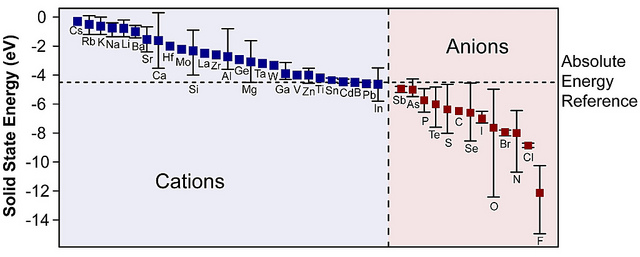
A new "solid state energy scale" developed by researchers at Oregon State University provides a new way to understand electronegativity, a fundamental but very important concept in chemistry. (Graphic courtesy of Oregon State University)

Researchers at Oregon State University have created a new, unifying method to describe a basic chemical concept called "electronegativity," first described almost 80 years ago by OSU alumnus Linus Pauling and part of the work that led to his receiving the Nobel Prize.

The new system offers simplicity of understanding that should rewrite high school and college chemistry textbooks around the world, even as it opens important new avenues in materials and chemical research, with possible applications in everything from to solid state batteries.

The findings were just published in the , in work supported by the National Science Foundation and the U.S. Department of Energy.

"This is a forward in understanding basic tendencies in chemical ," said John Wager, a professor of electrical engineering at OSU. "We can now take a concept that college students struggle with and I could explain it to a kindergarten class.

"Even advanced scientists will gain new insights and understanding into the chemical processes they study," Wager said. "Using this system, I could look at various materials being considered for use in new solar energy cells and determine quickly that this one might work, that one doesn't stand a chance."

Electronegativity, as defined by Pauling, is "the power of an atom in a molecule to attract to itself." This concept is useful for explaining why some atoms tend to attract electrons, others share them and some give them away. In the 1930s, Pauling was the first to devise a method for numerically estimating the electronegativity of an atom. Other researchers later developed different approaches.

The new system developed at OSU – the first of its type since the early 1990s - is called an atomic "solid state energy scale." It characterizes electronegativity as the solid state energy of elements in a compound, and shows that electrons simply move from a higher energy to a lower energy.

"This is a remarkably intuitive approach to understanding electronegativity, and yet it's based on data that are absolute, not arbitrary," said Douglas Keszler, an OSU professor of chemistry, co-author on the study and an international expert in materials science research.

"This is already one of the best instruments in my tool box for predicting the properties of new materials and understanding inorganic reactions," Keszler said. "It's not only more accurate and comprehensive, it just offers a simplicity of understanding that is very important."

The electronegativity scale developed by Pauling is among the most widely known of his contributions in studies on the nature of the , the work for which he received a in chemistry.

According to Ram Ravichandran, an electrical engineering student at OSU and co-author of the study, the new approach is based on the study of how the "band gap," a fundamental property of materials, varies for a variety of compounds. This helps to derive an absolute energy reference and a new energy scale, providing a surprisingly simple way to visualize the way materials will interact.

The system could aid research in new semiconductor devices, catalysts, solar cells, light emitting materials and many other uses.

Provided by Oregon State University search and more info website

Filter


Move the slider to adjust rank threshold, so that you can hide some of the comments.


Display comments: newest first

jimbo92107
Oct 04, 2011

Rank: not rated yet
Does this imply energy scales for other phases? Energy scales for atom clusters? Why is the line dividing cations from anions where it is? How can Indium be both a cation and an anion? Is the scale temperature dependent within the solid phase?
Bryan_Sanctuary
Oct 07, 2011

Rank: not rated yet
Can this explain why the Electron Affinity for chlorine is greater than for fluorine?
Callippo
Oct 07, 2011

Rank: not rated yet
Why is the line dividing cations from anions where it is?
This line belongs to hydrogen ionization - it determines, wheter the ion in aqueous solution would expel protons from water or vice-versa.
How can Indium be both a cation and an anion?
The indium dissolves in alkali into indates(III).
Can this explain why the Electron Affinity for chlorine is greater than for fluorine?
Nope, regarding the sterical issues the solid state energy scale suffers with the same problems, like the classical electronegativity.
Rank 5 /5 (3 votes)
Relevant PhysicsForums posts
  • Calculating partial pressures Pa and Pw
    created55 minutes ago
  • Gibbs Free Energy Change/Entropy
    created11 hours ago
  • What's the rule to covalent character
    created12 hours ago
  • Schwartz reagent-- NMR/MS/IR
    createdMay 26, 2012
  • High school chemistry EEI
    createdMay 25, 2012
  • oxidation of I- by KMnO4
    createdMay 25, 2012
  • More from Physics Forums - Chemistry

More news stories

Computer model used to pinpoint prime materials for efficient carbon capture

When power plants begin capturing their carbon emissions to reduce greenhouse gases – and to most in the electric power industry, it's a question of when, not if – it will be an expensive undertaking.

Chemistry / Materials Science

created 3 hours ago | popularity not rated yet | comments 0 | with audio podcast

Scientists develop ultra-sensitive test that detects diseases in their earliest stages

Scientists have developed an ultra-sensitive test that should enable them to detect signs of a disease in its earliest stages, in research published today in the journal Nature Materials.

Chemistry / Analytical Chemistry

created 3 hours ago | popularity not rated yet | comments 0 | with audio podcast

New CO2-removing catalyst can take the heat

(Phys.org) -- The current method of removing the greenhouse gas carbon dioxide (CO2) from the flues of coal-fired power plants uses so much energy that no one bothers to use it. So says Roger Aines, principal ...

Chemistry / Materials Science

created May 24, 2012 | popularity 5 / 5 (9) | comments 10 | with audio podcast

High-speed method to aid search for solar energy storage catalysts

Eons ago, nature solved the problem of converting solar energy to fuels by inventing the process of photosynthesis.

Chemistry / Materials Science

created May 25, 2012 | popularity 5 / 5 (3) | comments 4 | with audio podcast

Researchers demonstrate possible primitive mechanism of chemical info self-replication

(Phys.org) -- When scientists think about the replication of information in chemistry, they usually have in mind something akin to what happens in living organisms when DNA gets copied: a double-stranded molecule ...

Chemistry / Materials Science

created May 25, 2012 | popularity 5 / 5 (4) | comments 2 | with audio podcast


Land and sea species differ in climate change response: study

(Phys.org) -- Marine and terrestrial species will likely differ in their responses to climate warming, new research by Simon Fraser University and Australia’s University of Tasmania has found.

'Unzipped' carbon nanotubes could help energize fuel cells, batteries

Multi-walled carbon nanotubes riddled with defects and impurities on the outside could replace some of the expensive platinum catalysts used in fuel cells and metal-air batteries, according to scientists at ...

T cells 'hunt' parasites like animal predators seek prey, study shows

By pairing an intimate knowledge of immune-system function with a deep understanding of statistical physics, a cross-disciplinary team at the University of Pennsylvania has arrived at a surprising finding: T cells use a movement ...

Change in developmental timing was crucial in the evolutionary shift from dinosaurs to birds: study

At first glance, it's hard to see how a common house sparrow and a Tyrannosaurus Rex might have anything in common. After all, one is a bird that weighs less than an ounce, and the other is a dinosaur that ...

Nvidia trumpets Tegra 3 phone design wins for 2012

(Phys.org) -- Nvidia’s competitive war paint has a name, Tegra 3. On the heels of Nvidia announcements about lowering costs of its Tegra 3 processors and Nvidia-enabled tablets running Android Ice Cream ...

Yale study concludes public apathy over climate change unrelated to science literacy

Are members of the public divided about climate change because they don't understand the science behind it? If Americans knew more basic science and were more proficient in technical reasoning, would public consensus match ...