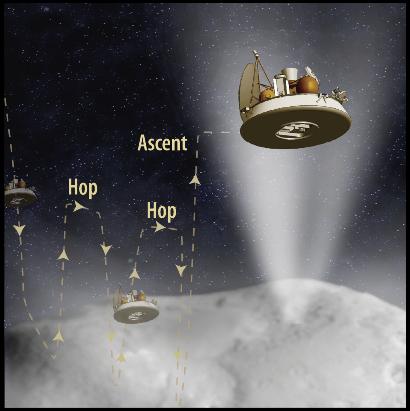
Comet Hopper moves to 'final round' in NASA selection process

May 12, 2011

Comet Hopper, a UMD/NASA Goddard Proposal, Moves to 'Final Round' in NASA Selection Process

Credit: NASA/GSFC/University of Maryland

(PhysOrg.com) -- A University of Maryland-led mission proposal know as Comet Hopper has been chosen to compete for final selection as a new planetary mission in NASA's Discovery Program. The team will receive $3 million to further develop its mission proposal concept.

A panel of NASA and other scientists and engineers reviewed 28 submissions and selected Comet Hopper and two other proposals for further study. After concept studies are reviewed in 2012, NASA will select one mission to continue development efforts leading up to launch in 2016. The selected mission will be cost-capped at $425 million, not including funding.

University of Maryland Astronomer Jessica Sunshine is the principal investigator (PI) for Comet Hopper. Additional Maryland scientists on the team include Deputy PI Michael A'Hearn, who led NASA's Deep Impact and EPOXI comet missions. The Comet Hopper mission would be managed by NASA Goddard Space Flight Center in Greenbelt, Md. Other partners include , KinetX, the Johns Hopkins University Applied Physics Laboratory, University of Bern, Jet Propulsion Laboratory and Discovery Communications.

"We've had some amazing cometary flybys but they have given us only snapshots of one point in time of what a comet is like," said Sunshine. "Comets are exciting because they are dynamic, changing throughout their orbits. With this new mission, we will start out with a comet that is in the cold, outer reaches of its orbit and watch its activity come alive as it moves closer and closer to the sun."

The Comet Hopper mission would study the evolution of 46P/Wirtanen by landing on the comet multiple times and observing its changes as it interacts with the sun. Comet Hopper would observe the comet by making detailed in situ measurements from various locations on the surface and in the innermost coma as the comet moves through its orbit. The innermost coma is the atmosphere of the comet just off the surface of the nucleus where outgassing and jets originate. "We would extensively explore the surface of a comet, this is something that has never been done before," said Joe Nuth, Comet Hopper project scientist at NASA Goddard. "We know that there are volatiles (molecules that easily evaporate at normal temperatures) inside a comet. We would go to places that are relatively flat and are likely hiding volatiles. Comet Hopper could be called a reconnaissance mission for an upcoming Comet Nucleus Sample Return , which has been deemed a high priority development effort by the Decadal Survey."

The spacecraft carries complementary instruments that would study the physical and chemical structure of the comet's nucleus and innermost coma. The suite of instruments includes both remote and in situ capabilities. Among the instruments are a Mapping Camera, an IR Spectrometer, a Mass Spectrometer, Panoramic Cameras, and a Thermal Probe.

The two planetary missions against which Comet Hopper will compete for final NASA selection as a Discovery Program are:

-- Geophysical Monitoring Station (GEMS) would study the structure and composition of the interior of Mars and advance understanding of the formation and evolution of terrestrial planets. Bruce Banerdt of NASA's Jet Propulsion Laboratory (JPL) in Pasadena, Calif., is principal investigator. JPL would manage the project.

-- Titan Mare Explorer (TiME) would provide the first direct exploration of an ocean environment beyond Earth by landing in, and floating on, a large methane-ethane sea on Saturn's moon Titan. Ellen Stofan of Proxemy Research Inc. in Gaithersburg, Md., is principal investigator. Johns Hopkins University's Applied Physics Laboratory in Laurel, Md., would manage the project.

Provided by University of Maryland search and more info website

4.7 /5 (3 votes)  

Filter


Move the slider to adjust rank threshold, so that you can hide some of the comments.


Display comments: newest first

that_guy
May 12, 2011

Rank: not rated yet
I like the missions it's competing with better, like the Titan one with the boat.
Rank 4.7 /5 (3 votes)
Relevant PhysicsForums posts
  • revamping general concept and cosmological principle
    createdMay 25, 2012
  • Transiting Exoplanet Light Curve
    createdMay 25, 2012
  • Math behind Theoretical Physics
    createdMay 24, 2012
  • Do we know whats at the center of galaxies yet?
    createdMay 23, 2012
  • Structure of the Milky Way?
    createdMay 20, 2012
  • What would it take to terraform Pluto and Charon?
    createdMay 19, 2012
  • More from Physics Forums - General Astronomy

More news stories

SpaceX capsule has 'new car' smell, astronauts say (Update)

SpaceX's Dragon cargo vessel smells like a new car, said astronauts at the International Space Station after opening the hatches Saturday following the spacecraft's landmark mission to the orbiting lab.

Space & Earth / Space Exploration

created 23 hours ago | popularity 4.5 / 5 (21) | comments 2

Australia hails surprise super-telescope decision

Australia has hailed a surprise decision giving it a role in a radio telescope project aimed at revolutionising astronomy, vowing to draw on its decades of experience in space science.

Space & Earth / Astronomy

created 23 hours ago | popularity 5 / 5 (4) | comments 2

Astronomers seize last chance in lifetime for Venus Transit

Astronomers are gearing for one the rarest events in the Solar System: an alignment of Earth, Venus and the Sun that will not be seen for another 105 years.

Space & Earth / Astronomy

created 23 hours ago | popularity 5 / 5 (3) | comments 2

Astronauts enter world's 1st private supply ship

(AP) -- Space station astronauts floated into the Dragon on Saturday, a day after its heralded arrival as the world's first commercial supply ship.

Space & Earth / Space Exploration

created 23 hours ago | popularity 5 / 5 (6) | comments 0

Sophisticated simulations predict future warming

The chances of our planet being hit by a global warming of 3 degrees Celsius by 2050 is as likely as it being hit by an increase of 1.4 degrees, new research shows. Presented in the journal Nature Geoscience, the British study ...

Space & Earth / Earth Sciences

created May 22, 2012 | popularity 4.4 / 5 (9) | comments 51


Nvidia trumpets Tegra 3 phone design wins for 2012

(Phys.org) -- Nvidia’s competitive war paint has a name, Tegra 3. On the heels of Nvidia announcements about lowering costs of its Tegra 3 processors and Nvidia-enabled tablets running Android Ice Cream ...

Browser wars flare in mobile space

The browser wars are heating up again, but this time the fight is for dominance of the mobile Internet.

Scientist: Evolution debate will soon be history

(AP) -- Richard Leakey predicts skepticism over evolution will soon be history. Not that the avowed atheist has any doubts himself.

Dell tablet leak: 10.1-inch display, two-battery choice

(Phys.org) -- Headline after headline talks about vendors’ tablets in the wings as likely number-one contenders for the iPad. Such claims have justifiably been taken with a grain of salt, considering ...

SpotterRF debuts Radar Backpack Kit (w/ Video)

(Phys.org) -- SpotterRF has announced a special radar backpack kit designed to enhance situational awareness for soldiers on the ground. The company says its special radar is designed for warfighters as part ...

Thousands of shellfish found dead in Peru

Thousands of crustaceans were found dead off the coast of Lima following the mystery mass death of dolphins and pelicans, the Peruvian Navy said Friday.