Cassini gazes at veiled Titan

Sep 23, 2010
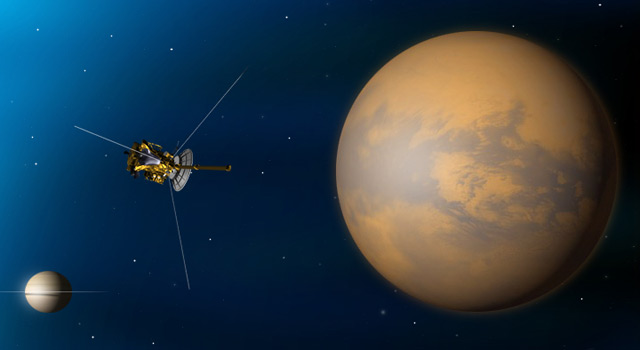
Artist's concept of Cassini's Sept. 24, 2010, flyby of Saturn's moon Titan. Image credit: NASA/JPL-Caltech

(PhysOrg.com) -- NASA's Cassini spacecraft will swing high over Saturn's moon Titan on Friday, Sept. 24, taking a long, sustained look at the hazy moon. At closest approach, Cassini will fly within 8,175 kilometers (5,080 miles) above the hazy moon's surface. This flyby is the first in a series of high-altitude Titan flybys for Cassini over the next year and a half.

Cassini's composite infrared spectrometer instrument will be probing Titan's stratosphere to learn more about its vertical structure as the seasons change. Equinox, when the sun shone directly over the equator, occurred in August 2009, and the northern hemisphere is now in spring.

Another instrument, the visual and infrared mapping spectrometer, will be mapping an equatorial region known as Belet at a resolution of 5 kilometers (3 miles) per pixel. This mosaic will complement the mosaics that were obtained in earlier Titan flybys in January and April. This spectrometer will also look for clouds at northern mid-latitudes and near the poles.

Cassin's visible-light imaging cameras will also be taking images of Titan's trailing hemisphere, or the side that faces backward as Titan orbits around Saturn. If Titan cooperates and has a cloudy day, scientists plan to analyze the images for cloud patterns.

Explore further: Billion-pixel view of Mars comes from Curiosity rover

add to favorites email to friend print save as pdf

Related Stories

Route 66: Cassini's Next Look at Titan

Jan 27, 2010

(PhysOrg.com) -- Sixteen days after last visiting Saturn's largest moon, NASA's Cassini spacecraft returns for another look-see of the cloud-shrouded moon - this time from on high. The flyby on Thursday, Jan. ...

Cassini Doubleheader: Flying By Titan and Dione

Apr 05, 2010

(PhysOrg.com) -- In a special double flyby early next week, NASA's Cassini spacecraft will visit Saturn's moons Titan and Dione within a period of about a day and a half, with no maneuvers in between. A fortuitous ...

Cassini Double Play: Enceladus and Titan

May 18, 2010

(PhysOrg.com) -- About a month and a half after its last double flyby, NASA's Cassini spacecraft will be turning another double play this week, visiting the geyser moon Enceladus and the hazy moon Titan. The ...

Cassini Getting the Lowdown on Titan This Weekend

Jun 18, 2010

(PhysOrg.com) -- NASA's Cassini spacecraft will take its lowest dip through the hazy atmosphere of Saturn's moon Titan in the early morning of June 21 UTC, which is the evening of June 20 Pacific time. This ...

Recommended for you

Metamorphosis of moon's water ice explained

3 hours ago

Using data gathered by NASA's Lunar Reconnaissance Orbiter (LRO) mission, scientists believe they have solved a mystery from one of the solar system's coldest regions—a permanently shadowed crater on the ...

User comments : 0

More news stories

Metamorphosis of moon's water ice explained

Using data gathered by NASA's Lunar Reconnaissance Orbiter (LRO) mission, scientists believe they have solved a mystery from one of the solar system's coldest regions—a permanently shadowed crater on the ...

One in four stroke patients suffer PTSD

One in four people who survive a stroke or transient ischemic attack (TIA) suffer from symptoms of post-traumatic stress disorder (PTSD) within the first year post-event, and one in nine experience chronic PTSD more than ...

Unexpected behavior of well-known catalysts

Industrial palladium-copper catalysts change their structures before they get to work, already during the activation process. As a result, the reaction is catalysed by a catalyst that is different from the ...