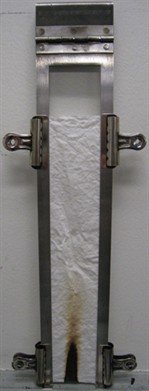
Cotton fabric after a vertical flame test, where a flame touches the fabric for 12 seconds
(Phys.org) -- A thin polymer coating developed by materials engineers at Texas A&M University could keep cotton clothing and polyurethane-foam-based furniture from going up in flames.
And the coating is environmentally friendly, too.
Dr. Jaime Grunlan, an associate professor in the Department of Mechanical Engineering, works with polymer nanocomposites that have properties similar to those of metals and ceramics — conducting electricity, for instance — while maintaining properties of polymers, such as low density.
In 2010, Grunlan’s development of a flame-resistant polymer coating got him some attention, as he fielded calls from the United States military, the cotton industry, mattress manufacturers and the Federal Aviation Administration, and from companies around the world.
New advancements in the area, however, should garner even more attention.
“We can now make cotton fabric that doesn’t burn at all,” Grunlan says.
Grunlan's technology — which has been reported in Science News, Chemical and Engineering News, Nature and Advanced Materials — involves covering every microscopic fiber in a fabric with a thin composite coating of two polymers that exhibit an intumescent effect, producing a protective carbon foam coating when exposed to high temperatures.
The thin films are about one-tenth of a micron thick, or about one-thousandth the thickness of a human hair, and are created with the layer-by-layer assembly technique in which the coating is deposited onto the surface of the fiber being coated. This layer-by-layer process allows Grunlan to control the thickness of the coating down to the nanometer level.
Grunlan says the technology will be suitable for clothing, including children's clothing; lab coats; and medical clothing for both doctors and patients. It can even be used in military camps, where a fire in a single tent can wipe out an entire camp.
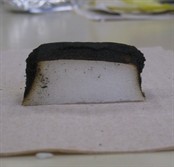
Foam cut through the middle after being exposed to fire from a butane torch
But the technology's applications go far beyond just clothing and fabric. The coating could be used in foams, such as those found in sofas, mattresses, theatre and auditorium seats, airplane seat cushions, and building insulation.
On polyurethane foam, a coating of chitosan (a natural material extracted from shrimp and lobster shells) and clay is deposited to eliminate melt dripping during burning. The nanocomposite mixture coats the interior walls of foam. The result is that when burned, the treated foam keeps its shape instead of puddling at high temperatures like untreated polyurethane foam does. This quality eliminates the “melt-dripping” effect that further spreads fires.
"It's like we're building a nano-brick wall within each cell of the foam," Grunlan says.
That brick wall keeps the foam from being destroyed. And the coating is so thin that it adds only 4 to 5 weight-percent to the foam and does not negatively alter its color, texture or flexibility.
"A lot of anti-flammables degrade fabric and foam properties," Grunlan says.
But with Grunlan's technique, each thread can be individually coated, in the case of cotton fabric. In fact, his coating could potentially strengthen fabric. The researchers are also looking at ways to make the coating softer and more durable to washing.
Current flame-retardant materials rely on brominated compounds, many of which have been banned due to concerns over their potential toxicity. The Texas A&M researchers were searching for an alternative to these toxic chemicals, and had previously been using a commonly known clay and a commercial synthetic polymer to make their coatings. But in order to make the coatings more sustainable, Grunlan switched to chitosan.
“Based on initial results,” he says, “I really think this is going to become a widely adopted, environmentally benign alternative to current flame retardant treatments.
"Anywhere you want to make fabric or foam anti-flammable, you can use this technology," he says.
Provided by Texas A&M University


