
The purple bog fritillary (Boloria titania) is now mainly found in the Alps and in the mountains of the Balkans and the Baltics. The cold-loving species is on the common bistort (Polygonum bistortum) as their food plant, and thus reacting very sensitively to changes. A "drifting apart" of the butterfly habitat and food plant by climate change would endanger the species in the future. These cold-loving species may be among the losers of climate change. Credit: © Albert Vliegenthart
Scientists present the largest distribution data compilation ever on butterflies of an entire continent. The Germany based Society for the Conservation of Butterflies and Moths GfS ("Gesellschaft für Schmetterlingsschutz"), the German Nature Conservation Association NABU ("Naturschutzbund Deutschland") and the Helmholtz-Centre for Environmental Research (UFZ) are delighted to announce the publication of the „Distribution Atlas of Butterflies in Europe".
The atlas was initiated by Otakar Kudrna and is a result of the joint efforts of a team of authors, led by him. It contains full colour distribution maps of all 441 European butterfly species. Apart from providing comprehensive chorological data for taxonomists and biogeographers, the prime purpose of the Atlas is to aid and promote the conservation of European butterflies. The analysis and evaluation of the distribution data, graphically shown on coincidence maps, facilitates the identification of priorities in selecting species and areas of European significance for conservation purposes from a truly European perspective.
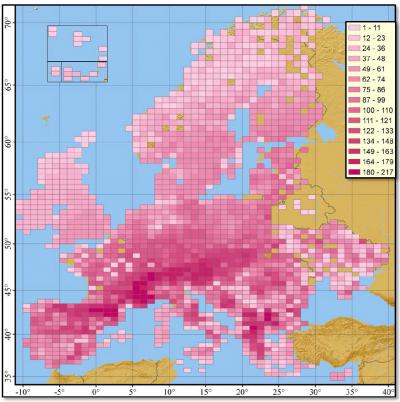
This coincidence map shows the distribution and concentration of all European butterfly species (diversity "hotspots" in the mountains of Iberian Peninsula, Alps and Balkan Peninsula) Every third butterfly species inhabits 1 percent or less of the territory of Europe. Credit: Distribution Atlas of Butterflies in Europe. GfS, Halle, Germany.
Nine years have elapsed since The Distribution Atlas of European Butterflies appeared back in March 2002, the first distribution atlas of the butterflies of any continent. The present book is more than a new edition. The number of data records has almost trebled to about 655.000 and the distribution maps reflect the progress of computer-aided cartographical techniques.
While the atlas from 2002 was the sole work of Otakar Kudrna, progress in different scientific fields now is reflected in the combination of expertise of different colleagues who comprise the author team of the new atlas.
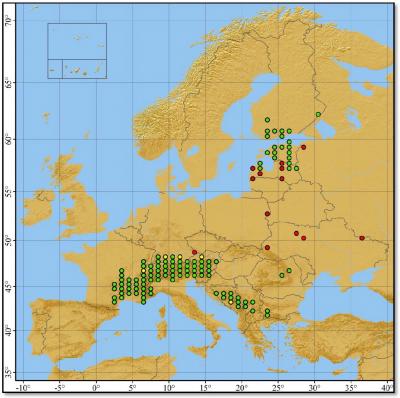
The purple bog fritillary (Boloria titania) is now mainly found in the Alps and in the mountains of the Balkans and the Baltics. The cold-loving species is on the common bistort (Polygonum bistortum) as their food plant, and thus reacting very sensitively to changes. A "drifting apart" of the butterfly habitat and food plant by climate change would endanger the species in the future. These cold-loving species may be among the losers of climate change. Credit: Distribution Atlas of Butterflies in Europe. GfS, Halle, Germany.
Last but not least is has to be highlighted that the atlas was only possible due to the contributions of 272 volunteers, who provided the basic data.
The atlas is expected to serve as baseline for numerous scientific analyses and publications – similar to the „Climatic Risk Atlas of European Butterflies", which was published in 2008 and provided a timely assessment of risks due to the present climate change impacts and thus a contribution for the conservation of butterflies.
More information: Publication: Otakar Kudrna, Alexander Harpke, Kristian Lux, Josef Pennerstorfer, Oliver Schweiger, Josef Settele, Martin Wiemers (2011). Distribution Atlas of Butterflies in Europe. GfS, Halle, Germany. 576pp.
Provided by Helmholtz Association of German Research Centres


