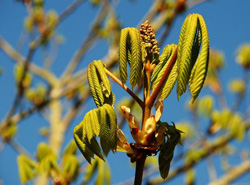
A spring sycamore with buds opened and flowers appearing. Credit: Albert Bridge, geograph.org.uk
If you’re in the lower latitudes of Canada right now, take a look outside. Most trees are in the process of sprouting their 2011 crop of leaves. Only a few weeks ago, they appeared barren – now there is an explosion of new life.
But how does this happen? As internationally acclaimed plant biologist (and Vice-Principal, Research at U of T Scarborough) Professor Malcolm Campbell explains in this interview, this bursting of buds is the result of a complex program designed by the trees over tens of thousands of years. It all depends on a number of factors occurring throughout the year – and variation in one factor can change the timing of trees’ buds bursting in the spring.
What is it about the spring that makes the new growth of leaves on trees occur, year in and year out?
It’s actually two things.
Even though we’re in the spring now, the whole program that you’re observing was set up in the autumn.
As the days get shorter in the autumn and the temperatures decline, the tree sets itself up to go dormant and then in the same program sets itself up to burst bud in the spring. And of the two components I mentioned, day length and temperature, the one in the autumn that’s most important is day length.
That functions as a signal for the plant to begin to shut down. Actually, to put it another way, it’s night length that’s important. As the nights get longer, the plant perceives the lengthening night or the shortening day and embarks on a program to shut down.
That said, even plants in tropical zones or in lower latitudes will still shut down in the winter months, even though the day length may not decrease as dramatically as what we experience in Canada. And they do that by perceiving other cues. Decreasing temperature is one cue. Water availability is also important. Take a look at forests that exist close to the Equator — they use signals that are derived from water availability. So in late August and early September in the northern hemisphere, when precipitation rates drop, that can function as a cue and have the tree shut down and enter that dormant state.
When the trees make that dormant bud, that hardened bud we see through the winter months that protects the growing tissues underneath from the foul weather, they are set up to grow again in the spring and to make sure they interpret the cues during the winter so that they don’t grow again in the spring at the wrong time.
Why is there variation in when the leaves sprout from year to year? My wife noted in 2010 that all the leaves had come in on May 1. This year, it’s mid-May and the trees are not fully in bloom yet. Why?
Let me provide a bit of background first.
The program that is set up is contingent on having what’s called a “cold requirement”. That is, having a minimum number of days of cold temperature. After this critical number of cold days has passed and, provided the plants are warmed to an adequate temperature, they will burst buds in the spring. Both factors are essential.
This explains why trees from lower, warmer latitudes don’t do well in cold climates. What will happen in cold climates is that their need for cold temperature or reduced water will be fulfilled very rapidly and you can imagine that you might have a very warm day in January and what will happen is that those trees will burst bud and then we’ll have a cold snap after that and it will kill them.
We’ve seen this before, even in Canada, for trees at lower latitudes, especially those running along the Canada-US border. In the 1930s, the trees had their minimum requirement for cold days fulfilled and the temperature rose relatively early in the spring. The trees burst bud and they were making leaves and then there was a cold snap and we had a catastrophic loss of trees due to fulfilling the cold requirement, having a warm time and then having a late spring frost again.
So, to answer your question, in 2010 the buds may have burst two weeks earlier than this year because the autumn of 2009 was cold enough for the trees. So, once the night length got longer, the trees went into their dormant program, and then the tree was able to fulfill its cold days requirement and then there were enough warm days to allow the tree to say, “OK, timing is right, I can burst bud again.”
And what happened this year to make them burst bud later?
There could have been a warmer autumn last year. Warm autumns can mess the plants up. As I recall, it was a warm autumn last year. This is one of the things that people are worried about with global climate change — if we have warmer autumns, that cue won’t be there to tell the tree to go dormant in the autumn and they won’t have the necessary combination of day length and temperature to properly shut them down.
This is what could have happened this year. The other cue is that we didn’t have sufficiently long enough numbers of warm days on the spring side to bring them out of dormancy. So their cold requirement might have been met during the winter, but now we haven’t had enough warm days in a row to bring them out of dormancy. So, everything is delayed. Remember, trees won’t do anything until they get their cues.
Is it possible for trees to adapt to what we expect to be the vastly different climate conditions global warming will bring about?
It is true that trees can adapt and have adjusted to pretty significant climate changes in the past.
For example, during the last period of glaciation, we had many of the tree species familiar here in southern Canada pushed down into southwest California and the Florida panhandle, as the ice sheet pushed from north. That took 10,000 to 15,000 years. Herein lies the problem today – while it is true that over long geological time scales plants and animals can adapt, if you’re talking about a tree that doesn’t have the capacity to pick up and move long distances, then climate change that takes place over a very compressed time scale can make it very difficult for the tree to contend with.
U of T is doing a lot of research in understanding life systems of trees and plants, isn’t it?
Yes, we’ve made some important discoveries. One is by U of T professors Peter McCourt, Darrell Desveaux and Nick Provart of Cells and Systems Biology and a former U of T professor, Sean Cutler. This group has reached an understanding, at a very detailed level, of the mechanism that perceives hormones that tell the plant “OK, now it’s time to shut down.”
My own lab has been working on understanding all the genes that are expressed in response to cues like that but we’ve been focused on a different cue — not temperature but water availability. To put it more simply, we’re working to understand the molecular pathways that control the plant processes that we see change around us, like the leaves dropping and then growing again.
It’s interesting how this work, in the study of trees and plants, sounds similar to work done on human health.
Absolutely. The tools we’re using to investigate personalized medicine or translational genomics, which are so important to humans, are the same tools being used to understand and protect forest and crop health.
Provided by University of Toronto
.jpg)


