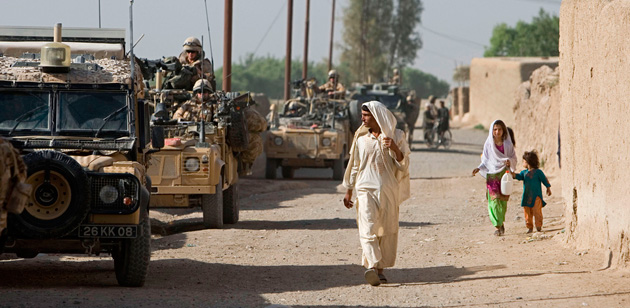
Stanford scholar calls for a balance between military necessity and human concerns. (Photo courtesy of IASF/NATO)
(PhysOrg.com) -- Civilian casualties in war have proliferated despite the international courts, laws and tribunals meant to protect them. What do we do?
Today's world abounds in international courts, laws and tribunals – more so than ever before – yet war is becoming more brutal, more transnational, with mounting civilian casualties. What's the solution to the awful paradox?
Helen Stacy, a Stanford scholar in international and comparative law, noted that "civilians, often women and children, who played no role in the conflict – these are the people who suffer first, last and in the middle."
Richard Goldstone, a former justice of the Constitutional Court of South Africa, characterized the last hundred years as "a very bloody century" when "deliberate attacks against civilians grew." He noted that at the beginning of the 20th century, there was one civilian casualty for every eight or nine soldier casualties. With World War II, the ratio became 1-to-1. Over the last 30 years, the ratio has flipped: Now, every combatant casualty is matched by nine civilian deaths.
A recent panel discussion on "Civilians in War Zones" considered the effects of war on the people who want it least – civilians. The discussion, at times contentious and marked by audience murmuring and dissent, was part of the campus "Ethics and War" series. An overflow crowd attended the event in Encina Hall.
Stacy, a senior fellow at the Freeman Spogli Institute for International Studies, moderated the panel. In addition to Goldstone, the panel included history Professor James Campbell, who headed Brown University's Steering Committee on Slavery and Justice to consider black reparations, and Peter Berkowitz, a senior fellow at Hoover Institution.
"Our only hope is in an efficient, international system of justice" and "an effective, coherent international system of law," said Goldstone, who opened the discussion with a review of the investigations of the NATO bombing of Kosovo, the Gaza conflict and the civil war in Sri Lanka.
Berkowitz, cofounder and director of the Israel Program on Constitutional Government, objected to last year's "Goldstone Report," the 575-page Report of the United Nations Fact Finding Mission on the Gaza Conflict, which he said "lacked proper foundation in international law" and "struck at the heart of Israel's judicial system." He said that the report relied on the comments of Gaza residents who would not have been able to speak freely, and that the report blurs the distinctions between civilians and combatants.
Stacy pointed out that technology also has introduced paradoxes: Recent events in Tunisia would not have gotten worldwide attention without cell phones, and human rights violations in Burma were broadcast internationally with webcams. On the other hand, vicious radio attacks spurred the Rwandan genocide.
Goldstone said that "our world has changed rapidly. Modern technology – the Internet, telephones that take photographs that literally, instantly become the knowledge of the world – that can be taken advantage of."
"There should be true equality," he said. "People's human dignity and their right to that dignity needs to be recognized," he said, with "a concerted effort to implement international law."
Asked what change he would make to international law, Goldstone responded: "The first change is to require all international human rights lawyers to get a serious education in military affairs," so they could learn "to balance military necessity and human concerns." The balance is "immensely difficult in the new age of warfare," he said, where "liberal democracies are fighting transnational terrorists."
Stacy noted that without the United States, the Universal Declaration of Human Rights would not have been adopted and the Nuremberg Trials would not have occurred. Yet despite its "shining, shining" example, America has since failed to sign the Convention on the Rights of the Child, ratified by 194 nations and all of the U.N. nations except Somalia and the United States, and the U.N. Convention on the Elimination of All Forms of Discrimination Against Women, signed by all but the United States.
Berkowitz referred to America's "special burdens" and noted that the United States has other checks to potential human rights abuses, thanks to Americans' right to protest, publicly discuss issues and elect their representatives.
"The Gaza report is important," said Campbell. "Conversations like this are enormously important.
"The future of international humanitarian law is being determined," he said. "What is at stake here," he said, with due respect to the victims of violence, "is very much larger than Hamas and Israel."
Campbell said that international humanitarian law is "a constant struggle, an inescapably political struggle assailed by powerful enemies, and curiously mocked by a public that regards it as naive, feckless, or who regard the idea of international law as an oxymoron."
Nevertheless, he said, "the rapid expansion of international law is ongoing." Campbell noted that we now define "sexual violence as a crime against humanity instead of an ancillary crime of war."
"Just as freedom is a constant struggle, so is international humanitarian law," said Campbell. "It is being waged in our country, in dialogues like the one we're having today."
Provided by Stanford University


