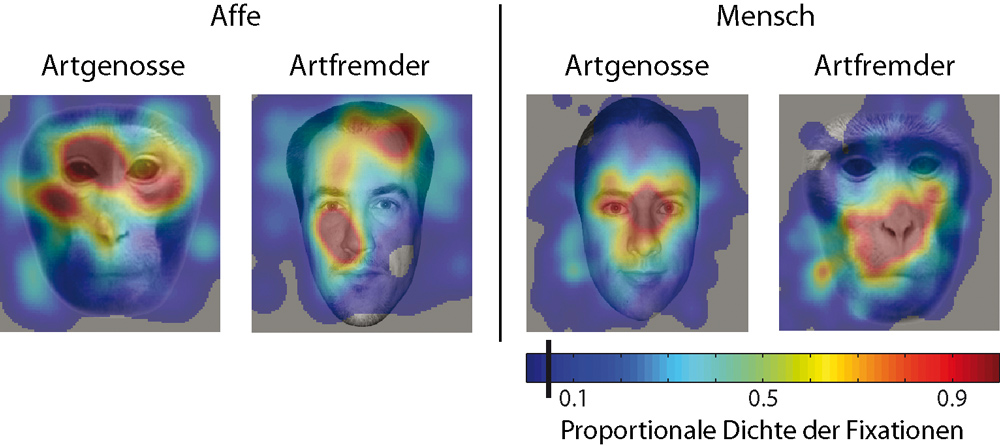
Monkeys and humans both look predominately at the eyes of conspecifics whereas they let their gaze wander over the whole face when presented with images of an individual of a different species. Image: Max Planck Institute for Biological Cybernetics/Christoph Dahl
(PhysOrg.com) -- Already Charles Darwin investigated facial expressions of monkeys in order to find out how closely related humans and monkeys really are. Scientists at the Max Planck Institute for Biological Cybernetics have now shown that rhesus monkeys and humans employ the same strategies to process faces of conspecifics: both species look first at the eyes of conspecifics, whereas for non-conspecific faces they let their gaze wander over the whole face.
This means that for both species during evolution the same perceptual mechanisms have developed in the brain. It must have therefore been adventitious also for our next of kin to process faces of conspecifics with a dedicated perceptual strategy. (Current Biology, February 26th, 2009)
In the study, faces of the two species were shown to both monkey and human observers while their eye movements were being recorded. The faces were presented both "normally" and upside-down. It is a well-known effect in perceptual psychology that upside-down faces are hard to recognize as the usual face processing mechanisms cease to work. In addition, we know that gaze is attracted to the eyes for "normally" shown faces. These two facts can therefore be used to uncover different processing strategies: many fixations on an eye region are a tell-tale sign of "normal" face processing.
The study has shown that this processing strategy in monkeys only holds for monkey faces, whereas in humans it only holds for human faces - even though the two species share rather similar facial features (eyes, nose, mouth). In addition, the recorded eye movements of both species were exactly the same for non-conspecific faces as for upside-down faces: in both cases fixations moved away from the eyes to other parts of the face.
Monkeys are therefore experts for monkey faces and humans experts for human faces. "The surprising finding is that in addition the perceptual strategies for processing conspecific faces are exactly the same. Humans and monkeys are therefore even more similar than previously thought," said Christoph Dahl, one of the two main authors of the study.
More information: Christoph D. Dahl, Christian Wallraven, Heinrich H. Bülthoff & Nikos K. Logothetis, Humans and macaques employ similar face-processing strategies, Current Biology (2009), doi:10.1016/j.cub.2009.01.061
Provided by Max-Planck-Institute for Biological Cybernetics


