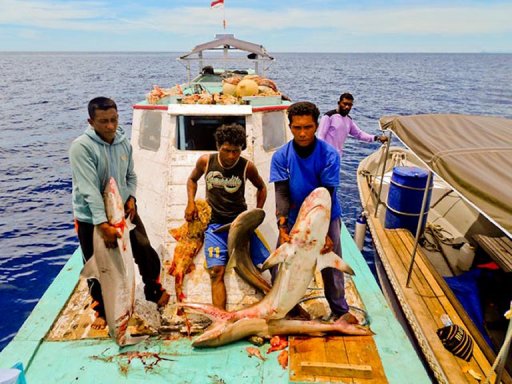
An undated file photo, released by Conservation International, shows fishermen apprehended by community patrol holding carcasses of dead sharks caught in Raja Ampat, a declared shark and manta ray sanctuary, in West Papua province of Indonesia. Ninety percent of the world's sharks have disappeared over the past 100 years, mostly due to overfishing.
Dozens of weary Indonesian fishermen sail into a busy port on the resort island of Bali celebrating their lucrative and controversial haul that is destined to end up at Chinese banquets.
The fishermen show off about 100 shark fins, already sliced off the carcasses, that are ready to be sold to middle-men and then most likely onwards to mainland China or cities around the world with big Chinese populations.
"We don't only look for sharks—we mainly catch tuna and marlin—but finding sharks is a good bonus. Their fins are worth a lot and the meat is easy to sell locally," said 33-year-old Warsito, who goes by one name.
Fishermen around Bali sell shark fins fresh off the boat for between $15 and $50, helping to satiate an ancient but fast-growing Chinese appetite for soup in which it is the main ingredient.
Shark fin soup was once a delicacy for China's elite, but shark populations have been decimated around the world as the country's 1.3 billion people have grown wealthier and incorporated it into their festivities.
While the Chinese government has banned shark fin soup from state banquets, and some five-star restaurants in Hong Kong and Singapore have dropped it from their menus, a burgeoning middle class in China continues to stoke demand.
Humans kill about 100 million sharks each year, mostly for their fins, according to the UN Food and Agriculture Organisation (FAO), and conservationists are warning that dozens of species are under threat.
Ninety percent of the world's sharks have disappeared over the past 100 years, mostly because of overfishing in countries such as Indonesia, the FAO said.
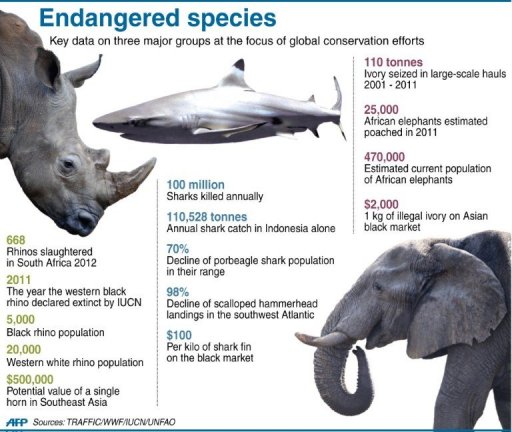
Graphic fact file on threats to rhinos, elephants and sharks.
Conservationists also point out that "finning"—slicing the valuable fins from live sharks—is simply inhumane, as the rest of the animal is typically dumped back into the ocean where it bleeds slowly to death.
How to save the shark will be a top concern at the Convention on International Trade in Endangered Species of Wild Fauna and Flora (CITES) that begins in Bangkok, Thailand, on Sunday.
World authorities will look at restricting trade of certain shark species.
Restrictions would apply to manta rays and five shark species—the porbeagle, scalloped hammerhead, great hammerhead, smooth hammerhead and oceanic whitetip—and must be approved by two-thirds of member states.
However, experts say laws to restrict trade will mean little unless there are total bans on fishing, with greater efforts needed to control unregulated fisheries.
Indonesia is particularly important because it is the world's biggest fisher and exporter of sharks, with thousands of small-time fishermen such as those in Bali able to operate with impunity.
Management of the Indonesian industry has been "total chaos", Conservation International Indonesia marine programme director Tiene Gunawan said, with no national restrictions on the trade.
In 2010, the Indonesian government designed a national plan of action to better manage the shark fishing industry, but it has so far issued no regulations.
Rampant shark fishing has already affected ecosystems in Indonesian waters, Gunawan said, including the world-famous diving spot Raja Amapat in the region of Papua.
However recent efforts by the provincial authorities there—emanating from a recognition that there is greater economic benefit in maintaining shark populations—could be a model for the future.
After authorities in Raja Ampat noticed a surge in boats carrying hundred of shark fins but no carcasses, the local government banned shark fishing in 2010.
Last week the ban was made into law, creating the country's only shark and manta ray sanctuary. It is also the first in the Coral Triangle, a massive region in Southeast Asia known as the "Amazon of the ocean".
"What they realised, and our studies support this, is that the value of a dead shark is much lower than if we keep it alive for tourism," Gunawan said.
(c) 2013 AFP


