More 'hollowed ground' on Mercury

Jan 05, 2012 by Jason Major, Universe Today
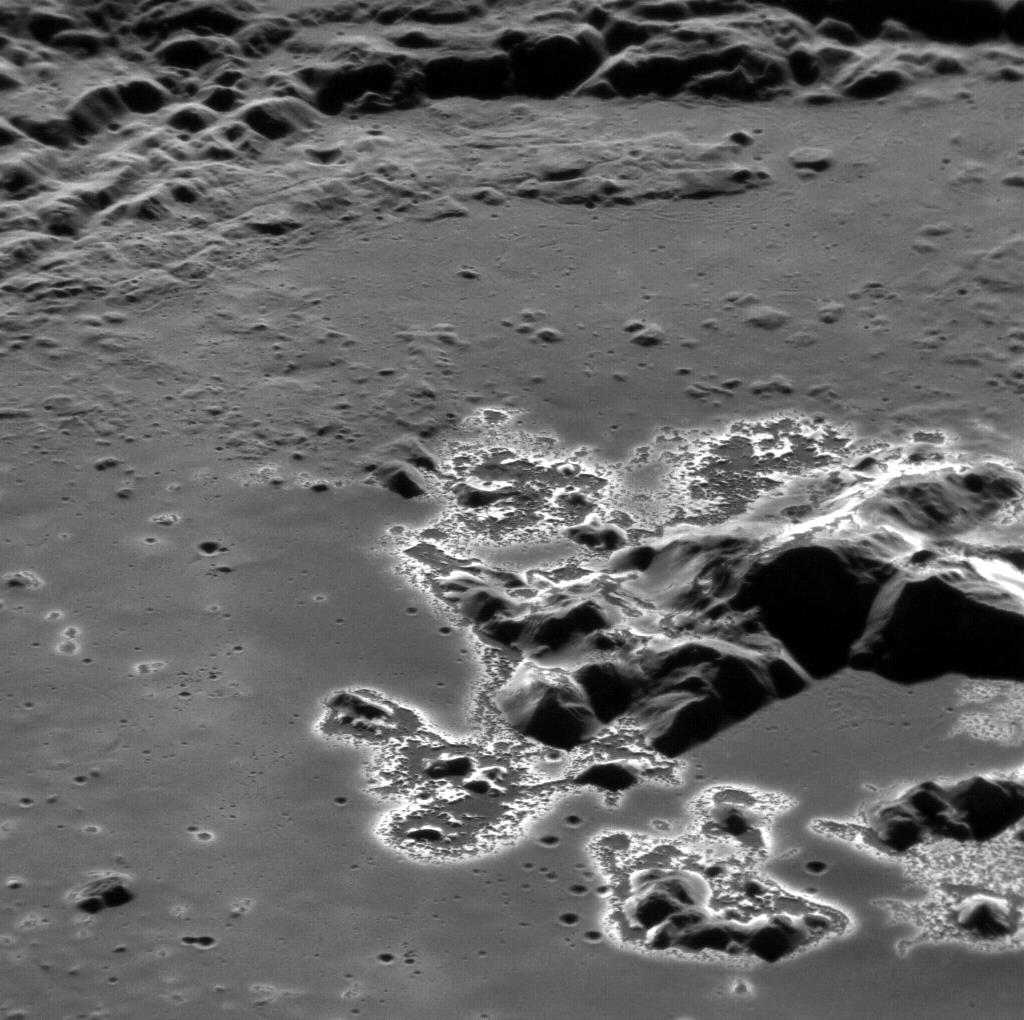
MESSENGER's latest NAC image of curious "hollows" surrounding a crater peak. The image shows an area approximately 41 miles (66 km) across. It has been rotated to enhance perspective. Credit: NASA/Johns Hopkins University Applied Physics Laboratory/Carnegie Institution of Washington

The latest featured image from NASA’s MESSENGER spacecraft, soon to complete its first year in orbit around Mercury, shows the central peak of the 78-mile (138-km) – wide crater Eminescu surrounded by more of those brightly-colored surface features dubbed “hollows”. Actually tinted a light blue color, hollows may be signs of an erosion process unique to Mercury because of its composition and close proximity to the Sun.

First noted in September of last year, hollows have now been identified in many areas across . They showed up in previous images as only bright spots, but once MESSENGER established orbit in March of 2011 and began high-resolution imaging of Mercury’s surface it became clear that these features were something totally new.

The lack of craters within hollows seems to indicate that they are relatively young features. In fact, they may be part of a process that continues even now.

“Analysis of the images and estimates of the rate at which the hollows may be growing led to the conclusion that they could be actively forming today,” said David Blewett of the Johns Hopkins University Applied Physics Laboratory (APL).

One hypothesis is that the hollows are formed by the sublimation of subsurface material exposed during the creation of craters, around which they are most commonly seen. Being so close to the Sun (29 million miles/46 million km at closest) and lacking a protective atmosphere like Earth’s, Mercury is constantly being scoured by the powerful solar wind. This relentless stream of charged particles may literally be “sandblasting” exposed volatile materials off the planet’s surface!

The image above shows an area approximately 41 miles (66 km) across. It has been rotated to enhance perspective; see the original image and caption here.

Explore further: Field tests in Mojave Desert pave way for human exploration of small bodies

add to favorites email to friend print save as pdf

Related Stories

Strange hollows discovered on Mercury

Oct 25, 2011

NASA's MESSENGER spacecraft has discovered strange hollows on the surface of Mercury. Images taken from orbit reveal thousands of peculiar depressions at a variety of longitudes and latitudes, ranging in size ...

MESSENGER Returns Images from Oct. 6 Mercury Fly-By

Oct 07, 2008

MESSENGER is the first mission sent to orbit the planet closest to the sun. On Oct. 6, 2008, at roughly 4:40 a.m. ET, MESSENGER flew by Mercury for the second time this year. During the encounter, the probe ...

Incredible ‘sideways’ look at Mercury’s limb

Nov 29, 2011

Wow -- just wow! Here’s a unique, jaw-dropping, and beautiful look at Mercury from the MESSENGER spacecraft, in a mosaic created from nine images taken by the Narrow Angle Camera (NAC) of the Mercury ...

Recommended for you

Mars rover Opportunity examines clay clues in rock

5 hours ago

(Phys.org) —NASA's senior Mars rover, Opportunity, is driving to a new study area after a dramatic finish to 20 months on "Cape York" with examination of a rock intensely altered by water.

NASA's STEREO detects a CME from the sun

19 hours ago

On 5:24 a.m. EDT on May 17, 2013, the sun erupted with an Earth-directed coronal mass ejection or CME, a solar phenomenon that can send billions of tons of solar particles into space that can reach Earth ...

Nine-year-old Mars rover passes 40-year-old record

May 17, 2013

While Apollo 17 astronauts Eugene Cernan and Harrison Schmitt visited Earth's moon for three days in December 1972, they drove their mission's Lunar Roving Vehicle 19.3 nautical miles (22.210 statute miles ...

Bright explosion on the Moon

May 17, 2013

For the past 8 years, NASA astronomers have been monitoring the Moon for signs of explosions caused by meteoroids hitting the lunar surface. "Lunar meteor showers" have turned out to be more common than anyone ...

User comments : 1

Adjust slider to filter visible comments by rank

Display comments: newest first

Dr_Strange
5 / 5 (1) Jan 05, 2012
In that particular case, I think it tells us more about the impactor than from the planet itself.

In this picture, the place this process occur (around the central peak of an impact crater) makes me think this is a an outgassing phenomenon from the depts of Mercury but maybe more from the outgasing from the residual debris of the impactor itself (probably a comet, because it is mainly made of ices), burried under the crater.
By searching this kind of phenomenon, the scientists might be able to differentiate the craters left by an icy impactor than a rocky one.

More news stories

Alaska volcano shoots ash 15,000 feet into the air

(AP)—One of Alaska's most restless volcanoes has shot an ash cloud 15,000 feet into the air in an ongoing eruption that has drawn attention from a nearby community but isn't expected to threaten air traffic.

Chinese, Indian airlines face EU pollution fines

Eight Chinese and two Indian airlines face fines of up to several million euros for not paying for their greenhouse gas emissions during flights within the bloc, the European Commission said on Friday.

NASA's STEREO detects a CME from the sun

On 5:24 a.m. EDT on May 17, 2013, the sun erupted with an Earth-directed coronal mass ejection or CME, a solar phenomenon that can send billions of tons of solar particles into space that can reach Earth ...

New colonoscope provides ground-breaking view of colon

A ground-breaking advance in colonoscopy technology signals the future of colorectal care, according to research presented today at Digestive Disease Week(DDW). Additional research focuses on optimizing the minimal withdrawal ...

US seizes Bitcoin operator accounts

US authorities seized the accounts of a Bitcoin digital currency exchange operator, claiming it was functioning as an "unlicensed money service business," court documents showed Friday.

Yahoo Japan suspects 22 million IDs stolen

Yahoo Japan Corp. has said it suspects up to 22 million user IDs may have been stolen during an unauthorised attempt to access the administrative system of its Yahoo! Japan portal.