Researchers discover a way to significantly reduce the production costs of fuel cells
Dec 20, 2011

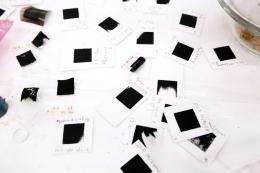
Researchers at Aalto University in Finland have developed a new and significantly cheaper method of manufacturing fuel cells. A noble metal nanoparticle catalyst for fuel cells is prepared using atomic layer deposition (ALD). This ALD method for manufacturing fuel cells requires 60 per cent less of the costly catalyst than current methods.

"This is a significant discovery, because researchers have not been able to achieve savings of this magnitude before with materials that are commercially available," says Docent Tanja Kallio of Aalto University.

Fuel cells could replace polluting that are presently in use. However, in a fuel cell, must be sped up by using a . The high price of catalysts is one of the biggest hurdles to the wide adoption of fuel cells at the moment.

The most commonly used fuel cells cover with expensive noble metal powder which reacts well with the fuel. By using the Aalto University researchers’ ALD method, this cover can be much thinner and more even than before which lowers costs and increases quality.
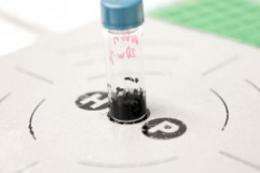
A noble metal nanoparticle catalyst for fuel cells is prepared using atomic layer deposition. This ALD method for manufacturing fuel cells requires 60 per cent less of the costly catalyst than current methods. Credit: Adolfo Vera

With this study, researchers are developing better alcohol fuel cells using methanol or ethanol as their fuel. It is easier to handle and store alcohols than commonly used hydrogen. In alcohol fuel cells, it is also possible to use palladium as a catalyst. The most common catalyst for hydrogen fuel cells is platinum, which is twice as expensive as palladium. This means that alcohol fuel cells and palladium will bring a more economical product to the market.

Fuel cells can create electricity that produces very little or even no pollution. They are highly efficient, making more energy and requiring less fuel than other devices of equal size. They are also quiet and require low maintenance, because there are no moving parts.

In the future, fuel cells are expected to power electric vehicles and replace batteries, among other things. Despite their high price, fuel cells have already been used for a long time to produce energy in isolated environments, such as space crafts. These results are based on preliminary testing with anodes using a palladium catalyst. Commercial production could start in 5-10 years.

This study was published in the Journal of Physical Chemistry C.

Explore further: User awareness key to effective energy monitoring

More information: Atomic Layer Deposition Preparation of Pd Nanoparticles on a Porous Carbon Support for Alcohol Oxidation. The Journal of Physical Chemistry C, 2011, 115, 23067–23073. dx.doi.org/10.1021/jp2083659

add to favorites email to friend print save as pdf

Related Stories

Carbon Nanotubes Make Fuel Cells Cheaper

Feb 09, 2009

(PhysOrg.com) -- As fuel cells are becoming more popular due to their potential use in applications such as hydrogen-powered vehicles, auxiliary power systems, and electronic devices, the need for the precious ...

Replacing Platinum in Fuel Cell Technology

Oct 20, 2009

(PhysOrg.com) -- One of the biggest hindrances to the development of fuel cell technology is its cost. In order to work properly, polymer electrolyte fuel cells require a catalyst. So far, though, the most ...

Recommended for you

Radiation leak at Japan lab; small impact expected

8 hours ago

An atomic research lab in northern Japan has reported a radiation leak that may have affected about 50 people, though none were hospitalized and no impact was expected outside the facility, the lab's operator ...

The long road to the 2000-watt society

May 24, 2013

The vision of a society in which each inhabitant of the earth manages to consume only 2000 watts (48 kilowatt-hours per day) has already been around for 15 years. During this time, there has been a steady incr ...

Germany must spread cost of energy shift fairly: IEA

May 24, 2013

The International Energy Agency said Friday that Germany must shield its consumers from paying too much of the cost of its ambitious switch from nuclear power and fossil fuels toward renewable energy.

Solar Kettle allows for boiling water off the grid

May 23, 2013

(Phys.org) —A company called Contemporary Energy has unveiled a new device it calls the Solar Kettle. It looks very much like a normal coffee thermos, but has flaps on one side that open to allow for collecting ...

User comments : 0

More news stories

Yahoo, pay-TV operators among Hulu bidders

Online video site Hulu is again up for sale, with Yahoo and pay TV operators DirecTV and Time Warner Cable among the seven bidders, according to a person with direct knowledge of the matter.

Radiation leak at Japan lab; small impact expected

An atomic research lab in northern Japan has reported a radiation leak that may have affected about 50 people, though none were hospitalized and no impact was expected outside the facility, the lab's operator ...

Google eyes emerging markets networks

Google has become deeply involved in a series of projects to build and operate wireless networks in emerging markets including sub-Saharan Africa and Southeast Asia, a report said Friday.

Galaxies fed by funnels of fuel

(Phys.org) —Computer simulations of galaxies growing over billions of years have revealed a likely scenario for how they feed: a cosmic version of swirly straws.