Alternative LED lighting combats energy crisis
November 17, 2011 by Jacob Gersh
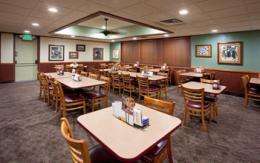
Cree LR6 LED downlights illuminate the dining room of a Denny's restaurant in Colorado Springs, Colo. A Denny's franchisee installed more than 400 LR6 downlights in the dining rooms of his five area restaurants, cutting approximately $15,500 per year in energy costs. Credit: Cree, Inc.
Alternative lighting is emerging as a potent method to combat the energy crisis. Light-emitting diode (LED) lighting technologies could provide an innovative way to save energy and make wasteful lighting obsolete.
Cree LED Lighting is manufacturing such a technology in Durham, N.C. Cree focuses on the production of light-emitting diode lighting, power and communications devices, all of which are supported by advancements in silicon carbide semiconductor technology.
Silicon carbide chips are more durable and perform better than traditional silicon semiconductors. Cree discovered these properties of carbide chips while working with the University of Arkansas in 2001 on a grant from the National Science Foundation (NSF). The company designed computer modeling methods to simulate silicon carbide semiconductors under extreme conditions. Cree then supported research on a 2007 NSF grant awarded to LT Technologies. This Small Business Innovation Research (SBIR) project develops microwave technology to rapidly process silicon carbide semiconductors.
LEDing the way
Although Cree's work led to semiconductor applications for power and radio technology, Cree's most successful products to date are LED lights using the company's silicon carbide semiconductors.
If LED lights are widely adopted, the potential impact on national energy consumption could be enormous. "On average, LED lighting can save up to 85 percent of the electricity used by incandescent bulbs, since most of the energy emitted from those lights is converted to heat instead of light," said Michelle Murray, director of communications at Cree. "For fluorescents, depending on whether you compare LED lighting to compact fluorescents or fluorescent tube lighting, LEDs can save between 20 and 50 percent of the energy used by those lighting sources."
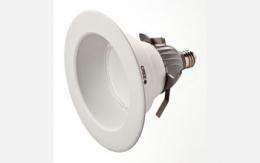
Cree's CR6 LED Energy Star-certified downlight powered by Cree TrueWhite technology. Credit: Cree, Inc.
In addition to LED lighting's energy benefits, it holds mechanical advantages over standard fluorescent and incandescent lights."LEDs do not have fragile filaments like incandescent bulbs, or special gases inside, like fluorescents," said Murray.
The best choice
The filaments in most incandescent bulbs not only limit each bulb's life, but they can generate large amounts of waste heat. Fluorescent bulbs are more efficient than incandescent bulbs, but contain potentially harmful mercury. When fluorescent bulbs expire, the toxic mercury has to be properly managed in order to protect both human health and the environment.
"Any lighting system is only as good as its weakest part," said Murray. "So good quality solid-state lighting [like LED based bulbs] has a system-level design approach--the LEDs, the optics, the driver and the thermals are all optimized for their specific application. This allows LED lighting to last for years--even decades."
LED lights are not given a lifetime based on failure, like incandescent or fluorescent bulbs. Instead, LED lights are considered in need of replacement when they only provide 70 percent of their original efficacy. The LED technology developed by Cree is engineered to last a minimum of 50,000 hours before requiring replacement.
Failing fluorescents
Fluorescent bulbs are given an estimated lifetime based upon the failure rate of the bulb: After 40,000 hours of use, 50 percent of fluorescent lights will have broken and will require replacement. According to the DOE Caliper 9 Summary Report, because of that high failure rate, some fluorescent bulbs are advertised at a more practical lifetime of 24,000 hours--less than half the lifetime of a silicon carbide semiconductor-based LED.
In June 2011, President Barack Obama visited Cree to tour the company's Durham manufacturing facilities as well as meet with the Jobs and Competitiveness Council to discuss the direction of American business. The president highlighted Cree technology as a driving force in leading a clean energy revolution and aiding American manufacturing, but LED lighting is still not yet a familiar technology to the public.
"Awareness is the biggest challenge," Murray said. "Awareness about how to buy good quality LED lighting products, and awareness that they already are on the market."
Murray also highlights challenges in educating the public to understand the up-front cost of LED lighting versus the potential payback over the life of a fixture. Initially, LED lights cost more than fluorescent and incandescent bulbs, but the savings in energy and bulb replacement typically pay for the LED's higher cost over time.
Provided by
National Science Foundation
-
From lemons to lemonade: Reaction uses carbon dioxide to make carbon-based semiconductor,
32 comments
-
Thioridazine kills cancer stem cells in human while avoiding toxic side-effects of conventional cancer treatments,
3 comments
-
SpaceX private rocket blasts off for space station (Update),
42 comments
-
Climate scientists say they have solved riddle of rising sea,
31 comments
-
SpaceX capsule has 'new car' smell, astronauts say (Update),
4 comments
-
Need a rigid insulation material???
17 hours ago
-
magnets or EMF in car bumpers to protect from fender bender
May 26, 2012
-
length of wire in a coil of known dimensions?
May 25, 2012
-
India Engineering Powerhouse
May 25, 2012
-
electromagnet core dereference between hard and soft iron
May 25, 2012
-
Measuring water pressure in an open tank
May 24, 2012
- More from Physics Forums - General Engineering
More news stories
Browser wars flare in mobile space
The browser wars are heating up again, but this time the fight is for dominance of the mobile Internet.
10 hours ago |
5 / 5 (1) |
3
Probability of contamination from severe nuclear reactor accidents is higher than expected: study
Catastrophic nuclear accidents such as the core meltdowns in Chernobyl and Fukushima are more likely to happen than previously assumed. Based on the operating hours of all civil nuclear reactors and the number ...
Technology / Energy & Green Tech
May 22, 2012 |
3.6 / 5 (22) |
56
|
SpotterRF debuts Radar Backpack Kit (w/ Video)
(Phys.org) -- SpotterRF has announced a special radar backpack kit designed to enhance situational awareness for soldiers on the ground. The company says its special radar is designed for warfighters as part ...
HyperSolar shows dirty water no barrier to power world
(Phys.org) -- The Santa Barbara, California, company, HyperSolar, is set to transparently share the ups and downs of its research experiences toward the companys ultimate vision, successfully producing ...
Tesla to launch electric sedan in US on June 22
Tesla Motors said Tuesday it would begin deliveries of "the world's first premium electric sedan" on June 22, slightly ahead of schedule.
Technology / Energy & Green Tech
May 22, 2012 |
4.5 / 5 (12) |
18
Land and sea species differ in climate change response: study
(Phys.org) -- Marine and terrestrial species will likely differ in their responses to climate warming, new research by Simon Fraser University and Australia’s University of Tasmania has found.
Almost half of new vets seek disability
(AP) -- America's newest veterans are filing for disability benefits at a historic rate, claiming to be the most medically and mentally troubled generation of former troops the nation has ever seen.
'Unzipped' carbon nanotubes could help energize fuel cells, batteries
Multi-walled carbon nanotubes riddled with defects and impurities on the outside could replace some of the expensive platinum catalysts used in fuel cells and metal-air batteries, according to scientists at ...
T cells 'hunt' parasites like animal predators seek prey, study shows
By pairing an intimate knowledge of immune-system function with a deep understanding of statistical physics, a cross-disciplinary team at the University of Pennsylvania has arrived at a surprising finding: T cells use a movement ...
Computer model used to pinpoint prime materials for efficient carbon capture
When power plants begin capturing their carbon emissions to reduce greenhouse gases and to most in the electric power industry, it's a question of when, not if it will be an expensive undertaking.
Change in developmental timing was crucial in the evolutionary shift from dinosaurs to birds: study
At first glance, it's hard to see how a common house sparrow and a Tyrannosaurus Rex might have anything in common. After all, one is a bird that weighs less than an ounce, and the other is a dinosaur that ...

Nov 17, 2011
Rank: 1 / 5 (2)
Nov 17, 2011
Rank: 5 / 5 (5)
He will never manage to figure it out until he learns how to add, subtract, multiply and divide.
Nov 17, 2011
Rank: not rated yet
Nov 17, 2011
Rank: 1 / 5 (1)
This is a Cree PR release and shouldn't be believed.
CFL's are as eff as LED's if fairly rated. CFL's put out 360deg light vs a narrow beam for LED's.
And I can buy a 100 wt Equivalent CFL for $2 vs $50-75 for am equivalent light LED. Only in places like traffic lights, etc is LED's worthwhile.
Nov 17, 2011
Rank: 5 / 5 (1)
Nov 18, 2011
Rank: not rated yet
Nov 18, 2011
Rank: 1 / 5 (1)
Nov 30, 2011
Rank: 1 / 5 (1)