Beams to order from table-top accelerators
August 22, 2011

Beams to order from table-top accelerators

Enlarge

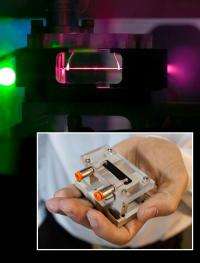
A laser pulse through a capillary filled with hydrogen plasma creates a wake that can accelerate an electron beam to a billion electron volts in just 3.3 centimeters. The same LOASIS accelerating structure has been modified to tune stable, high-quality beams from 100 to 400 million electron volts. Credit: Photos by Roy Kaltschmidt, Berkeley Lab Public Affairs

Laser plasma accelerators offer the potential to create powerful electron beams within a fraction of the space required by conventional accelerators – and at a fraction of the cost. Their promise for the future includes not only compact high-energy colliders for fundamental physics but diminutive sources of intensely bright beams of light, spanning the spectrum from microwaves to gamma rays – a new kind of ultrafast light source for investigating new materials, biological structures, and green chemistry. Compared to today's giant science facilities, "table-top" laser plasma accelerators may eventually be able to do equally powerful research with minimal environmental impact.

To reach these goals, laser accelerators must be able to produce high-quality, stable electron beams and tune those beams to the users' needs. The LOASIS program at the U.S. Department of Energy's Lawrence Berkeley National Laboratory (Berkeley Lab) has already demonstrated high-quality beams up to a billion electron volts in a mere 3.3 centimeters; the BELLA project will reach 10 billion electron volts in a single meter.

Now the LOASIS team has demonstrated a simple way to tune highly stable beams through a wide range of energies. They describe their methods in the journal Nature Physics.

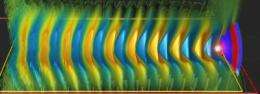
"To describe how a laser plasma accelerator works, I use the analogy of a surfer riding a wave," says Wim Leemans, who heads the LOASIS program in Berkeley Lab's Accelerator and Fusion Research Division. "The surfers are the electrons themselves. The waves form when a laser pulse plows through a plasma."

In a plasma, atomic nuclei (ions) are separated from electrons, and immensely strong electric fields can build up between the oppositely charged particles when they are separated by the waves behind a powerful laser pulse. Some of the electrons in the plasma are swept up by the waves and are quickly accelerated to high energy.

"In this case the wave is a tsunami, and it doesn't much matter what the surfers do; they'll be carried along," Leemans says. "That's called self-trapping. But there are other ways a surfer can catch a wave. Real surfers can gauge the size and speed of an oncoming wave and start paddling to match its momentum."

Attempts to create tunable electron beams through momentum-matching have been tried, by injecting electrons into the accelerating field – first giving them a boost using colliding laser pulses to catch the wave, then using a different drive-laser pulse to excite a wave on which those surfing electrons can be accelerated to high energies. It's an approach that demands sophisticated timing and synchronization, and along with other tuning methods for one-stage accelerators, requires electron injection that's localized in space and time.
Beams to order from table-top accelerators
Enlarge

A laser plasma accelerator uses a laser pulse (red and blue disks, extreme right) to create a wake through a plasma, creating strong electric fields. Like surfers on a wave, free electrons ride the wake and are accelerated to high energies. Only the electron bunch propelled by the first wave (white glow) is shown in this simulation. Credit: Simulation by Jean-Luc Vay and Cameron Geddes

"But there's a third way of helping a surfer catch a wave," Leemans says, "and that's by slowing the wave until even slow surfers can catch it – then increasing the speed of the wave." In other words, a two-stage process – and this turns out to be the secret to tunable, high-quality electron beams.

For their experiments the Berkeley Lab scientists modified the same 3.3-centimeter LOASIS accelerator and the same 40-trillion-watt peak-power drive laser, dubbed TREX, they used to produce the first billion-electron-volt beam. The accelerator is a block of titanium sapphire with a narrow capillary through it, filled with hydrogen gas that's ionized to a plasma by a jolt of electricity, just before the drive-laser pulse enters.

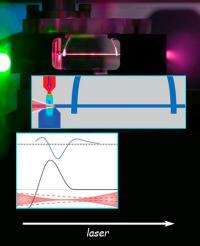
Slowing the laser wake and then speeding it up requires controlling the wake's phase velocity. To modify the LOASIS system for "two-stage," tunable acceleration, the researchers introduced a supersonic jet of helium gas that passes through the accelerator's hydrogen-filled capillary at the upstream front end. This sharply increases the density of electrons in the subsequent plasma. The plasma density then falls off rapidly downstream.

"The extra density itself serves as a lens to focus the laser to higher intensity, and the laser is focused right where the extra density is beginning to decrease," says Leemans. Here at the edge of the "density downramp," the slower waves trap electrons more readily. "The waves in the wake are falling farther behind the laser pulse as it enters the region of lower density."

Density control is only one way to control wave velocity, however. Another method is through laser intensity – an unexpected gift from Albert Einstein's Special Theory of Relativity. Leemans explains, "The particles in the plasma waves have slowed because of the increased density, but they're still moving relativistically, near the speed of light,"
Beams to order from table-top accelerators
Enlarge

A supersonic jet of helium gas (red, upper panel) greatly increases plasma density upstream of the hydrogen-filled capillary (blue). In the lower panel, the black curve shows density increasing, then falling off downstream. The blue curve indicates the phase velocity of the wake, slowing where the laser pulse (pink) is focused, then increasing again as density decreases. Credit: image from Wim Leemans

Carl Schroeder, a theoretician with LOASIS and an author of the Nature Physics paper, says that "as the laser is focused, its intensity increases, driving larger and larger plasma waves. Larger waves increase the relativistic mass effect. This reduces the frequency of the wave and stretches the wavelength. The peaks of the waves fall even farther behind the laser pulse."

Says experimenter Tony Gonsalves, first author of the Nature Physics paper, "If we simply end the plasma there, we have a stable low-energy accelerator. But with a second stage we can accelerate the to much higher energy, and we can tune that energy."

The same drive-laser pulse whose wake has been slowed by plasma density and laser intensity now powers into the low-density region of the accelerator; the following waves, carrying their extra load of electron "surfers," rapidly catch up.

"Tuning the energy is possible because by changing the density or location of the higher-density plasma, we can change its focusing power, the intensity of the laser pulse, and how much the pulse spreads out in the following lower-density plasma," Gonsalves says. "This allows us to tune the acceleration length and the final beam energy. The stability we achieve over our tunable range is quite amazing."

By tailoring plasma density in the two zones over the length of the accelerator, the LOASIS researchers were able to tune the energy of the electron beams over a range from 100 million electron volts to 400 million electron volts, while maintaining energy stability to within a few percent.

Leemans says, "Tailoring plasma density longitudinally this way is a concept that shows a new path to the level of sophisticated tuning for accelerators and light sources that users of conventional facilities just take for granted. It's a major step toward perfecting the plasma light sources and accelerators of the future."

Provided by Lawrence Berkeley National Laboratory search and more info website

Filter


Move the slider to adjust rank threshold, so that you can hide some of the comments.


Display comments: newest first

po6ert
Aug 22, 2011

Rank: not rated yet
would these produce enough voltage to power a thorium based reactor?
Shootist
Aug 22, 2011

Rank: 5 / 5 (2)
This is an electron beam, Thorium needs neutrons (IIRC), but don't tell Oliver.
Graeme
Aug 22, 2011

Rank: not rated yet
po6ert a reactor is supposed to be producing power it self. But in any case those electron energies are enough to split any atom. But can the energy be transferred to protons or alpha particles?
mrwolfe
Aug 22, 2011

Rank: not rated yet
the most likely use for this is as an electron source for synchrotron radiation. 1Gev is certainly impressive in such a small space given that a 40Mev electrostatic accelerator is about 5 storeys tall. The problem, though, is that you need a terawatt laser to pump it ...
StarGazer2011
Aug 23, 2011

Rank: 2 / 5 (4)
bit of weird CAGW faithiness in the intro 'green chemistry' umm why not just 'chemistry'? religous nutcases with their greenness.
despinos
Aug 23, 2011

Rank: not rated yet
Tabletop Terawatt lasers are not so hard to fabricate today.
The main problem I see with this technique is escalability. They achieve some kind of density "control" with the use of a supersonic jet, which must be rather difficult to escalate. Aside from power (eV and watts), for many applications they would also require high energy (joules). A terawat laser producing many jolues at the same time it's what's really hard to fabricate.
A nice application can be to use the electron beam for imaging and/or medical surgery, something like what a gamma-knife can do for cancer surgery. An advantage of the method in this article is the tunability (in eV), which would possible allow for different penetration of the e-beam. Aside from that the e-beam can be used to generate other particles and radiation, as in x-ray generation from conventional x-ray tubes.
And finally, what about adding a CNT (carbon nanotube) "cold" cathode as electron source?
Ricochet
Aug 23, 2011

Rank: not rated yet
That ceramic-based laser they came up with to replce spark plugs could probably do the job, just scale it up for the bigger job.
Twin
Aug 23, 2011

Rank: not rated yet
The military will probably mount it on a helicopter & be able to slice a human into 34,000 slices at a rate of 13 billion / second.
Jaeherys
Aug 23, 2011

Rank: 3 / 5 (2)
@StarGazer2011

Right from wiki, "Green chemistry, also called sustainable chemistry, is a philosophy of chemical research and engineering that encourages the design of products and processes that minimize the use and generation of hazardous substances."

You guys are just as bad as conspiracy theorists. Everyone is against you ooOOOOOoooOooOOooooooo!
Rank 5 /5 (14 votes)
Relevant PhysicsForums posts
  • Water flow question
    created2 hours ago
  • [Drift velocity] Factors affecting velocity
    created5 hours ago
  • does cold gasoline have less energy
    created5 hours ago
  • distribution of molecules throughout the atmosphere
    created7 hours ago
  • The Global Positioning System !
    created8 hours ago
  • A Question relating Power
    created9 hours ago
  • More from Physics Forums - General Physics

More news stories

Is a classical electrodynamics law incompatible with special relativity?

(Phys.org) -- The laws of classical electromagnetism that were developed in the 19th century are the same laws that scientists use today. They include Maxwell’s four equations along with the Lorentz la ...

Physics / General Physics

created May 24, 2012 | popularity 4.7 / 5 (17) | comments 43 | with audio podcast feature

Landmark calculation clears the way to answering how matter is formed

(Phys.org) -- An international collaboration of scientists, including Thomas Blum, associate professor of physics, is reporting in landmark detail the decay process of a subatomic particle called a kaon – ...

Physics / General Physics

created May 25, 2012 | popularity 4.3 / 5 (22) | comments 50 | with audio podcast

Lying in wait for WIMPs: Researchers seek to dramatically increase sensitivity of Large Underground Xenon detector

Although it's invisible, dark matter accounts for at least 80 percent of the matter in the universe. No one knows what it is, but most scientists would bet on weakly interacting massive particles, or WIMPs.

Physics / General Physics

created May 23, 2012 | popularity 4 / 5 (7) | comments 15 | with audio podcast

Hawaii lab turns laser-powered bubbles into microrobots

(Phys.org) -- A team of scientists from the University of Hawaii are working on microrobots created from bubbles of air in a saline solution. The bubbles take on their title of “robots” as a laser ...

Physics / General Physics

created May 23, 2012 | popularity 5 / 5 (4) | comments 2 | with audio podcast weblog

Sound increases the efficiency of boiling

Scientists at the Georgia Institute of Technology achieved a 17-percent increase in boiling efficiency by using an acoustic field to enhance heat transfer. The acoustic field does this by efficiently removing vapor bubbles ...

Physics / Soft Matter

created May 24, 2012 | popularity 5 / 5 (2) | comments 2


Change in developmental timing was crucial in the evolutionary shift from dinosaurs to birds: study

At first glance, it's hard to see how a common house sparrow and a Tyrannosaurus Rex might have anything in common. After all, one is a bird that weighs less than an ounce, and the other is a dinosaur that ...

Computer model used to pinpoint prime materials for efficient carbon capture

When power plants begin capturing their carbon emissions to reduce greenhouse gases – and to most in the electric power industry, it's a question of when, not if – it will be an expensive undertaking.

'Unzipped' carbon nanotubes could help energize fuel cells, batteries

Multi-walled carbon nanotubes riddled with defects and impurities on the outside could replace some of the expensive platinum catalysts used in fuel cells and metal-air batteries, according to scientists at ...

T cells 'hunt' parasites like animal predators seek prey, study shows

By pairing an intimate knowledge of immune-system function with a deep understanding of statistical physics, a cross-disciplinary team at the University of Pennsylvania has arrived at a surprising finding: T cells use a movement ...

Manufacturing genes to attack flu virus

An international research team has manufactured a new protein that can combat deadly flu epidemics.

Yale study concludes public apathy over climate change unrelated to science literacy

Are members of the public divided about climate change because they don't understand the science behind it? If Americans knew more basic science and were more proficient in technical reasoning, would public consensus match ...