Chicken fat fuel emissions look cleaner, greener
April 27, 2011 By Gray Creech

Chicken fat fuel emissions look cleaner, greener

Enlarge

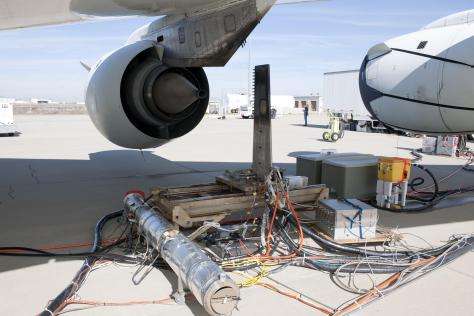
An emissions detection rake device is positioned behind the No.3 engine on NASA's DC-8 flying laboratory during ground tests of an alternative jet fuel made from chicken and beef tallow. Credit: NASA / Tom Tschida

NASA recently performed emissions testing on alternative, renewable fuels for a greener and less petroleum-dependent future. The search for alternative fuels is driven by environmental concerns as well as a desire for reduced reliance on foreign sources.

"Renewable" means that the fuel source isn't some form of fossil fuel. The source could be algae, a plant such as jatropha, or even rendered animal fat. In late March and early April 2011, a team at NASA's Dryden Flight Research Center in California tested renewable made from chicken and beef tallow in one of the four engines of a DC-8 airplane.

The airplane remained on the ground during the test, known as the Alternative Aviation Fuels Experiment, or AAFEX, while aeronautics researchers measured the fuel's performance in the engines and examined the engine exhaust for chemicals and contamination that could contribute to . It was the first test ever to measure biofuel emissions for , commonly known as NOx, and tiny particles of soot or unburned hydrocarbon - both of which can degrade air quality in communities with airports. NOx contributes to smog and particulate matter contributes to respiratory and cardiovascular ailments.

"The test results seem to support the idea that biofuels for jet engines are indeed cleaner-burning, and release fewer pollutants into the air. That benefits us all," said Ruben Del Rosario of NASA's Glenn Research Center in Ohio. Del Rosario manages NASA's Subsonic Fixed Wing Project, which sponsored the experiment through the agency's Fundamental Aeronautics Program.

The team ran one engine using Hydrotreated Renewable Jet Fuel, or HRJ, and another engine using Jet Propellant 8, or JP-8, fuel, which is very similar to the industry standard Jet-A fuel used in commercial aircraft. They also ran one engine using a 50-50 blend of the two fuels.

The experiment's chief scientist, Bruce Anderson of NASA's Langley Research Center in Virginia, said that in the engine that burned the biofuel, black carbon emissions were 90 percent less at idle and almost 60 percent less at takeoff thrust. Anderson added that the biofuel also produced much lower sulfate, organic aerosol, and hazardous emissions than the standard jet . Researchers will spend the next several months comparing the results and drawing conclusions.

The recent test came a little more than two years after the same team used the same airplane to test two synthetic, or man-made, fuels derived from coal and natural gas. Researchers found that the synthetic fuels significantly reduced particulate emissions at all engine power settings and also saw some smaller reductions in gaseous emissions at certain engine operating conditions.

"NASA Dryden was excited to contribute to the study of alternative fuels for aviation use," said Frank Cutler, NASA's DC-8 flying laboratory project manager. "The results of these tests will tell us a lot about emissions generated by modern turbine aircraft engines using these fuels," Cutler said.

The test setup involved positioning the DC-8 at Dryden's Aircraft Operations Facility in Palmdale, Calif., surrounded by ground support equipment, emissions sensors, and test equipment trailers to house the researchers and observers.

The AAFEX tests in 2009 and this year were funded through NASA's Aeronautics Research Mission Directorate in Washington.

The experiments included investigators and consultants from private industry, other federal organizations, and academia. In all, 17 government, industry and academic organizations participated in the recent test.

Provided by JPL/NASA search and more info website

Filter


Move the slider to adjust rank threshold, so that you can hide some of the comments.


Display comments: newest first

rgwalther
Apr 27, 2011

Rank: not rated yet
How many chickens per mile?
Rank not rated yet
Relevant PhysicsForums posts

More news stories

SpotterRF debuts Radar Backpack Kit (w/ Video)

(Phys.org) -- SpotterRF has announced a special radar backpack kit designed to enhance situational awareness for soldiers on the ground. The company says its special radar is designed for warfighters as part ...

Technology / Hi Tech & Innovation

created 19 hours ago | popularity 5 / 5 (5) | comments 12 | with audio podcast report

Probability of contamination from severe nuclear reactor accidents is higher than expected: study

Catastrophic nuclear accidents such as the core meltdowns in Chernobyl and Fukushima are more likely to happen than previously assumed. Based on the operating hours of all civil nuclear reactors and the number ...

Technology / Energy & Green Tech

created May 22, 2012 | popularity 3.6 / 5 (21) | comments 56 | with audio podcast

Delphi gasoline-injection engine technique rivals hybrid's edge

(Phys.org) -- Running a diesel like engine on gasoline is something Delphi is doing in notable fashion. They claim they are on to a promising way to enjoy an engine that gives the vehicle owner high efficiency ...

Technology / Energy & Green Tech

created May 21, 2012 | popularity 4.7 / 5 (18) | comments 37 | with audio podcast report

HyperSolar shows dirty water no barrier to power world

(Phys.org) -- The Santa Barbara, California, company, HyperSolar, is set to transparently share the ups and downs of its research experiences toward the company’s ultimate vision, successfully producing ...

Technology / Energy & Green Tech

created May 24, 2012 | popularity 4.8 / 5 (15) | comments 17 | with audio podcast report

Tesla to launch electric sedan in US on June 22

Tesla Motors said Tuesday it would begin deliveries of "the world's first premium electric sedan" on June 22, slightly ahead of schedule.

Technology / Energy & Green Tech

created May 22, 2012 | popularity 4.5 / 5 (11) | comments 18


Scientist: Evolution debate will soon be history

(AP) -- Richard Leakey predicts skepticism over evolution will soon be history. Not that the avowed atheist has any doubts himself.

Dell tablet leak: 10.1-inch display, two-battery choice

(Phys.org) -- Headline after headline talks about vendors’ tablets in the wings as likely number-one contenders for the iPad. Such claims have justifiably been taken with a grain of salt, considering ...

SpaceX capsule has 'new car' smell, astronauts say (Update)

SpaceX's Dragon cargo vessel smells like a new car, said astronauts at the International Space Station after opening the hatches Saturday following the spacecraft's landmark mission to the orbiting lab.

Thousands of shellfish found dead in Peru

Thousands of crustaceans were found dead off the coast of Lima following the mystery mass death of dolphins and pelicans, the Peruvian Navy said Friday.

Astronomers seize last chance in lifetime for Venus Transit

Astronomers are gearing for one the rarest events in the Solar System: an alignment of Earth, Venus and the Sun that will not be seen for another 105 years.

Keep food safety in mind this memorial day weekend

(HealthDay) -- Picnics, parades and cookouts are as much a part of Memorial Day weekend as tributes to the United States' war veterans.