New reactor paves the way for efficiently producing fuel from sunlight
January 19, 2011 by Kathy Svitil
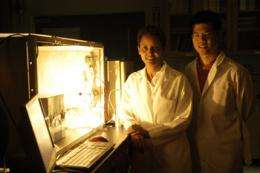
Sossina Haile and William Chueh next to the benchtop thermochemical reactor used to screen materials for implementation on the solar reactor.
Using a common metal most famously found in self-cleaning ovens, Sossina Haile hopes to change our energy future. The metal is cerium oxideor ceriaand it is the centerpiece of a promising new technology developed by Haile and her colleagues that concentrates solar energy and uses it to efficiently convert carbon dioxide and water into fuels.
Sossina Haile and William Chueh next to the benchtop thermochemical reactor used to screen materials for implementation on the solar reactor.
Solar energy has long been touted as the solution to our energy woes, but while it is plentiful and free, it can't be bottled up and transported from sunny locations to the drearierbut more energy-hungryparts of the world. The process developed by Hailea professor of materials science and chemical engineering at the California Institute of Technology (Caltech)and her colleagues could make that possible.
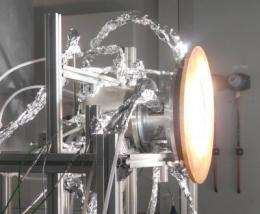
The researchers designed and built a two-foot-tall prototype reactor that has a quartz window and a cavity that absorbs concentrated sunlight. The concentrator works "like the magnifying glass you used as a kid" to focus the sun's rays, says Haile.
At the heart of the reactor is a cylindrical lining of ceria. Ceriaa metal oxide that is commonly embedded in the walls of self-cleaning ovens, where it catalyzes reactions that decompose food and other stuck-on gunkpropels the solar-driven reactions. The reactor takes advantage of ceria's ability to "exhale" oxygen from its crystalline framework at very high temperatures and then "inhale" oxygen back in at lower temperatures.
"What is special about the material is that it doesn't release all of the oxygen. That helps to leave the framework of the material intact as oxygen leaves," Haile explains. "When we cool it back down, the material's thermodynamically preferred state is to pull oxygen back into the structure."
The ETH-Caltech solar reactor for producing H2 and CO from H2O and CO2 via the two-step thermochemical cycle with ceria redox reactions.
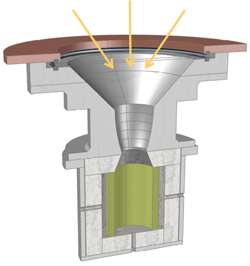
The ETH-Caltech solar reactor for producing H2 and CO from H2O and CO2 via the two-step thermochemical cycle with ceria redox reactions.
Specifically, the inhaled oxygen is stripped off of carbon dioxide (CO2) and/or water (H2O) gas molecules that are pumped into the reactor, producing carbon monoxide (CO) and/or hydrogen gas (H2). H2 can be used to fuel hydrogen fuel cells; CO, combined with H2, can be used to create synthetic gas, or "syngas," which is the precursor to liquid hydrocarbon fuels. Adding other catalysts to the gas mixture, meanwhile, produces methane. And once the ceria is oxygenated to full capacity, it can be heated back up again, and the cycle can begin anew.
For all of this to work, the temperatures in the reactor have to be very highnearly 3,000 degrees Fahrenheit. At Caltech, Haile and her students achieved such temperatures using electrical furnaces. But for a real-world test, she says, "we needed to use photons, so we went to Switzerland." At the Paul Scherrer Institute's High-Flux Solar Simulator, the researchers and their collaboratorsled by Aldo Steinfeld of the institute's Solar Technology Laboratoryinstalled the reactor on a large solar simulator capable of delivering the heat of 1,500 suns.
In experiments conducted last spring, Haile and her colleagues achieved the best rates for CO2 dissociation ever achieved, "by orders of magnitude," she says. The efficiency of the reactor was uncommonly high for CO2 splitting, in part, she says, "because we're using the whole solar spectrum, and not just particular wavelengths." And unlike in electrolysis, the rate is not limited by the low solubility of CO2 in water. Furthermore, Haile says, the high operating temperatures of the reactor mean that fast catalysis is possible, without the need for expensive and rare metal catalysts (cerium, in fact, is the most common of the rare earth metalsabout as abundant as copper).
This is the ETH-Caltech solar reactor for producing H2 and CO from H2O and CO2 via the two-step thermochemical cycle with ceria redox reactions. Credit: Courtesy of ETH
In the short term, Haile and her colleagues plan to tinker with the ceria formulation so that the reaction temperature can be lowered, and to re-engineer the reactor, to improve its efficiency. Currently, the system harnesses less than 1% of the solar energy it receives, with most of the energy lost as heat through the reactor's walls or by re-radiation through the quartz window. "When we designed the reactor, we didnt do much to control these losses," says Haile. Thermodynamic modeling by lead author and former Caltech graduate student William Chueh suggests that efficiencies of 15% or higher are possible.Ultimately, Haile says, the process could be adopted in large-scale energy plants, allowing solar-derived power to be reliably available during the day and night. The CO2 emitted by vehicles could be collected and converted to fuel, "but that is difficult," she says. A more realistic scenario might be to take the CO2 emissions from coal-powered electric plants and convert them to transportation fuels. "You'd effectively be using the carbon twice," Haile explains. Alternatively, she says, the reactor could be used in a "zero CO2 emissions" cycle: H2O and CO2 would be converted to methane, would fuel electricity-producing power plants that generate more CO2 and H2O, to keep the process going.
A paper about the work, "High-Flux Solar-Driven Thermochemical Dissociation of CO2 and H2O Using Nonstoichiometric Ceria," was published in the December 23 issue of Science.
Provided by
California Institute of Technology
-
From lemons to lemonade: Reaction uses carbon dioxide to make carbon-based semiconductor,
28 comments
-
Thioridazine kills cancer stem cells in human while avoiding toxic side-effects of conventional cancer treatments,
3 comments
-
SpaceX private rocket blasts off for space station (Update),
41 comments
-
Climate scientists say they have solved riddle of rising sea,
30 comments
-
Scotland passes turbine test to harness tidal power,
41 comments
-
magnets or EMF in car bumpers to protect from fender bender
10 hours ago
-
length of wire in a coil of known dimensions?
May 25, 2012
-
India Engineering Powerhouse
May 25, 2012
-
electromagnet core dereference between hard and soft iron
May 25, 2012
-
Measuring water pressure in an open tank
May 24, 2012
-
Question from a non-engineer: Pulley Systems
May 24, 2012
- More from Physics Forums - General Engineering
More news stories
SpotterRF debuts Radar Backpack Kit (w/ Video)
(Phys.org) -- SpotterRF has announced a special radar backpack kit designed to enhance situational awareness for soldiers on the ground. The company says its special radar is designed for warfighters as part ...
Yahoo kills 'Livestand' just 6 months after debut
(AP) -- Yahoo is killing a tablet magazine called Livestand just six months its debut on the iPad.
22 hours ago |
not rated yet |
1
Yahoo! ditches digital newsstand for iPads
Yahoo! shuttered its fledgling digital newsstand for iPads on Friday in what it said was the start of a product purge intended to make the floundering Internet pioneer more nimble.
23 hours ago |
not rated yet |
0
Probability of contamination from severe nuclear reactor accidents is higher than expected: study
Catastrophic nuclear accidents such as the core meltdowns in Chernobyl and Fukushima are more likely to happen than previously assumed. Based on the operating hours of all civil nuclear reactors and the number ...
Technology / Energy & Green Tech
May 22, 2012 |
3.4 / 5 (17) |
49
|
Delphi gasoline-injection engine technique rivals hybrid's edge
(Phys.org) -- Running a diesel like engine on gasoline is something Delphi is doing in notable fashion. They claim they are on to a promising way to enjoy an engine that gives the vehicle owner high efficiency ...
Australia hails surprise super-telescope decision
Australia has hailed a surprise decision giving it a role in a radio telescope project aimed at revolutionising astronomy, vowing to draw on its decades of experience in space science.
Astronomers seize last chance in lifetime for Venus Transit
Astronomers are gearing for one the rarest events in the Solar System: an alignment of Earth, Venus and the Sun that will not be seen for another 105 years.
Thousands of shellfish found dead in Peru
Thousands of crustaceans were found dead off the coast of Lima following the mystery mass death of dolphins and pelicans, the Peruvian Navy said Friday.
SpaceX capsule has 'new car' smell, astronauts say
SpaceX's Dragon cargo vessel smells like a new car, said astronauts at the International Space Station after opening the hatches Saturday following the spacecraft's landmark mission to the orbiting lab.
Family history of Alzheimer's affects functional connectivity
(HealthDay) -- Cognitively normal individuals with a family history of late-onset Alzheimer's disease (AD) may display lower resting state functional connectivity in the default mode network (DMN) of the brain, ...
Astronauts enter world's 1st private supply ship
(AP) -- Space station astronauts floated into the Dragon on Saturday, a day after its heralded arrival as the world's first commercial supply ship.

Jan 19, 2011
Rank: 1 / 5 (2)
Jan 19, 2011
Rank: 5 / 5 (2)
I don't get this. The energy requirement for creating fuel out of the CO2 emission is (necessarily) greater than the energy you gained by burning the coal and producing the CO2 in the first place. So in effect you'd be putting more energy into producing a portable fuel than the energy which was available inthe portable fuel (coal) you had to begin with.
This makes no sense.
Using concentrated sunlight is a good idea, but then: why have a coal powered plant there at all and not just a solar power plant that switches all excess energy over to fuel production?
Jan 19, 2011
Rank: 1 / 5 (1)
getting rid of Co2 is not a bad thing though and I am not sure that there are many other ideas and ways to do it as good as this one.
Jan 19, 2011
Rank: 5 / 5 (1)
Photovoltaics beat this by a mile with way fewer moving parts. This is more of a lab curiosity than anything with practical energy production potential.
Jan 19, 2011
Rank: 1 / 5 (1)
Jan 19, 2011
Rank: 4.2 / 5 (5)
the point is not to be more efficient than solar (thermal or PV). The point is to use solar to create a storeable/portable fuel for those times when no sun is available (night, inclement weather) and for areas where demand for energy is greater than solar can provide locally (e.g. your car).
Jan 19, 2011
Rank: 5 / 5 (1)
Jan 19, 2011
Rank: 3 / 5 (2)
Why would we want to produce more carbon monoxide anyways? I have a feeling you could put a highly focused magnifying glass over some atomized water and the sunlight would liberate the hydrogen and oxygen at efficencies higher than .8% these dufuses just want their patented ceria shit as a required piece of any new solar, fuel generating, technology.
Jan 19, 2011
Rank: 1.9 / 5 (7)
Jan 19, 2011
Rank: 5 / 5 (2)
It's possible to turn syngas (H2 and CO) into something you can put into a gasoline or diesel engine, and even jet fuels. While PV might be better at making electricity, it sucks for transport. This doesn't.
As for the 'batteries are better' argument that's bound to turn up - most of the world's cars aren't battery powered. Most of the cars that are going to be built over the next decade probably wont be battery powered. This sort of tech means existing cars could still be CO2 neutral, and I wont need to give up my 1974 V8 muscle car...
Jan 19, 2011
Rank: not rated yet
Jan 19, 2011
Rank: 2 / 5 (4)
Jan 21, 2011
Rank: 1 / 5 (1)
Vidyardhi Nanduri [Cosmology Vedas Interlinks]
Jan 23, 2011
Rank: not rated yet
But what do you use it for? If you need a way to produce hydrogen gas from water, this might be a decent competitor to existing methods. Hydrogen gas is heavily used in the petrochemical industry. But that just makes it a less expensive way to use hydrocarbons, whether from oil wells or renewable resources. Converting CO2 to CO or methane is a dead end.
The only real use I can think of is reducing flare gas at oil refineries. (Flare gas is a messy mix of hydrocarbons, alcohols, esters, and other stuff that refineries bleed off of cat crackers to keep the catalyst working.) Wouldn't need sunlight for that exothermic case.