Salt and Paper Battery May One Day Replace Lithium Batteries
Sep 15, 2009 by John Messina weblog
Salt and Paper Battery
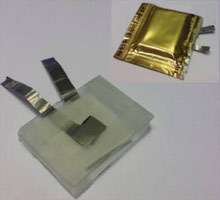
A new thin-film battery has electrodes made of polymer-coated paper and an electrolyte made of salt-soaked paper. A laboratory prototype shows the cell pressed between glass slides and packaged in an aluminum pouch.
Credit: Maria Stromme, Uppsala University

(PhysOrg.com) -- Salt and paper battery can be used in many low-power devices, such as medical implants, RFID tags, wireless sensors and smart cards. This battery uses a thin-film which makes it an attractive feature for many portable devices that draws a low current.

At Uppsala University in Sweden, researchers have developed a flexible made of two inexpensive materials: cellulose and salt.

The cellulose is derived from a polluting algae found in seas and lakes. The algae's walls contain cellulose that has a different , which gives it 100 times the surface area.

The battery is made by coating the paper, made from this cellulose, with a conducting polymer and inserting a salt-solution-soaked filter paper between the paper electrodes.

Chlorine ions travel from the batteries positive terminal to the negative terminal while current is produced in the external circuit by the flow of electrons.

The battery can be recharged in tens of seconds because the ions flow through the thin quickly. In comparison to a that would take 20 minutes to recharge.

The salt and paper battery is still in the early stages of development as compared to other thin-film technologies. For a battery to be cost effective you need to able to obtain the material at relatively low cost and have a good manufacture process in place.

The battery could be produced commercially in about three years and made available to distributors.

Via: RSC and Technology Review

© 2009 PhysOrg.com

Explore further: Juiced roads: Volvo explores electric power for trucks, buses

add to favorites email to friend print save as pdf

Related Stories

Flexible battery power

Mar 19, 2007

A paper-like, polymer based rechargeable battery has been made by Japanese scientists. The news is reported in the latest edition of The Royal Society of Chemistry journal Chemical Communications.

Recommended for you

Japan formally OKs new nuke safety requirements

53 minutes ago

Japan's nuclear watchdog formally approved a set of new safety requirements for atomic power plants Wednesday, paving the way for the reopening of facilities shut down since the Fukushima disaster.

Cape Wind gets $200M investment from Danish fund

4 hours ago

The Cape Wind offshore wind project has secured a $200 million investment from a Danish pension fund in what the wind farm's president said Tuesday is a milestone for the long-delayed project.

Toxic radiation in groundwater at Fukushima: operator

7 hours ago

Cancer-causing radioactive substances have been found in groundwater at the crippled Fukushima nuclear plant, its Japanese operator said on Wednesday, as it pledged to prevent it getting into the sea.

Poland may delay launch of nuclear plants

17 hours ago

Poland could delay building its first nuclear power plants as natural gas, including shale gas, becomes less costly, the prime minister of the central European heavyweight said Tuesday.

User comments : 6

Adjust slider to filter visible comments by rank

Display comments: newest first

NeilFarbstein
2.8 / 5 (4) Sep 15, 2009
Probably has low energy density. Too low.
lenmillar
2 / 5 (1) Sep 15, 2009
How does this differ from the batteriy in the Polaroid camera?
lenm
PPihkala
4 / 5 (1) Sep 15, 2009
I did read about this cellulose discovery some time ago. It has very large surface area, so it has potential to have large capacities, once otherwise optimized.
Sweetcheeks
1.8 / 5 (4) Sep 16, 2009
This is just a capacitor. I'm unimpressed with this article's vague references to "polymer" and "cellulose." You can do the same thing with aluminum foil, two wires, and some wax paper. The only difference here is that the surface area of the cellulose is larger, so capacitance increases. Well, that and whatever insulation the polymer offers.
Capacitance is a function of surface area, a dielectric constant, and distance between the plates. This isn't even rolled up-- it's just flat! (less surface area) LAAAAAAAAAAAAAME.
alexxx
4 / 5 (3) Sep 16, 2009
This is just a capacitor. ...


Capacitors store their energy in an electrostatic field; batteries - in chemical form. This is BATTERY!
austux
4.8 / 5 (4) Sep 16, 2009
This is BATTERY!

{pedant} It's a cell. A battery is made of several cells. {/pedant}

More news stories

Japan formally OKs new nuke safety requirements

Japan's nuclear watchdog formally approved a set of new safety requirements for atomic power plants Wednesday, paving the way for the reopening of facilities shut down since the Fukushima disaster.

Multiview 3-D photography made simple

Computational photography is the use of clever light-gathering tricks and sophisticated algorithms to extract more information from the visual environment than traditional cameras can.

Sound waves precisely position nanowires

(Phys.org) —The smaller components become, the more difficult it is to create patterns in an economical and reproducible way, according to an interdisciplinary team of Penn State researchers who, using ...