Discovery opens door for better way of making medicine
Jan 25, 2013
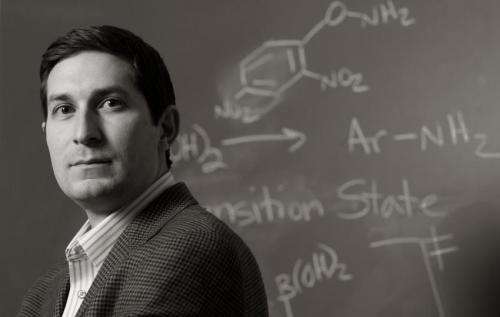
Professor Daniel Ess

(Phys.org)—To make most medicines, metals like copper are needed for a critical chemical reaction.

Afterward, pharmaceutical makers need to remove the metal to make the material safe for .

They might be spared the trouble in the future thanks to a discovery by a Brigham Young University chemist and collaborators at The University of Texas Southwestern Medical Center.

The researchers did something that has eluded scientists for several decades: They converted typically unreactive boronic acids to compounds known as aryl amines. The aryl amine functionality is ubiquitous in chemistry and this new methodology provides a novel route to their synthesis – without the use of a .

"This is a conceptual breakthrough and a novel reaction more than anything," said BYU chemistry professor Daniel Ess.

The findings were published recently in the Journal of the American Chemical Society. The industry magazine Chemical and Engineering News also highlighted the work.

Ess and his students at BYU use theories to predict which organic materials could produce desired reactions. Typically, their work guides how the researchers at Southwestern Medical Center set up their experiments.

This time, however, it worked in reverse: Laszlo Kurti of Southwestern Medical found a successful compound and asked Ess to figure out why it worked.

"A whole bunch of other compounds look very similar but failed," Ess said. "This one has the proper reactivity without decomposing. One of the bonds doesn't break until it goes in the reaction."

Pharmaceutical companies won't be the only ones interested in developing this approach. The study authors note the potential agricultural uses with the production of pesticides and fertilizers.

Explore further: Scientists determine activation barrier in ammonia-sulfuric acid clusters that could lead to cloud formation

Related Stories

Novel chemical reaction

Apr 16, 2012

(Phys.org) -- A chemical reaction reported by University of Delaware assistant professor Donald Watson and his laboratory group has set the chemistry world abuzz for its creativity and potential utility. 

Organic chemistry: Amino acids made easy

May 04, 2011

Amino acids are the building blocks of proteins. There are 22 different amino acids and they can combine in a myriad ways to form a vast array of proteins. All amino acids except glycine are chiral molecules, ...

Recommended for you

Unique method creates correct mirror image of molecule

May 22, 2013

Many molecules have a right and a left form, just like shoes. In pharmaceuticals, it is important that the correct form of the molecule is used. Researchers at the University of Gothenburg, Sweden, have been ...

New method for producing clean hydrogen

May 21, 2013

Duke University engineers have developed a novel method for producing clean hydrogen, which could prove essential to weaning society off of fossil fuels and their environmental implications.

Non-wetting fabric drains sweat

May 20, 2013

(Phys.org) —Waterproof fabrics that whisk away sweat could be the latest application of microfluidic technology developed by bioengineers at the University of California, Davis.

User comments : 0

More news stories

Scientists develop advanced biological computer

(Phys.org) —Using only biomolecules (such as DNA and enzymes), scientists at the Technion-Israel Institute of Technology have developed and constructed an advanced biological transducer, a computing machine capable of manipulating ...

Galaxies fed by funnels of fuel

(Phys.org) —Computer simulations of galaxies growing over billions of years have revealed a likely scenario for how they feed: a cosmic version of swirly straws.

Google eyes emerging markets networks

Google has become deeply involved in a series of projects to build and operate wireless networks in emerging markets including sub-Saharan Africa and Southeast Asia, a report said Friday.