Fighting sleeping sickness with X-ray lasers
Dec 21, 2012
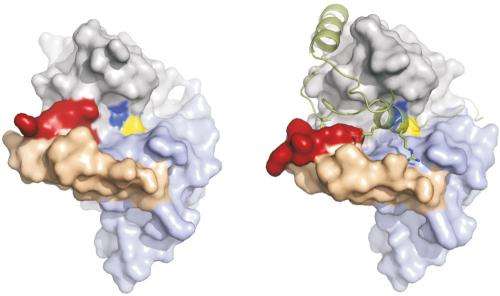
3D structure of Cathepsin B. In the "closed" conformation, an occluding loop (rigid segment: beige; flexible segment: red) blocks access to the substrate site. The propeptide binding shifts the flexible part of the loop in such a manner that the reactive partners of cathepsin B can reach the substrate site. Credit: Science Express, DOI: 10.1126/science.1229

Structure analysis of the trypanosomal protein Cathepsin B is among the scientific breakthroughs of 2012.

Using the world's most powerful X-ray free-electron laser, an international team of researchers, including scientists of the Max Planck Institute for Medical Research in Heidelberg, has obtained new insight into the structure of a medicinally important that may serve as a blueprint for the development of drugs to fight sleeping sickness. Science magazine have chosen the experimental study as one of the top ten of the year.

Sleeping sickness is caused by the Trypanosoma brucei that is transmitted by flies. The disease kills about 30,000 people word-wide each year. The currently available drugs against the disease are of limited efficacy and can have severe side effects. Moreover, resistance against them is increasing. A promising drug target is the protein Cathepsin B whose is vital for the parasite's survival. Inhibitors of Cathepsin B need to be highly specific against the trypanosomal variant because it resembles the human form. The featured work provides detailed insight into the structure of trypanosomal Cathepsin B in a natively inhibited form that might serve as a blueprint for the of drugs. The biologically important form of the protein was obtained by a trick: instead of crystallizing the protein in plastic trays in the lab, it was crystallized in vivo in the cells that produced the protein. This approach provides natively modified proteins, but the crystals obtained are tiny.

The use of the X-ray free-electron laser (FEL) at Stanford was essential for the work. Protein structures are typically determined by exposing crystals of the protein to X-rays. Unfortunately, many of the most interesting proteins, such a , do not form crystals of sufficient size for analysis by conventional X-ray sources. Measurements using very tiny crystals have now become feasible thanks to the extreme intensity of FELs whose ultrashort pulse durations outrun most radiation damage effects. It is these properties that allowed structure analysis of the tiny in-vivo grown Cathepsin B crystals. Using a model system, the Heidelberg researchers and their international colleagues had previously validated this new approach using FELs as a tool for structure analysis, an important step in the method development that published in February 2012 in Science. The current featured research demonstrates for the first time FEL use to obtain new biologically important information. The international team shows in detail how the structures of typanosomal and human Cathepsin B differ and how the naturally occurring native inhibitor binds . This may provide new ideas for designing drugs against .

The team included researchers from the Max Planck Institute for Medical Research, Heidelberg, the Center of Free-Electron Laser Science at Deutschen Elektronen-Synchrotron DESY, the Arizona State University, the Universities of Hamburg, Lübeck, Tübingen, Uppsala and Göteborg, the SLAC National Accelerator Center (USA), the Lawrence Livermore National Laboratory (USA) and the Max Planck Advanced Study Group at the Hamburg Center for Free-Electron Laser Science (CFEL).

Explore further: X-ray laser helps fight sleeping sickness: Exploiting parasite's weak spot may lead to new treatments

More information: Lars Redecke et al. Natively Inhibited Trypanosoma brucei Cathepsin B Structure Determined by Using an X-ray Laser, Science Express, November 29, 2012, DOI: 10.1126/science.1229663

Related Stories

LCLS offers new method for examining membrane proteins

Mar 15, 2012

Many membrane proteins serve as gateways in and out of the cell. Because they act as “traffic control” for infectious agents and disease-fighting drugs, they are the targets of more than 60 percent ...

Fastest X-ray images of tiny biological crystals

Jan 05, 2012

(PhysOrg.com) -- An international research team headed by DESY scientists from the Center for Free-Electron Laser Science (CFEL) in Hamburg, Germany, has recorded the shortest X-ray exposure of a protein crystal ...

New research improves quality of free electron laser

Jun 02, 2011

The free electron laser is the next step in the development of equipment to help us see the structure of materials. Nino Čutić at MAX-lab in Lund, Sweden, has done a PhD in further improving the test free electron ...

Recommended for you

Protein study suggests drug side effects are inevitable

May 20, 2013

A new study of both computer-created and natural proteins suggests that the number of unique pockets – sites where small molecule pharmaceutical compounds can bind to proteins – is surprisingly small, meaning drug side ...

Attacking MRSA with metals from antibacterial clays

May 17, 2013

In the race to protect society from infectious microbes, the bugs are outrunning us. The need for new therapeutic agents is acute, given the emergence of novel pathogens as well as old foes bearing heightened antibiotic resistance.

Keeping fruit, vegetables and cut flowers fresh longer

May 15, 2013

New technology offers the promise of reducing billions of dollars of losses that occur each year from the silent, invisible killer of fruits, vegetables and cut flowers—a gas whose effects are familiar to everyone who has ...

Why don't beetles freeze in the winter?

May 14, 2013

For 37 years, Queen's University Biochemistry professor Peter Davies has been unraveling the mystery of why some organisms including insects and fish don't freeze in the winter. His research into insect antifreeze protein ...

User comments : 0

More news stories

New method for producing clean hydrogen

Duke University engineers have developed a novel method for producing clean hydrogen, which could prove essential to weaning society off of fossil fuels and their environmental implications.

Protein study suggests drug side effects are inevitable

A new study of both computer-created and natural proteins suggests that the number of unique pockets – sites where small molecule pharmaceutical compounds can bind to proteins – is surprisingly small, meaning drug side ...

Beautiful 'flowers' self-assemble in a beaker

By simply manipulating chemical gradients in a beaker of fluid, materials scientists at Harvard have found that they can control the growth behavior of crystals to create precisely tailored structures—such ...

Attacking MRSA with metals from antibacterial clays

In the race to protect society from infectious microbes, the bugs are outrunning us. The need for new therapeutic agents is acute, given the emergence of novel pathogens as well as old foes bearing heightened antibiotic resistance.

Power of US tornado dwarfs Hiroshima bomb

Wind, humidity and rainfall combined precisely to create Monday's massive killer tornado in Oklahoma. The awesome amount of energy released dwarfed the power of the atomic bomb that leveled Hiroshima.

Amazon plans greenhouse-style headquarters

US online giant Amazon has unveiled plans for a futuristic greenhouse style headquarters "where employees can work and socialize in a more natural, park-like setting."