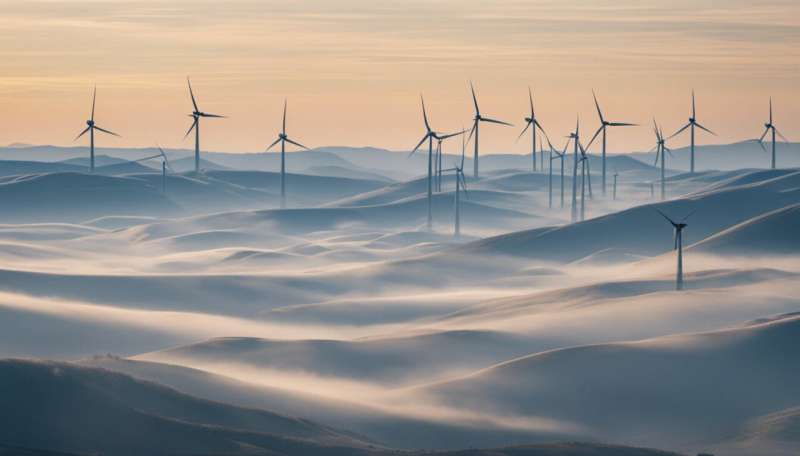
Wind turbines - bigger means more environmentally friendly
Jul 12, 2012
Source: iStockPhoto

(Phys.org) -- A study conducted by researchers from the ETH and Empa has come to the conclusion that large sized wind turbines produce "greener" electric power than small ones. Environmental benefits have also accrued as wind turbine producers gain experience and learn from each other. The developers of life-cycle analyses have also profited from the experience of the last 30 years of wind generator usage because this allows them to fine tune their techniques, enabling them to better estimate the effects of new technologies over large timespans.

is one of the beacons of hope among the various sources of renewable energy. But exactly how "ecological" are in reality when taking into account every relevant aspect over their entire life-cycle? These include the energy necessary to manufacture, produce and transport the materials from which they are made all the way through to the energy used in their installation, operation and dismantling. In a scientific article in & Technology, a research group from the ETH Zurich, Empa and Radboud University, Nijmegen (Holland) has provided a new perspective on this topic. They conclude that the larger the wind generation plant, the greener is the electricity that it produces.

According to the main author of the study, Marloes Caduff, this effect is due to a combination of plant size and the lessons learned by manufacturers as their experience increases over time. Doubling the performance of a wind turbine does not automatically mean that twice as much energy and materials are necessary to construct it. In fact it requires only slightly more energy to build wind energy plants on a large scale than it does for small ones. Caduff adds that of the main reasons why electric power produced by large-scale plants is greener is because the manufacturers are gaining experience and learning from each other, thus accelerating progress in the design and construction of these systems. This has meant for example that the shape of the rotor blade could be quickly optimized, allowing better exploitation of the available wind power without the necessity of increasing the size of the turbine tower or generator head.

Wind turbine manufacturers now have about 30 years of development experience under their belts. In 1980 the average rotor diameter was about 15 meters; today plants exist whose rotor diameters are up to 10 times larger, for example those in the «Alstom Haliade 150» offshore installation off the French coast. Scientists working on methodologies for ecobalance life-cycle analyses have also been able to take advantage of these three decades of technological development. A team of Empa researchers headed by Hans-Joerg Althaus is investigating if the development of wind turbine plants is following the same defined set of rules as any other "new" technology. After all, they too must follow the path from drawing board to prototype to pilot plant to become a reality. The results of the continuous further development and up-scaling of wind turbine plants are now feeding into the methodology of life cycle analyses, making it possible to take into account new technologies in a meaningful way when appropriate.

Explore further: Toward super-size wind turbines: Bigger wind turbines do make greener electricity

add to favorites email to friend print save as pdf

Related Stories

Recycling wind turbines

Sep 21, 2007

The development of wind power promises much in terms of providing us with renewable energy for the future and wind turbines could be the most effective way to harness that power. Danish researchers now suggest that in order ...

Vestas Announces New 7 megawatt offshore wind turbine

Apr 01, 2011

(PhysOrg.com) -- Vestas Chief Executive Officer Ditlev Engel announced in London their new V164 wind turbine, designed specifically for offshore wind power. Optimized for conditions in the North Sea, Vestas ...

New offshore turbine design to create and store energy

Sep 28, 2011

(PhysOrg.com) -- While many are taking to the oceans and trying to find the best ways to harness offshore wind and provide clean energy from renewable sources, the basic design of any wind turbine is that ...

Smart wind turbines can predict the wind

Jan 05, 2010

Risø DTU researchers have recently completed the world’s first successful test on a wind turbine with a laser-based anemometer built into the spinner in order to increase electricity generation.

Recommended for you

Radiation leak at Japan lab; small impact expected

7 hours ago

An atomic research lab in northern Japan has reported a radiation leak that may have affected about 50 people, though none were hospitalized and no impact was expected outside the facility, the lab's operator ...

The long road to the 2000-watt society

May 24, 2013

The vision of a society in which each inhabitant of the earth manages to consume only 2000 watts has already been around for 15 years. During this time, there has been a steady increase in environmental awareness ...

Germany must spread cost of energy shift fairly: IEA

May 24, 2013

The International Energy Agency said Friday that Germany must shield its consumers from paying too much of the cost of its ambitious switch from nuclear power and fossil fuels toward renewable energy.

Solar Kettle allows for boiling water off the grid

May 23, 2013

(Phys.org) —A company called Contemporary Energy has unveiled a new device it calls the Solar Kettle. It looks very much like a normal coffee thermos, but has flaps on one side that open to allow for collecting ...

User comments : 0

More news stories

Yahoo, pay-TV operators among Hulu bidders

Online video site Hulu is again up for sale, with Yahoo and pay TV operators DirecTV and Time Warner Cable among the seven bidders, according to a person with direct knowledge of the matter.

Radiation leak at Japan lab; small impact expected

An atomic research lab in northern Japan has reported a radiation leak that may have affected about 50 people, though none were hospitalized and no impact was expected outside the facility, the lab's operator ...

Google eyes emerging markets networks

Google has become deeply involved in a series of projects to build and operate wireless networks in emerging markets including sub-Saharan Africa and Southeast Asia, a report said Friday.

Facial-recognition technology proves its mettle

(Phys.org) —In a study that evaluated some of the latest in automatic facial recognition technology, researchers at Michigan State University were able to quickly identify one of the Boston Marathon bombing ...

Galaxies fed by funnels of fuel

(Phys.org) —Computer simulations of galaxies growing over billions of years have revealed a likely scenario for how they feed: a cosmic version of swirly straws.