Japan's Sony generates power from paper
Dec 15, 2011
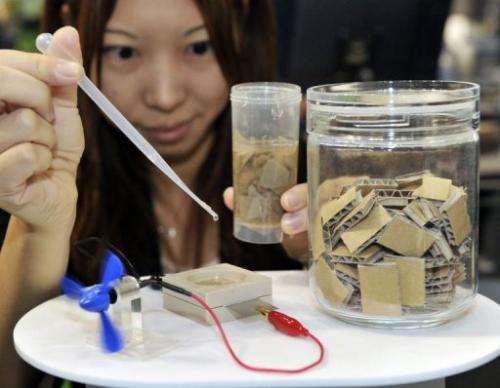
An employee of Sony demonstrates a new bio battery, generated from the cellilose of recycle papers, powering a fan (L) at the Eco-Products exhibition in Tokyo. Japanese electronics giant Sony on Thursday revealed technology that generates electricity from shredded paper.

Japanese electronics giant Sony on Thursday revealed technology that generates electricity from shredded paper.

As an environmental products fair opened in Tokyo, Sony invited children to put paper into a mixture of water and enzymes, shake it up and wait for a few minutes to see the liquid become a source of electricity, powering a small fan.

"This is the same mechanism with which termites eat wood to get energy," said Chisato Kitsukawa, a public relations manager at Sony.

While academic research has previously taken place on this kind of power generation, proof-of-concept demonstrations are rare, he said.

The performance was part of Sony's drive to develop a sugar-based "bio battery" that turns glucose into power.

Shredded paper or pieces of corrugated board were used at the fair to provide cellulose, a long chain of glucose sugar found in the walls of .

Enzymes are used to break the chain and the resulting sugar is then processed by another group of enzymes in a process that provides and electrons.

The electrons travel through an outer circuit to generate electricity, while the hydrogen ions combine with oxygen from the air to create water.

"Bio batteries are environmentally friendly and have great potential" as they use no metals or , Kitsukawa said.

But the technology is a long way from because of its low power output. It is currently sufficient to run digital music players but not powerful enough to replace commonly used batteries, he said.

Sony first unveiled test sugar in 2007 and has since reduced the battery's size into a small sheet.

Another sugar battery was on display at the fair embedded in a Christmas card, which played music when drops of were added to it.

Explore further: User awareness key to effective energy monitoring

add to favorites email to friend print save as pdf

Related Stories

The 'Ene Pocket' toy car runs on sugar (w/ Video)

Jan 29, 2010

(PhysOrg.com) -- Takara Tomy, the Japanese toy makers have unveiled their "Ene Pocket", a radio-controlled toy car with a Sony bio-battery that is fuelled by sugars like those in fruit drinks and sodas.

Modified Mobile Phone Runs on Coca-Cola

Jan 13, 2010

Daizi Zheng, a Chinese developer who is currently based in London, has modified a Nokia cell phone to run on Coca-Cola or any other sugary solution.

Bacteria -- energy producers of the future? (w/ video)

Aug 22, 2011

All of us use water and in the process, a lot of it goes to waste. Whether it goes down drains, sewers or toilets, much of it ends up at a wastewater treatment plant where it undergoes rigorous cleaning before it flows back ...

Recommended for you

Radiation leak at Japan lab; small impact expected

9 minutes ago

An atomic research lab in northern Japan has reported a radiation leak that may have affected about 50 people, though none were hospitalized and no impact was expected outside the facility, the lab's operator ...

The long road to the 2000-watt society

23 hours ago

The vision of a society in which each inhabitant of the earth manages to consume only 2000 watts has already been around for 15 years. During this time, there has been a steady increase in environmental awareness ...

Germany must spread cost of energy shift fairly: IEA

May 24, 2013

The International Energy Agency said Friday that Germany must shield its consumers from paying too much of the cost of its ambitious switch from nuclear power and fossil fuels toward renewable energy.

Solar Kettle allows for boiling water off the grid

May 23, 2013

(Phys.org) —A company called Contemporary Energy has unveiled a new device it calls the Solar Kettle. It looks very much like a normal coffee thermos, but has flaps on one side that open to allow for collecting ...

User comments : 2

Adjust slider to filter visible comments by rank

Display comments: newest first

that_guy
not rated yet Dec 15, 2011
kind of a clever fuel cell. Still, right now it is just a science project.
Tommi_Henriksen
not rated yet Dec 17, 2011
@that guy And the Wright Brothers' 'plane started as a crazy shed idea.
With the support of Sony, and their partners, this will be a market changer in just a few years.

More news stories

Radiation leak at Japan lab; small impact expected

An atomic research lab in northern Japan has reported a radiation leak that may have affected about 50 people, though none were hospitalized and no impact was expected outside the facility, the lab's operator ...

Drones may violate international law

(Phys.org) —As President Obama gives a speech on national security—including defending U.S. use of drones to combat terrorism—Leila Sadat, JD, international law expert and professor of law at Washington University in ...

Google eyes emerging markets networks

Google has become deeply involved in a series of projects to build and operate wireless networks in emerging markets including sub-Saharan Africa and Southeast Asia, a report said Friday.

Facial-recognition technology proves its mettle

(Phys.org) —In a study that evaluated some of the latest in automatic facial recognition technology, researchers at Michigan State University were able to quickly identify one of the Boston Marathon bombing ...

The long road to the 2000-watt society

The vision of a society in which each inhabitant of the earth manages to consume only 2000 watts has already been around for 15 years. During this time, there has been a steady increase in environmental awareness ...

Heart failure accelerates male 'menopause'

Heart failure accelerates the aging process and brings on early andropausal syndrome (AS), according to research presented today at the Heart Failure Congress 2013. AS, also referred to as male 'menopause', was four times ...

Galaxies fed by funnels of fuel

(Phys.org) —Computer simulations of galaxies growing over billions of years have revealed a likely scenario for how they feed: a cosmic version of swirly straws.