New detectors could provide easy visual identification of toxins or pathogens
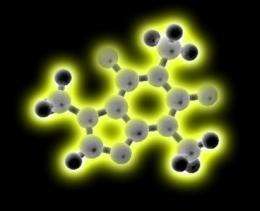
Researchers at MIT have developed a new way of revealing the presence of specific chemicals — whether toxins, disease markers, pathogens or explosives. The system visually signals the presence of a target chemical by emitting a fluorescent glow.
The approach combines fluorescent molecules with an open scaffolding called a metal-organic framework (MOF). This structure provides lots of open space for target molecules to occupy, bringing them into close proximity with fluorescent molecules that react to their presence.
The findings were reported in the Journal of the American Chemical Society in a paper by assistant professor of chemistry Mircea Dincă, with postdoc Natalia Shustova and undergraduate student Brian McCarthy, published online in November and to appear in a forthcoming print issue.
The work could have significant applications in sensors attuned to specific compounds whose detection could be read at a glance simply by watching for the material to glow. “A lot of known sensors work in reverse,” Dincă says, meaning they “turn off” in the presence of the target compound. “Turn-on sensors are better,” he says, because “they’re easier to detect, the contrast is better.”
Mark Allendorf, a research scientist at Sandia National Laboratory, who was not involved in this work, agrees. “Present materials generally function via luminescence quenching,” and thus “suffer from reduced detection sensitivity and selectivity,” he says. “Turn-on detection would address these limitations and be a considerable advance.”
For example, if the material is tuned to detect carbon dioxide, “the more gas you have, the more intensity in the response,” making the device’s readout more obvious. And it’s not just the presence or absence of a specific type of molecule: The system can also respond to changes in the viscosity of a fluid, such as blood, which can be an important indicator in diseases such as diabetes. In such applications, the material could provide two different indications at once — for example, changing in color depending on the presence of a specific compound, such as glucose in the blood, while changing in intensity depending on the viscosity.
MOF materials were first produced about 15 years ago, but their amazing porosity has made them a very active area of research. Although they simply look like little rocks, the sponge-like structures have so much internal surface area that one gram of the material, if unfolded, would cover a football field, Dincă says.
The material’s inner pores are about one nanometer (one billionth of a meter) across, making them “about the size of a small molecule” and well suited as molecular detectors, he says.
The new material is based on the MIT team’s discovery of a way to bind a certain type of fluorescent molecules, also known as chromophores, onto the MOF’s metal atoms. While these particular chromophores cannot emit light by themselves, they become fluorescent when bunched together. When in bunches or clumps, however, target molecules cannot reach them and therefore cannot be detected. Attaching the chromophores to nodes of the MOF’s open framework keeps them from clumping, while also keeping them close to the empty pores so they can easily respond to the arrival of a target molecule.
Ben Zhong Tang, a professor of chemistry at the Hong Kong University of Science and Technology, who was not involved in this work, says the MIT researchers have taken “an elegant approach” to producing functional MOFs, and “have already demonstrated the utility of their MOFs for detection and differentiation of normally difficult-to-distinguish” molecules called volatile organic compounds.
Tang says the new system still needs further refinement to improve the efficiency of production, which he says should be easily accomplished. Once that is achieved, he says, it could find many uses. “Many more applications may be envisioned: For example, the MOFs may serve as smart vehicles and monitors for controlled drug deliveries,” with the additional benefit that “the fluorescence should be gradually weakened in intensity along with progressive release of the drugs, thus enabling in situ real-time monitoring of the drug release profiles.” But for now, he says, “the work is excellent in terms of proof of concept.”
Provided by Massachusetts Institute of Technology
This story is republished courtesy of MIT News (web.mit.edu/newsoffice/), a popular site that covers news about MIT research, innovation and teaching.


