New approach to solar power with hybrid solar-thermoelectric systems
October 21, 2011 by David L. Chandler
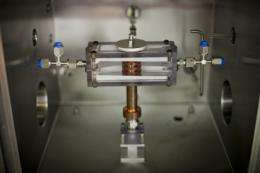
This laboratory setup was used to test the principles behind Wang and Miljkovic's concept for a hybrid solar thermoelectric system that could deliver both electricity and heat. Photo: Dominick Reuter
Systems to harness the sun's energy typically generate either electricity or heat in the form of steam or hot water. But a new analysis by researchers at MIT shows that there could be significant advantages to systems that produce both electricity and heat simultaneously.
The new study incorporates thermoelectrics devices that can produce an electric current from a temperature gradient into a concentrating solar thermal system, also called a parabolic trough. Such systems use long, curved mirrors (the trough) to focus sunlight onto a glass tube running along the centerline of the trough. A liquid pumped through that tube gets heated by the sun, and then can be used to produce steam to drive a turbine, or used directly for space heating or industrial processes that require heat.
The new MIT study shows a unique opportunity for thermoelectrics integrated within solar thermal systems, says Evelyn Wang, associate professor of mechanical engineering at MIT, who was co-author of a paper describing the potential for such hybrid systems in the journal Solar Energy.
The novel arrangement proposed by Wang and graduate student Nenad Miljkovic embeds a thermoelectric system in the central tube of a parabolic-trough system so that it produces both hot water and electricity at the same time. The key to making this work is a device called a thermosiphon that draws heat away from the cold part of a thermoelectric system, maintaining its temperature gradient.
Wang and Miljkovics system would modify a parabolic-trough systems central tube into a series of concentric tubes: A narrower tube inside the first would contain the thermoelectric material, with an even narrower tube at the center of the apparatus housing the thermosiphon, passively transferring heat from the thermoelectric cold side and alleviating the need to pump cooling fluid as in a conventional parabolic-trough system. The heat carried away by the thermosiphon could then be used to heat water for space heating, industrial processes or hot water.
One advantage such a system has over traditional photovoltaics (devices that generate electricity from sunlight), Wang says, is that thermoelectrics can be much cheaper than photovoltaics. Also, conventional solar cells do not operate well at high temperatures. But, she explains, thermoelectrics thrive in hot conditions, which allow them to build up a greater temperature gradient.
There really is no solar system now to do combined electricity and heat production at high temperature, Miljkovic says. But, he adds, there are companies actively trying to pursue this.
Theres an opportunity for bringing together different technologies, Wang says. The thermosiphon, which draws heat from one place to another just as a siphon draws liquid, is a passive way to transfer heat and can be low cost as well, she says.
Thermosiphons are typically filled with materials that undergo a phase change (usually from liquid to vapor) as they heat up, and can achieve a thermal conductivity a capacity for transferring heat from one place to another much higher than any solid material, Wang says. Its an efficient way to carry away the heat, to whatever you want to deliver it to.
Wang and Miljkovic devised a computer model to search for optimal combinations of existing materials for the thermoelectrics and the thermosiphon. This model allows different combinations to be tested at varying operating conditions to make the overall system as efficient as possible.
A system for a single house could provide both heat and electricity, Wang says. In a house, you need a lot of heat, but you only need so much electricity, she says. While the thermoelectric efficiency of such a system is relatively low, in a household system you dont need that much power relative to heat, she says.
Abraham Kribus, a professor of mechanical engineering at Tel Aviv University in Israel who was not involved in this research, says this paper describes a fresh approach to solar energy conversion, with optimistic results showing high theoretical conversion efficiency.
Kribus adds that because this is still an early stage of analysis, its not yet clear how such a system would stack up to traditional solar systems on cost and reliability. But thats not a criticism, he says: This is the situation at early stage with every nonconventional idea. Overall, the paper shows a nice start and a very capable team behind it.
Wang agrees that it is likely to take a few years to develop a practical implementation of these ideas. She and Miljkovic are going ahead with working on building a system to demonstrate how the combination could work, she says.
This story is republished courtesy of MIT News (http://web.mit.edu/newsoffice/), a popular site that covers news about MIT research, innovation and teaching.
Provided by
Massachusetts Institute of Technology
-
From lemons to lemonade: Reaction uses carbon dioxide to make carbon-based semiconductor,
32 comments
-
Thioridazine kills cancer stem cells in human while avoiding toxic side-effects of conventional cancer treatments,
3 comments
-
SpaceX private rocket blasts off for space station (Update),
42 comments
-
Climate scientists say they have solved riddle of rising sea,
31 comments
-
SpaceX capsule has 'new car' smell, astronauts say (Update),
4 comments
-
Need a rigid insulation material???
19 hours ago
-
magnets or EMF in car bumpers to protect from fender bender
May 26, 2012
-
length of wire in a coil of known dimensions?
May 25, 2012
-
India Engineering Powerhouse
May 25, 2012
-
electromagnet core dereference between hard and soft iron
May 25, 2012
-
Measuring water pressure in an open tank
May 24, 2012
- More from Physics Forums - General Engineering
More news stories
Browser wars flare in mobile space
The browser wars are heating up again, but this time the fight is for dominance of the mobile Internet.
11 hours ago |
5 / 5 (1) |
3
Probability of contamination from severe nuclear reactor accidents is higher than expected: study
Catastrophic nuclear accidents such as the core meltdowns in Chernobyl and Fukushima are more likely to happen than previously assumed. Based on the operating hours of all civil nuclear reactors and the number ...
Technology / Energy & Green Tech
May 22, 2012 |
3.6 / 5 (22) |
56
|
HyperSolar shows dirty water no barrier to power world
(Phys.org) -- The Santa Barbara, California, company, HyperSolar, is set to transparently share the ups and downs of its research experiences toward the companys ultimate vision, successfully producing ...
SpotterRF debuts Radar Backpack Kit (w/ Video)
(Phys.org) -- SpotterRF has announced a special radar backpack kit designed to enhance situational awareness for soldiers on the ground. The company says its special radar is designed for warfighters as part ...
Tesla to launch electric sedan in US on June 22
Tesla Motors said Tuesday it would begin deliveries of "the world's first premium electric sedan" on June 22, slightly ahead of schedule.
Technology / Energy & Green Tech
May 22, 2012 |
4.5 / 5 (12) |
18
Land and sea species differ in climate change response: study
(Phys.org) -- Marine and terrestrial species will likely differ in their responses to climate warming, new research by Simon Fraser University and Australia’s University of Tasmania has found.
'Unzipped' carbon nanotubes could help energize fuel cells, batteries
Multi-walled carbon nanotubes riddled with defects and impurities on the outside could replace some of the expensive platinum catalysts used in fuel cells and metal-air batteries, according to scientists at ...
T cells 'hunt' parasites like animal predators seek prey, study shows
By pairing an intimate knowledge of immune-system function with a deep understanding of statistical physics, a cross-disciplinary team at the University of Pennsylvania has arrived at a surprising finding: T cells use a movement ...
Computer model used to pinpoint prime materials for efficient carbon capture
When power plants begin capturing their carbon emissions to reduce greenhouse gases and to most in the electric power industry, it's a question of when, not if it will be an expensive undertaking.
Change in developmental timing was crucial in the evolutionary shift from dinosaurs to birds: study
At first glance, it's hard to see how a common house sparrow and a Tyrannosaurus Rex might have anything in common. After all, one is a bird that weighs less than an ounce, and the other is a dinosaur that ...
Nvidia trumpets Tegra 3 phone design wins for 2012
(Phys.org) -- Nvidias competitive war paint has a name, Tegra 3. On the heels of Nvidia announcements about lowering costs of its Tegra 3 processors and Nvidia-enabled tablets running Android Ice Cream ...
Oct 21, 2011
Rank: 3 / 5 (4)
Not really. The maximum temperature for the typical PN junction is around 150 degrees C, and pretty soon after that it stops working.
The major stumbling block in building these kinds of systems is the cooling loop, that has to have a low-enough thermal resistance to actually sink the heat.
If you have water at 80 degrees C on the "cold" side, and the thermosiphon necessarily impending heat flow in the middle, raising the temperature another 20 degrees at the thermocouple, and the solar concentrator is limited to 150 degrees maximum so as to not destroy the thermocouple, your dT is going to be just 50 degrees.
The ideal carnot efficiency over that range is about 12% but any practical thermoelectric device we have right now isn't going to give you half of that.
So what you really get is a lot of heat, and very little electricity for a high price of a complex system.
Oct 21, 2011
Rank: not rated yet
Oct 21, 2011
Rank: not rated yet
http://en.wikiped...tex_tube
Type slowly, I'm still learning very basic science :)
Oct 21, 2011
Rank: not rated yet
http://www.coolenergyinc.com/
Issac - probably not as a vortex tube uses the energy from the inlet pressure to separate the streams. Heat pipes generally run at zero over-pressure to keep the costs down.
Oct 21, 2011
Rank: not rated yet
They are pretty effective at it, because the temperature at which the liquid boils keeps the temperature of the "sock" within a narrow range, but the problem still persists with the actual sink where the heat is being dumped.
A household water boiler will have a temperature of at least 55 degrees C to stop any bacteria from growing in the stagnant water in the pipes, and it will necessarily approach the boiling point of water because you can't have an infinitely large boiler to store all the heat.
So you really have two conflicting goals: store heat for later use, or generate electricity. A compromize between the two will just mean a high system price for little or no benefit.
Oct 22, 2011
Rank: 5 / 5 (2)
Oct 23, 2011
Rank: not rated yet