Examining the safety of the next generation of nuclear reactors
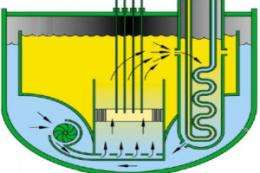
Scientists from The University of Manchester have been selected to undertake vital safety work on the next generation of the world’s nuclear reactors.
As part of a consortium of EU research institutes and universities, academics from the University’s Dalton Nuclear Institute will carry out research on evolutionary designs of nuclear reactors called Generation IV.
The 1mEuro project is called SARGEN IV, which stands for 'Safety Assessment of Reactors of Generation IV'. The money has been provided from the EC Euratom Framework Program.
The outcome of the University of Manchester research will be key in defining the future EU research agenda for the successful implementation of this advanced technology.
Generation IV reactors are evolutionary in design and so will be able to ‘burn’ plutonium created from the spent fuel from pressurised water reactors (PWR).
This will allow them to improve the efficiency of the fuel cycle and form an option for the UK when its expected new fleet of PWRs has been built and is operational – forecast to be in about 2040.
Being evolutionary, they will be the state-of-the-art in design and types of materials used and will have a high level of nuclear safety.
The safety claims will need assessing before their deployment and the objective of this project is to identify what the critical issues might be, to develop a roadmap for necessary research to address them and assist with the development of a safety assessment approach for the licensing of these new designs of reactor.
The consortium is led by IRSN, the French Technical Support Organization and has all the key European players involved in Gen IV reactor research.
Professor Peter Storey, from the Dalton Nuclear Institute, will lead the development of a roadmap for FAST reactor safety R&D and, with Dr. Tim Ware from the School of Physics and Astronomy, will be involved in identifying safety features of Gen IV reactors, identifying accident initiators and disseminating findings of the project.
Professor Storey said: “Involvement in this prestigious EC funded project on advanced nuclear reactors is of strategic importance to the Dalton Nuclear Institute.
“It builds on our involvement in two other European projects in this area, draws upon our high expertise in reactor technology and nuclear safety and involves the Institute in helping set the agenda for ground breaking research."
The project will start in early 2012 and last for two years. It will build upon other EC funded Gen IV projects that the University is already involved in and will act as a key step in engaging specialist expertise within the Centre for Nuclear Energy Technology (C-NET) in European projects that will grow as interest in advanced systems also grows.
Provided by University of Manchester


