Cheaper and cleaner electricity from wave-powered ships (w/ video)
July 20, 2011 by Deborah Braconnier report

Cheaper and cleaner electricity from wave-powered ships

Enlarge

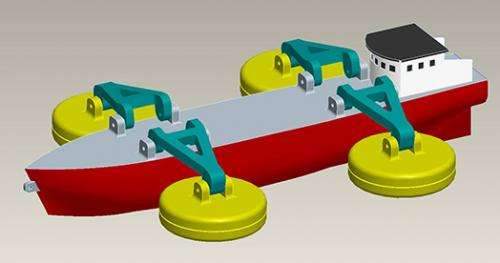
(PhysOrg.com) -- At the Clean Technology 2011 Conference and Expo in Boston, Andre Sharon presented a new concept of using ships equipped with a wave-power system to harvest energy and deliver it back to a power grid on shore.

Traditional wave-power systems are permanently located out in the middle of the ocean and send power back to the via undersea cables which typically cost $500,000 per kilometer. This new concept would eliminate the need for these costly cables and greatly reduce the cost.

The proposed ship would be 50 meters long and is designed to harvest the through a system of buoys hanging from pivoting arms on the side of the ship. The would bob up and down with the movement of the waves and cause the pivoting arms to drive a generator and create one megawatt of electrical power an hour. The power will be stored in an on-board battery with a capacity of 20 megawatts. The ship will be required to be out at sea for at least 20 hours in order to provide a full charge.

This video is not supported by your browser at this time.

Unlike fixed wave-power devices that must be built to withstand high waves and severe storms, these ships would be able to return to shore if conditions at sea were to become extreme. Sharon says this system could be constructed on already existing ships to further reduce costs.

Sharon, from Boston University and the Fraunhofer Center for Manufacturing Innovation, used 3D printing to create a prototype and demonstrated it in a wave tank. Current wave-power systems can generate electricity at a cost of between $0.30 and $0.65 per kWh, but Sharon calculates that the wave-power ships would be able to generate power for $0.15 per kWh which is comparable to offshore wind energy and cheaper than solar power.

More information: Project page

© 2010 PhysOrg.com

4.6 /5 (11 votes)  

Filter


Move the slider to adjust rank threshold, so that you can hide some of the comments.


Display comments: newest first

xznofile
Jul 20, 2011

Rank: 3.5 / 5 (2)
how about powering the ship with it instead?
Etreum
Jul 20, 2011

Rank: 5 / 5 (5)
how about powering the ship with it instead?

They have been using wind to power ships for a very long time...
LKD
Jul 20, 2011

Rank: not rated yet
how about powering the ship with it instead?


Because of the extra potential energy the vessel would need more power to perform the same function and would be less efficient, requiring more diesel or nuclear to operate than normal.
mertzj
Jul 20, 2011

Rank: 3.3 / 5 (4)
Ignorant idea. Enough said.
Scottingham
Jul 20, 2011

Rank: 4 / 5 (4)
Sounds like it needs a breakthrough in battery tech to be feasible, just like most renewable energy.
mertzj
Jul 20, 2011

Rank: 3 / 5 (4)
Seriously? How about we just do away with the power grid? The power company should just buy trucks full of batteries and deliver everyone's power while they are at it.
antonima
Jul 20, 2011

Rank: 5 / 5 (2)
why bother with a ship? I'd just use a towable raft. Also, the price of marine power cables seems like it couldn't be that high, but I have no real knowledge of this.
tarheelchief
Jul 20, 2011

Rank: 1 / 5 (1)
There are numerous and varied methods of capturing the power of waves.I thought it might be feasible to put a series of verticle pipes offshore which would take in water and then use the weight of the water to drive underwater turbines as they do at Hoover Dam.
Trim
Jul 20, 2011

Rank: not rated yet
NASA is known to be working on power beams both laser and microwave, couldn't a power ships with a beamers on top of a high mast transfer power to a receiver ship stationed close to shore which would have a much shorter cable or if the coast had a low population straight on to the shore?
Ozz
Jul 20, 2011

Rank: 5 / 5 (1)
Everytime these articles give estimated costs I question where they get the numbers. In studies of alternative energies by the U.S. Government the numbers related to the grid and Kwh costs as well as other numbers come from the commerical utilities. My experience with numbers comming out of the current utilities is that the numbers are more about profits than basic empirical numbers. The numbers include costs and what they consider they need for profits. This is not science this is about protecting their business and they like things the way they are.
socean
Jul 20, 2011

Rank: 3.5 / 5 (2)
how about powering the ship with it instead?


Because of the extra potential energy the vessel would need more power to perform the same function and would be less efficient, requiring more diesel or nuclear to operate than normal.


Say whaaaat? That makes no sense. If they can store 20 MW of power they can certainly cruise around for a while. The only question is, how often do you want to stop to recharge. If you have a lot of time, you could sail the world for free, even without the wind blowing.

Its a good idea.

As far as the battery goes, you could split water instead and come home with a tanker full of hydrogen.

dan42day
Jul 21, 2011

Rank: 5 / 5 (1)


Say whaaaat? That makes no sense. If they can store 20 MW of power they can certainly cruise around for a while. The only question is, how often do you want to stop to recharge. If you have a lot of time, you could sail the world for free, even without the wind blowing.


Well it says it can collect it's full capacity of 20mwh in 20 hours. So how far can a 150 ft ship full of batteries get on 1341 hp in 20 hours? Or 2682 hp in 10 hours?
meszigues
Jul 21, 2011

Rank: not rated yet
[i]and create one megawatt of electrical power an hour. The power will be stored in an on-board battery with a capacity of 20 megawatts.[/i]
Poor knowledge of basic electric units.
88HUX88
Jul 21, 2011

Rank: not rated yet
http://www.ledsma...ly202011
and let's waste lots of it in lighting
antialias_physorg
Jul 21, 2011

Rank: not rated yet
As far as the battery goes, you could split water instead and come home with a tanker full of hydrogen.

My thoughts exactly.

But it's an interesting concept that could be easily tested. They should outfit a pilot craft and see how it goes.
Sin_Amos
Jul 21, 2011

Rank: 5 / 5 (1)
"As far as the battery goes, you could split water instead and come home with a tanker full of hydrogen."---Perfect.

This works. The boat just has to float once it is out at sea. The waves create the energy. This is too easy. Then they use a small amount of their energy to go back to shore where the hydrogen can be deposited. This makes perfect sense. I also like the idea of adding sails to these ships. Why not use wind power to generate thrust and then use the technology to collect the energy of motion caused by the ships BOBBERS. Bring on the BOBBERS!
Sin_Amos
Jul 21, 2011

Rank: 5 / 5 (1)
On average, ocean water has a salinity of 35 parts salt to 1000 parts sea water. The higher the salinity of sea water is, the better a conductor it makes. Assuming ideal faradaic efficiency, the amount of hydrogen generated is twice the number of moles of oxygen, and both are proportional to the total electrical charge conducted by the solution. Wowzer! I just solved the energy crisis. I wish someone with money would take these connections and make them happen. By using the seawater itself as a highly conductive agent, the process of electrolysis would become even more efficient.
Vlasev
Jul 21, 2011

Rank: not rated yet
Hydrogen?!
Take a look at this http://www.physor...285.html (hydrogen storage problems are not even considered in this article, and these are big issue on their own)

Otherwise the idea looks bad enough. Wind turbines, producing more electricity are common these days and they should be far cheaper to build and operate than crewed ship. Project like that may be reasonable if it can scale well above 20MW/h production. This way one ship will be comparable with few wind turbines, but I'm sure it's not feasible otherwise authors would put something like that as in-theory showcase.
LKD
Jul 21, 2011

Rank: 4 / 5 (1)
Say whaaaat? That makes no sense.


If you add that much weight to a ship, basically doubling its mass, you will not get reduced fuel costs, you'll get a far far far less efficient ship.

It's akin to modern cars. The old 80's Civic got 60mpg, the Prius gets 45. They would be getting much better gas if they didn't have batteries, AC, Nav systems, sextuplet air bags, masive safety frames, etc...

It is exponentially more costly to move the larger the weight. Basic physics. Efficiency is still mastered by simplicity.
Eikka
Jul 21, 2011

Rank: 5 / 5 (1)
Wowzer! I just solved the energy crisis. I wish someone with money would take these connections and make them happen. By using the seawater itself as a highly conductive agent, the process of electrolysis would become even more efficient.


Next you have to invent how to stop the salt from clogging up the electrolysis cells.

Electrolysis is done on desalinated water for a good reason. One of them is the fact that salt breaks up into sodium hydroxide and chlorine gas under electrolysis. Even if you can avoid that, the salt concentration in the cell would rise until it crystallizes out of solution and blocks the cell.
antialias_physorg
Jul 21, 2011

Rank: 5 / 5 (2)
Hydrogen?!
Take a look at this http://www.physor...285.html (hydrogen storage problems are not even considered in this article, and these are big issue on their own)

Considering that the end-to-end usable percentage of energy from oil is much worse hydrogen is looking pretty good by comparison.

But basically Bossel is missing the point: Storage is important in some cases. Hydrogen delivers that - energy from the grid doesn't. If we stick with Lithiom-Ion batteries then we'll run into massive material shortages if we want to switch over to a battery-economy.
Hydrogen and batteries can very well complement each other.

A ship full of hydrogen tanks will also be massively cheaper than a ship full of batteries - and also will have no problem with the batteries needing replacement every now and then.

Vlasev
Jul 21, 2011

Rank: not rated yet

Considering that the end-to-end usable percentage of energy from oil is much worse hydrogen is looking pretty good by comparison.


You are trying to compare hydrogen energy transport efficiency with utilized energy from natural resource (oil) and it makes no sense to me. Compare using hydrogen and batteries for energy transport instead.


A ship full of hydrogen tanks will also be massively cheaper than a ship full of batteries - and also will have no problem with the batteries needing replacement...


Storing hydrogen is not an easy nor cheap task. Hydrogen goes right trough the walls of it's physical storage shortening it's life span. It uses both high pressure and low temperature to store the hydrogen. Providing these will further reduce the efficiency of the energy transport.
Chemical storage systems are even less useful for what I know.

Compressed air energy storage will be a lot more efficient and cheaper to build.
Sin_Amos
Jul 21, 2011

Rank: not rated yet
"Next you have to invent how to stop the salt from clogging up the electrolysis cells. "

Because you can't design a cell that reduces that problem. Stop with the can't and start with the will. You need will to solve problems. The people that say no never accomplish anything.
J-n
Jul 21, 2011

Rank: not rated yet
Because you can't design a cell that reduces that problem. Stop with the can't and start with the will. You need will to solve problems. The people that say no never accomplish anything.


I Agree that an idea could probally be come up with to solve the problem of salt clogging the electrolysis cells. Infact i'm sure there are a variety of solutions that would be easy and cheap. I dont know what they are though.

I VERY MUCH disagree, though, that it is incumbent on every person who disagrees or finds fault with a subject to be the person who attempts to fix it.

It is just as easy (often eaiser) to solve a problem that is pointed out to you, than a problem you notice yourself.

For instance, instead of yelling at that poster saying he should come up with the solution, instead of point out the problem, you could have yourself suggested something like using solar collectors to evaporate the water, condensing it again, then using electrolysis to seperate out the hydrogen.
J-n
Jul 21, 2011

Rank: not rated yet
Please note, that this is no where near my area of expertise or primary interest, so my idea above may not be fesiable, workable, efficent or physically possible, and is was really only suggested as an example.

I hope you understand my point. :)
NeilBlanchard
Jul 23, 2011

Rank: not rated yet
The yellow floats need to be shaped like boat hulls or outriggers, otherwise they will cause drag.

There are already several companies that make wave power machines: either arrays of buoys with magnets and coiled wire or long segmented tubes that flex at the hinges that pump hydraulic generators.

Neil
antialias_physorg
Jul 23, 2011

Rank: not rated yet
The yellow floats need to be shaped like boat hulls or outriggers, otherwise they will cause drag.

Since the boat will be stationary while producing energy that won't be much of a problem (and during movement from/to port I expect the floats will be raised.

Infact i'm sure there are a variety of solutions that would be easy and cheap. I dont know what they are though.

That's the sort of unqualified statement I really don't like. If you have no clue then don't say it's cheap (or has even been developed yet). Do some research (or at least google it). If you find something then argue the case. If you find nothing then don't argue the case. But argument from ignorance isn't any good to anybody.
Newbeak
Jul 23, 2011

Rank: not rated yet
Besides storage issues,I read somewhere H2 produced from hydrolyzing water is only about 50-80% efficient.The Aussies are selling a battery that might be just the ticket for wave-power ships: http://www.redflo...low_Home
Subach
Jul 24, 2011

Rank: not rated yet
Assuming they mean the thing average one MWH per hour and stores 20 MWH you would need 1,000 of these ships to match the power produced by one large power plant...
Newbeak
Jul 24, 2011

Rank: not rated yet
Assuming they mean the thing average one MWH per hour and stores 20 MWH you would need 1,000 of these ships to match the power produced by one large power plant...

I hope the storage capacity can be expanded beyond 20MW.They don't indicate what type of batteries are being considered,so higher capacity cells should bump up the storage ability.
sender
Jul 24, 2011

Rank: not rated yet
Superconductor cabling and klystrons should add some extra potential, also needs tethered kites or balloons.
Bob_Wallace
Jul 24, 2011

Rank: not rated yet
Let's see...

In order to avoid the cost of a cable from the grid out past the breakers they want to build a ship, power it, provide a crew, fill it with batteries, and cruise out a ways, drop anchor and wait for the batteries to fill. Then they're going to cast off, cruise back into port, feed the stored power into the grid, fuel up, and head back out again.

Much higher capital expense for things like the ship's engine, labor costs, fuel costs, power loss in charging batteries when they could just moor a wave-harvesting barge off the beach and wire it up. Remember, the most wave action (most power to be harvested) is close to the beach, when the water goes shallow.

That makes (no damn) sense.

(Is the site editor on vacation and the 17-year-old intern running things?)
Newbeak
Jul 24, 2011

Rank: not rated yet
Let's see...

In order to avoid the cost of a cable from the grid out past the breakers they want to build a ship, power it, provide a crew, fill it with batteries, and cruise out a ways, drop anchor and wait for the batteries to fill.


Yes,at the end of the day,this seems to make the most sense.The ship only has to cruise out a short distance,drop anchor,connect to a relatively short cable,and send power 24/7 to the grid.If the weather turns ugly,said ship can disconnect,and return to port.The only unknown is how feasible it would be to connect/disconnect from the undersea cable as needed.
antialias_physorg
Jul 26, 2011

Rank: not rated yet
In order to avoid the cost of a cable from the grid out past the breakers they want to build a ship, power it, provide a crew, fill it with batteries, and cruise out a ways, drop anchor and wait for the batteries to fill. Then they're going to cast off, cruise back into port, feed the stored power into the grid, fuel up, and head back out again.


A) Such a ship would need no crew. It would be perfectly possible to have this type of ship navigate to its destination via GPS (and possibly just hop a crew out to it for the last mile to port)
B)You'd need no fuel. Such a ship could be powerd via electric motors feeding from the batteries.

Laying underwater cables is expensive stuff. Plus: Having batteries means you can feed to the grid when the power is needed. Having the ship on a tether means you can only feed to the grid when the power is being produced. I can see where it would be preferrable to accumulate during the night and feed in during the day instead of feeding in 24/7.
Newbeak
Jul 26, 2011

Rank: not rated yet


Laying underwater cables is expensive stuff. Plus: Having batteries means you can feed to the grid when the power is needed. Having the ship on a tether means you can only feed to the grid when the power is being produced. I can see where it would be preferrable to accumulate during the night and feed in during the day instead of feeding in 24/7

Okay,how about running a cable to the anchoring site,and the ship can stay on station until it has to return to shore because of bad weather or whatever.Put your batteries on shore,where the cable would constantly charge them,and they could back up the grid as needed.The cable run would only have to be 5-10 miles.
Rank 4.6 /5 (11 votes)
Relevant PhysicsForums posts

More news stories

Browser wars flare in mobile space

The browser wars are heating up again, but this time the fight is for dominance of the mobile Internet.

Technology / Software

created 3 hours ago | popularity 5 / 5 (1) | comments 2

Probability of contamination from severe nuclear reactor accidents is higher than expected: study

Catastrophic nuclear accidents such as the core meltdowns in Chernobyl and Fukushima are more likely to happen than previously assumed. Based on the operating hours of all civil nuclear reactors and the number ...

Technology / Energy & Green Tech

created May 22, 2012 | popularity 3.6 / 5 (21) | comments 56 | with audio podcast

SpotterRF debuts Radar Backpack Kit (w/ Video)

(Phys.org) -- SpotterRF has announced a special radar backpack kit designed to enhance situational awareness for soldiers on the ground. The company says its special radar is designed for warfighters as part ...

Technology / Hi Tech & Innovation

created May 26, 2012 | popularity 5 / 5 (5) | comments 12 | with audio podcast report

HyperSolar shows dirty water no barrier to power world

(Phys.org) -- The Santa Barbara, California, company, HyperSolar, is set to transparently share the ups and downs of its research experiences toward the company’s ultimate vision, successfully producing ...

Technology / Energy & Green Tech

created May 24, 2012 | popularity 4.8 / 5 (15) | comments 17 | with audio podcast report

Tesla to launch electric sedan in US on June 22

Tesla Motors said Tuesday it would begin deliveries of "the world's first premium electric sedan" on June 22, slightly ahead of schedule.

Technology / Energy & Green Tech

created May 22, 2012 | popularity 4.5 / 5 (11) | comments 18


Nvidia trumpets Tegra 3 phone design wins for 2012

(Phys.org) -- Nvidia’s competitive war paint has a name, Tegra 3. On the heels of Nvidia announcements about lowering costs of its Tegra 3 processors and Nvidia-enabled tablets running Android Ice Cream ...

Scientist: Evolution debate will soon be history

(AP) -- Richard Leakey predicts skepticism over evolution will soon be history. Not that the avowed atheist has any doubts himself.

Dell tablet leak: 10.1-inch display, two-battery choice

(Phys.org) -- Headline after headline talks about vendors’ tablets in the wings as likely number-one contenders for the iPad. Such claims have justifiably been taken with a grain of salt, considering ...

Keep food safety in mind this memorial day weekend

(HealthDay) -- Picnics, parades and cookouts are as much a part of Memorial Day weekend as tributes to the United States' war veterans.

Family history of Alzheimer's affects functional connectivity

(HealthDay) -- Cognitively normal individuals with a family history of late-onset Alzheimer's disease (AD) may display lower resting state functional connectivity in the default mode network (DMN) of the brain, ...

Social welfare cuts ultimately come with heavy price, researchers say

(Phys.org) -- Slashing government funding for Medicaid, food stamps and other programs that serve the poor – while politically popular with some lawmakers and many conservatives – may do more harm ...