Short rotation energy crops could help meet UK's renewable energy targets
April 1, 2011

Short rotation energy crops could help meet UK's renewable energy targets

Enlarge

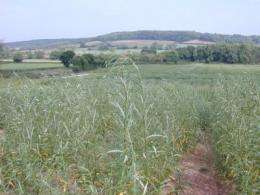
This image shows a field of coppiced willow trees being grown in England as an energy crop. Credit: University of Southampton

Planting short rotation energy crops on England's unused agricultural land could produce enough biomass to meet renewable energy targets without disrupting the food industry or the environment, according to research led by Professor Gail Taylor from the University of Southampton.

The study, funded by the UK Energy Research Centre (UKERC), is a rare investigation into energy crop supply which looks at the potential of planting short rotation coppice (poplar and willow) in England, taking into account social, economic and environmental constraints. It found that with efficient land use, England is able to produce enough biomass to generate approximately four per cent of current UK , without compromising environmental sustainability or food production.

UKERC researcher and co-author Gail Taylor, Professor of Plant Biology from the University of Southampton, said: "This study shows that bioenergy crops can be grown sustainably in parts of England, with no detrimental impact on or other ecosystem services. Our current work is taking this approach further to determine how future climate scenarios will influence biomass supply."

The UK is committed to meeting 15 per cent of all energy and 30 per cent electricity demand via by 2020 and bioenergy is expected to play an important role in this. Dedicated energy crops are currently only responsible for less than 0.1 per cent of the UK electricity but growing demand has led to conflicts with food production, attributing to the rising cost of food, and ecosystem services.

Studies suggest that converting crops to electrical energy is largely beneficial in reducing Green House Gas (GHG) emissions, relative to fossil fuel. However, crops should generally not displace forest or semi-natural land.

The UKERC research, published in Biofuels, states that new technology will enable biofuels to be made from 'lignocellulosic' crops (e.g. short rotation coppice willow and poplar), which, unlike current 'cellulosic' crops (typically derived from food crops such as wheat and maize) is able grow on poor quality agricultural land.

To estimate the country's supply of biomass from short rotation coppice, UKERC researchers, led by Professor Taylor, developed scenarios where should only be planted where they:

  • Do not impact on ecosystem services;
  • Do not conflict with food production;
  • Return a profit;
  • Do not displace alternative land uses that offer greater (GHG) savings.
Excluding restricted and semi-restricted land, 46 land designations were identified and assessed using Geographic Information Software (GIS) and spatially referenced classification (ACL) grades. ALC is based on a number of criteria, including climate (temperature, rainfall, frost risk etc), site (gradient, micro-relief and flood-risk), and soil (depth, structure, texture, chemicals and stoniness). It is classified by five grades; one being the highest and five being the poorest quality.

The results suggest that whilst over 39 per cent of land in England cannot be planted with short rotation due to agronomic or legislative restrictions, marginal land (ALC grades 4 and 5) is realistically available to produce 7.5 million tons of biomass. This would be enough to generate approximately four per cent of current UK electricity demand and approximately 1 per cent of energy demand.

The South West and North West were identified as two areas with the most potential to produce over one third of this figure, owing to their large areas of poor grade land.

Provided by University of Southampton search and more info website


Rank 5 /5 (2 votes)
Relevant PhysicsForums posts

More news stories

Browser wars flare in mobile space

The browser wars are heating up again, but this time the fight is for dominance of the mobile Internet.

Technology / Software

created 32 minutes ago | popularity not rated yet | comments 0

SpotterRF debuts Radar Backpack Kit (w/ Video)

(Phys.org) -- SpotterRF has announced a special radar backpack kit designed to enhance situational awareness for soldiers on the ground. The company says its special radar is designed for warfighters as part ...

Technology / Hi Tech & Innovation

created 21 hours ago | popularity 5 / 5 (5) | comments 12 | with audio podcast report

Computers excel at identifying smiles of frustration (w/ Video)

(Phys.org) -- Researchers at the Massachusetts Institute of Technology (MIT) in the US have trained computers to recognize smiles, and they have turned out to be more adept at recognizing smiles of frustration ...

Technology / Computer Sciences

created May 25, 2012 | popularity 4.3 / 5 (3) | comments 1 | with audio podcast report

HyperSolar shows dirty water no barrier to power world

(Phys.org) -- The Santa Barbara, California, company, HyperSolar, is set to transparently share the ups and downs of its research experiences toward the company’s ultimate vision, successfully producing ...

Technology / Energy & Green Tech

created May 24, 2012 | popularity 4.8 / 5 (15) | comments 17 | with audio podcast report

New inexpensive, environmentally friendly solar cell shines with potential

(Phys.org) -- The limitations of conventional and current solar cells include high production cost, low operating efficiency and durability, and many cells rely on toxic and scarce materials. Northwestern University researchers ...

Technology / Energy & Green Tech

created May 23, 2012 | popularity 4.8 / 5 (12) | comments 4 | with audio podcast


Nvidia trumpets Tegra 3 phone design wins for 2012

(Phys.org) -- Nvidia’s competitive war paint has a name, Tegra 3. On the heels of Nvidia announcements about lowering costs of its Tegra 3 processors and Nvidia-enabled tablets running Android Ice Cream ...

Dell tablet leak: 10.1-inch display, two-battery choice

(Phys.org) -- Headline after headline talks about vendors’ tablets in the wings as likely number-one contenders for the iPad. Such claims have justifiably been taken with a grain of salt, considering ...

Scientist: Evolution debate will soon be history

(AP) -- Richard Leakey predicts skepticism over evolution will soon be history. Not that the avowed atheist has any doubts himself.

SpaceX capsule has 'new car' smell, astronauts say (Update)

SpaceX's Dragon cargo vessel smells like a new car, said astronauts at the International Space Station after opening the hatches Saturday following the spacecraft's landmark mission to the orbiting lab.

Of mice and mental models: Neuroscientific implications of risk-optimized behavior in the mouse

(Medical Xpress) -- Regardless of an organism’s biological complexity, every encephalized animal continuously makes under-informed behavioral choices that can have serious consequences. Despite its ubiquity, ...

Is a classical electrodynamics law incompatible with special relativity?

(Phys.org) -- The laws of classical electromagnetism that were developed in the 19th century are the same laws that scientists use today. They include Maxwell’s four equations along with the Lorentz la ...