In the wake of the wind
April 26, 2011 by Anne M Stark

In the wake of the wind

Enlarge

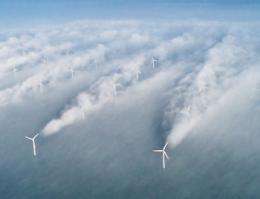
Normally invisible, wind wakes take shape in the clouds behind the Horns Rev offshore wind farm west of Denmark. Photo courtesy of Vattenfall.

On the Front Range within the Rocky Mountains, prevailing winds sweep eastward over the mountains smack into the National Wind Technology Center.

Several , some taller than a 40-story building, spin and hum at the site, just outside of Boulder, Colo., waiting for an experiment to start in the next month.

The turbines not only produce power, they produce wakes – similar to what forms in bodies of water – that are invisible ripples and waves and other disturbances in the atmosphere downstream that can damage turbines and decrease efficiency. Lawrence Livermore National Laboratory researchers and collaborators will launch a study of those wakes this month, with an eye toward improving the efficiency of wind farms.

The scientists also will collect valuable data that will help validate the wind flow models developed at Livermore and other laboratories and universities

"This study is part of a larger suite of observational and model development efforts under way at LLNL to help attain aggressive state and national targets for renewable energy deployment," said Jeff Mirocha of LLNL. "This field campaign dovetails with ongoing observational studies at our Site 300 that are focused on understanding the complex wind patterns occurring in hilly, coastally influenced locations, which is similar to much of California's wind resource."

Livermore is working with the University of Colorado, National Oceanic and Atmospheric Administration (NOAA) and the National Renewable Energy Laboratory (NREL).

The Laboratory also has been working on numerical weather prediction models to predict power generated by the wind, so that wind farms can operate more efficiently while providing more power to the nation's hungry power grids. Predictive time frames range from an hour ahead to days ahead of time.

The new project entails experiments that will help make a detailed study of wakes created by wind turbines. Those profiles could help turbine and wind farm developers improve layout and design.

"The wakes can damage turbines and affect turbine efficiency," said Julie Lundquist, a University of Colorado assistant professor who helped develop the models while at LLNL.

The study is aimed at an improved understanding and characterization of inflow conditions on turbines in complex terrain that would help engineers better understand, model, and design for turbine loading, turbine performance and power plant performance. The goal is to integrate advanced observational capabilities with innovative approaches to atmospheric simulation.

Researchers will collect meteorological data for validation of turbine wake models in a range of atmospheric stability conditions, including wind speed, wind direction and streamwise variance profiles.
In the wake of the wind
Enlarge

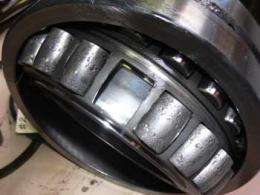
A damaged bearing from a wind turbine gearbox. Photo courtesy NREL.

Bob Banta, atmospheric scientist with NOAA's Earth System Research Laboratory, has spent the last several years using a sophisticated instrument – a high-resolution, scanning dopplar lidar – to make three-dimensional portraits of wind speeds and directions in the atmosphere. For the wind technology site project, the research team aims to capture turbulence and other wake effects in a broad wedge of air up to 7 km (4.3 miles) long and 1 km (3,280 feet) high.

The team will use the scanning lidar to make a detailed look at the atmosphere in front of and behind one of the large turbines on the NREL site: a 2.3-megawatt tower that stretches 100 m (328 ft) high to the central hub and 145 m (492 feet) to the top of a blade.

The researchers hope to capture the effects of ramp up and ramp down events, when winds suddenly gust high or die down, and they will gather data on what happens downstream when winds shift direction quickly.

"This generation of wind turbines is stretching up into a complicated part of the atmosphere," Lundquist said. "If we can understand how gusts and rapid changes in wind direction affect turbine operations and how turbine wakes behave, we can improve design standards, increase efficiency, and reduce the cost of energy,"

According to the American Wind Energy Associations, wind energy made up 2.3 percent of U.S. electricity by the end of 2010, up from 1.8 percent a year ago. Researchers have argued that to attain the Department of Energy goal of "20 percent by 2030," the turbulent lower atmosphere – and its effects on turbines and turbine arrays – must be better understood.

Provided by Lawrence Livermore National Laboratory search and more info website

4.8 /5 (6 votes)  

Filter


Move the slider to adjust rank threshold, so that you can hide some of the comments.


Display comments: newest first

Shootist
Apr 26, 2011

Rank: 1 / 5 (4)
Collectivist jibber jabber continues.

Wind is, and will always remain, too brittle for useful generation.

100 1GW fission plants will allow North America to tell the mideast to drink its oil.
x646d63
Apr 26, 2011

Rank: 5 / 5 (1)
100 1GW fission plants will allow North America to tell the mideast to drink its oil.


Yes, because you can make plastic from Cesium and Strontium, right?
CapitalismPrevails
Apr 26, 2011

Rank: 1 / 5 (1)
100 1GW fission plants will allow North America to tell the mideast to drink its oil.


Yes, because you can make plastic from Cesium and Strontium, right?


Yes, and fertilizers, pharmaceuticals, herbicides, paints, cosmetics, etc.
kcameron
Apr 26, 2011

Rank: not rated yet
The ignorance! It burns!!!

We don't generate electricity from oil.
group0
Apr 26, 2011

Rank: not rated yet
The ignorance! It burns!!!

We don't generate electricity from oil.


Easy kcameron or you'll turn yourself into a crispy critter. Grab a pillow, place on face and scream until you can no longer do so. Smile and accept the fact that ignorance for some is a way of life.

Oh, about the article, if they also measure vibration and couple that data to the LIDAR data, I suspect new designs for blades and gearboxes will emerge.
NotParker
Apr 26, 2011

Rank: 1 / 5 (1)
Yes, because you can make plastic from Cesium and Strontium, right?


Natural Gas is plentiful in the USA thanks to Shale Gas. NG makes an excellent inexpensive feedstock for the platics industry.

http://www.fibre2...id=98029
Alexander_Herrmann
Apr 26, 2011

Rank: 1 / 5 (1)
Looking more at the picture then the article you looks like lining up the turbines isnt such a good idea. The ones behind sure get vibrations from the turbines in front reducing there life span and efficiency.
NotParker
Apr 26, 2011

Rank: 1 / 5 (1)
The USA generated 1% of its electricity in 2009 from oil. I suspect it is even less in 2011.

http://www.eia.do...d_states

Alexander_Herrmann
Apr 26, 2011

Rank: not rated yet
So how many % of the oil is the US burning in there cars?
Skeptic_Heretic
Apr 27, 2011

Rank: not rated yet
The USA generated 1% of its electricity in 2009 from oil. I suspect it is even less in 2011.

http://www.eia.do...d_states
US fertilized 80% of its crops using petrochemical fertilizers. The problem in energy generation is coal. The issues with oil reside in how it is used in almost all aspects of our society, not primarily in energy generation.
NotParker
Apr 28, 2011

Rank: 1 / 5 (1)
US fertilized 80% of its crops using petrochemical fertilizers.


Hurrah. Starvation sucks! Hurrah for Fertilizer. Hurrah for Oil!

http://hubpages.c...n-Growth
kaasinees
Apr 28, 2011

Rank: 1 / 5 (1)
100 1GW fission plants will allow North America to tell the mideast to drink its oil.


Yes, because you can make plastic from Cesium and Strontium, right?

We can make plastic from other materials like chicken feathers, other oils that arent fossil.
Theres nothing wrong with processing fossil oils into products.
The problem is using it as fuel, burning it and releasing it into the environment in an uncontrolled matter.
Products can be made highly recyclable/reusable, when burning not so much.

Personally i am against any energy productivity that uses fuel, that includes nuclear, UNLESS this fuel is used in an enclosed ecosystem.
Rank 4.8 /5 (6 votes)
Relevant PhysicsForums posts

More news stories

SpotterRF debuts Radar Backpack Kit (w/ Video)

(Phys.org) -- SpotterRF has announced a special radar backpack kit designed to enhance situational awareness for soldiers on the ground. The company says its special radar is designed for warfighters as part ...

Technology / Hi Tech & Innovation

created 20 hours ago | popularity 5 / 5 (5) | comments 12 | with audio podcast report

Probability of contamination from severe nuclear reactor accidents is higher than expected: study

Catastrophic nuclear accidents such as the core meltdowns in Chernobyl and Fukushima are more likely to happen than previously assumed. Based on the operating hours of all civil nuclear reactors and the number ...

Technology / Energy & Green Tech

created May 22, 2012 | popularity 3.6 / 5 (21) | comments 56 | with audio podcast

Delphi gasoline-injection engine technique rivals hybrid's edge

(Phys.org) -- Running a diesel like engine on gasoline is something Delphi is doing in notable fashion. They claim they are on to a promising way to enjoy an engine that gives the vehicle owner high efficiency ...

Technology / Energy & Green Tech

created May 21, 2012 | popularity 4.7 / 5 (18) | comments 37 | with audio podcast report

HyperSolar shows dirty water no barrier to power world

(Phys.org) -- The Santa Barbara, California, company, HyperSolar, is set to transparently share the ups and downs of its research experiences toward the company’s ultimate vision, successfully producing ...

Technology / Energy & Green Tech

created May 24, 2012 | popularity 4.8 / 5 (15) | comments 17 | with audio podcast report

Tesla to launch electric sedan in US on June 22

Tesla Motors said Tuesday it would begin deliveries of "the world's first premium electric sedan" on June 22, slightly ahead of schedule.

Technology / Energy & Green Tech

created May 22, 2012 | popularity 4.5 / 5 (11) | comments 18


Scientist: Evolution debate will soon be history

(AP) -- Richard Leakey predicts skepticism over evolution will soon be history. Not that the avowed atheist has any doubts himself.

Dell tablet leak: 10.1-inch display, two-battery choice

(Phys.org) -- Headline after headline talks about vendors’ tablets in the wings as likely number-one contenders for the iPad. Such claims have justifiably been taken with a grain of salt, considering ...

SpaceX capsule has 'new car' smell, astronauts say (Update)

SpaceX's Dragon cargo vessel smells like a new car, said astronauts at the International Space Station after opening the hatches Saturday following the spacecraft's landmark mission to the orbiting lab.

Thousands of shellfish found dead in Peru

Thousands of crustaceans were found dead off the coast of Lima following the mystery mass death of dolphins and pelicans, the Peruvian Navy said Friday.

Astronomers seize last chance in lifetime for Venus Transit

Astronomers are gearing for one the rarest events in the Solar System: an alignment of Earth, Venus and the Sun that will not be seen for another 105 years.

Australia hails surprise super-telescope decision

Australia has hailed a surprise decision giving it a role in a radio telescope project aimed at revolutionising astronomy, vowing to draw on its decades of experience in space science.