New Si based photovoltaic cells may be the light of the future
February 10, 2011 by Katie Gatto weblog

New Si based photovoltaic cells may be the light of the future

Enlarge

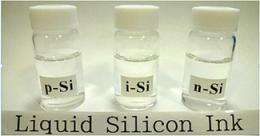
(PhysOrg.com) -- A team of scientists at the Japan Advanced Institute of Science and Technology, or JAIST for short, led by Tatsuya Shimoda, a professor at the JAIST School of Materials Science, has created an amorphous silicon photovoltaic cell by applying a liquid Si.

This world's first inphotovoltaics has a conversion efficiency of 1.79% which, when applied to a pin-type cell whose i-layer was made with the coating process, according to JAIST researchers.

They also have hopes that when the efficiency of the photovoltaic cells improves in the future, it may become possible to mass-produce the Si by using a roll-to-roll method.

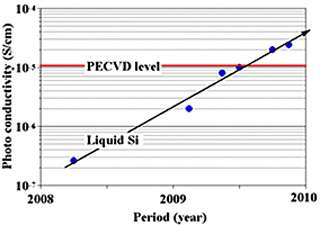
The research group started with cyclopentasilane, a liquid Si, but they did not reveal any further specifics of the liquid Si. We do know that it was developed by emitting at CPS in a carbon hydrogen solvent in order to polymerize part of the CPS to make a polysilane. This Liquid Si was developed during the period between 2006 and 2007.
New Si based photovoltaic cells may be the light of the future
The problem of forming an uniform polysilane film was solved by carefully examining controlled parameters and optimizing the burning conditions of the polysilane film and reduced the density of the unattached hands to 1 x 10¹⁶/cm3.

More details of the development process were not made public. The pin-type amorphous Si PV cells were put on the glass substrate by using a new coating process, which allowed the p- and n-layers to be formed by using the method. The of the cell that has their p-, i- and n-layers formed by using this coating process was 0.51%. This is tempered by the fact that the thickness of the new cell's i-layer is 120nm. This makes them significantly thinner than the amounts found in existing amorphous Si PV cells, which have a thickness of 250nm.

Researchers at JAIST believe that if this thickness is increased the efficiency will improve.

More information: Information in Japanese: http://translate.g … 1/02/10/011/

© 2010 PhysOrg.com

4.5 /5 (2 votes)  

Filter


Move the slider to adjust rank threshold, so that you can hide some of the comments.


Display comments: newest first

that_guy
Feb 10, 2011

Rank: not rated yet
the developers are holding all the least important information hostage.

The fact of the matter is that if one step requires chemical vapor deposition, then you lose a lot of cost savings...and at 2% conversion efficiency, you need a loooooot of cost savings...

It's great that they're trying to save by avoiding crystalline silicon, but at what point do they realize that they ruined every other benefit by going this route?
Rank 4.5 /5 (2 votes)
Relevant PhysicsForums posts

More news stories

SpotterRF debuts Radar Backpack Kit (w/ Video)

(Phys.org) -- SpotterRF has announced a special radar backpack kit designed to enhance situational awareness for soldiers on the ground. The company says its special radar is designed for warfighters as part ...

Technology / Hi Tech & Innovation

created 13 hours ago | popularity 5 / 5 (3) | comments 10 | with audio podcast report

Probability of contamination from severe nuclear reactor accidents is higher than expected: study

Catastrophic nuclear accidents such as the core meltdowns in Chernobyl and Fukushima are more likely to happen than previously assumed. Based on the operating hours of all civil nuclear reactors and the number ...

Technology / Energy & Green Tech

created May 22, 2012 | popularity 3.7 / 5 (20) | comments 50 | with audio podcast

Delphi gasoline-injection engine technique rivals hybrid's edge

(Phys.org) -- Running a diesel like engine on gasoline is something Delphi is doing in notable fashion. They claim they are on to a promising way to enjoy an engine that gives the vehicle owner high efficiency ...

Technology / Energy & Green Tech

created May 21, 2012 | popularity 4.7 / 5 (18) | comments 37 | with audio podcast report

HyperSolar shows dirty water no barrier to power world

(Phys.org) -- The Santa Barbara, California, company, HyperSolar, is set to transparently share the ups and downs of its research experiences toward the company’s ultimate vision, successfully producing ...

Technology / Energy & Green Tech

created May 24, 2012 | popularity 4.8 / 5 (14) | comments 17 | with audio podcast report

Tesla to launch electric sedan in US on June 22

Tesla Motors said Tuesday it would begin deliveries of "the world's first premium electric sedan" on June 22, slightly ahead of schedule.

Technology / Energy & Green Tech

created May 22, 2012 | popularity 4.5 / 5 (11) | comments 18


Dell tablet leak: 10.1-inch display, two-battery choice

(Phys.org) -- Headline after headline talks about vendors’ tablets in the wings as likely number-one contenders for the iPad. Such claims have justifiably been taken with a grain of salt, considering ...

Scientist: Evolution debate will soon be history

(AP) -- Richard Leakey predicts skepticism over evolution will soon be history. Not that the avowed atheist has any doubts himself.

SpaceX capsule has 'new car' smell, astronauts say (Update)

SpaceX's Dragon cargo vessel smells like a new car, said astronauts at the International Space Station after opening the hatches Saturday following the spacecraft's landmark mission to the orbiting lab.

Keep food safety in mind this memorial day weekend

(HealthDay) -- Picnics, parades and cookouts are as much a part of Memorial Day weekend as tributes to the United States' war veterans.

Thousands of shellfish found dead in Peru

Thousands of crustaceans were found dead off the coast of Lima following the mystery mass death of dolphins and pelicans, the Peruvian Navy said Friday.

Australia hails surprise super-telescope decision

Australia has hailed a surprise decision giving it a role in a radio telescope project aimed at revolutionising astronomy, vowing to draw on its decades of experience in space science.