Turning old oil into new mileage
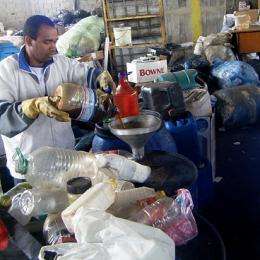
The estimated half-million garbage pickers in Brazil, known as catadores, turn trash into gold: they sort out recyclable items in the country’s dumps, then sell their findings to recycling companies. But the process of getting the recyclables to their final destination involves fleets of fuel-consuming vehicles.
Now — with help from some MIT students — the catadores have a less-expensive and environmentally friendly fuel option: recycled cooking oil.
In summer 2010, members of MIT’s biodiesel team, along with a Media Lab student and one Brazilian MIT student, traveled to Sao Paulo, Brazil, to begin work on the project, called Green Grease. They worked with Rede CataSampa, one of the many catadores cooperatives, to convert two of its large trucks to run directly on filtered vegetable oil.
The team, led by Libby McDonald, a Green Hub Global Program Associate at the Community Innovators Lab in the Department of Urban Studies and Planning, opted to convert the vehicles to use filtered oil — rather than converting the waste oil to biodiesel, as the team does at MIT — because the biodiesel conversion process requires relatively complex machinery and expensive, toxic chemicals. (But, where the facilities are available to convert the fuel, as at MIT, that conversion allows more flexibility since biodiesel can be used in any diesel vehicle, without any modifications. In addition, Brazil's warm temperatures allow for the waste oil to flow properly, without extra heaters that would be needed in northern climates.)
By contrast, the oil-filtration process and vehicle conversions are simple and can make use of many recycled parts that the catadores were able to find or improvise, explains junior Angela Hojnacki, president of the Biodiesel@MIT team and a member of the Green Grease team bringing the technology to Brazil.
The use of filtered vegetable oil provides multiple benefits for the catadores. First, it makes use of waste oil, a pollutant that, if dumped into rivers as tends to happen now, can kill fish and disrupt ecosystems. As a result, Brazil has begun to implement environmental regulations restricting the disposal of waste oil and requiring the installation of grease traps in residential buildings’ plumbing systems. Second, it can drastically reduce, or eventually even eliminate, the fuel costs for the catadores to operate their trucks. Fuel currently accounts for about one-fifth of the trash-pickers cooperatives’ operating costs.
Converting the trucks involved installing a separate, parallel fuel tank and fuel delivery system, along with a set of valves that can be adjusted so the vehicle can operate on either standard diesel fuel or filtered oil, depending on what is available, explains Hojnacki, who majors in mechanical engineering and urban studies and planning. As part of the process, the local catadores found materials such as an old metal street sign that was converted to use as a gasket for the added fuel tank. “We made use of their resourcefulness,” she says.
The Green Grease project won a $3,000 prize in last year’s IDEAS competition, an annual MIT contest for students’ innovative service projects that can help meet the needs of underserved communities. This project is aimed at improving the lives and incomes of the very poor trash pickers, who typically receive only a fraction of the value of the materials they collect because they usually sell to middlemen who earn most of the profits. Reducing or eliminating the transportation costs could make it easier for the cooperatives to deal directly with the recycling companies. Until they converted the trucks, they were selling collected waste oil to biodiesel manufacturers for just 50 cents a gallon — far less than they were paying for fuel to run their trucks.
The people they worked with “were really excited about the technology,” Hojnacki says.
Now that the truck drivers in one cooperative have been trained in how to carry out the vehicle conversions and set up filtration systems, the hope is that “they can convert it into a small business, converting other vehicles and providing the oil,” Hojnacki says, and thus helping to disseminate the technology. On a follow-up visit this year, the team plans to expand the project to five other Brazilian cities, with the help of the catadores they trained in Sao Paulo.
This story is republished courtesy of MIT News (web.mit.edu/newsoffice/), a popular site that covers news about MIT research, innovation and teaching.
Provided by Massachusetts Institute of Technology


