Molten carbonate fuel cells: An alternative and cleaner power supply for ships
January 12, 2011 by Carlo Dambra

Molten Carbonate Fuel Cells: an alternative and cleaner power supply for ships

Enlarge

A new application of Molten Carbonate Fuel Cell (MCFC) has been developed by the European-funded MC WAP research project to be eventually used as an alternative power supply for ships. This will be cleaner and avoid the pollution of the marine diesel engines which currently provide the power in the vast majority of the world's ships.

The research into molten carbonate fuel cells has it origins as early as the 1930s, Emil Baur and H.Preis in Switzerland experimented with high-temperature, solid oxide electrolytes. At the initial stages the research was applicable to both molten carbonate and which are both high-temperature devices. The technical history of both cells seems to follow a similar line of research. A divergence in the development appeared in the late 1950s. From then on, the Molten Carbonate (MCFC) was developed from a purely experimental prototype to today’s practical demonstrator.

Molten carbonate fuel cells demand very high operating temperatures (600°C and above) and most applications for this kind of cell are limited to large, stationary power plants. The envisaged initial application is associated with waste heat, industrial processing, and in steam turbines to generate more electricity.

The MC WAP project has developed a molten carbon fuel cell which uses hydrogen obtained from a system that converts diesel oil into a hydrogen-rich gas, and air coming from the compressor of a microturbine. The reaction produces electricity and heat, without combustion.

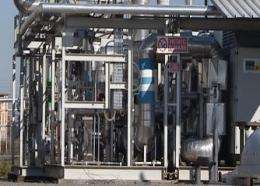
To operate the MCFC on board a ship, researchers of the MC-WAP project have developed two major elements: The Fuel Processor Module and the Fuel Cells Module. The Fuel Cells Module is a chemical plant. It is fed from one side by compressed air and from the other side by a gas called syngas (produced from diesel) by the Fuel Processor Module. This gas is currently being tested in Germany, at the University of Freiberg. The chemical reaction between air and syngas then generates electricity.

The energy produced by the current system, corresponds to about 250 kilowatts, and represents one production unit of reserve energy that can power the essential systems on board, such as the control systems, communication, lighting and main auxiliary systems. Although at this time it will not power the propulsion, it will be able to contribute to it in some cases.

No combustion means fewer greenhouse gas emissions from the many tourist and cargo ships that carry the millions of people and goods around the coasts of Europe and the world. The cleaner ship exhausts are better for the environment and will help the operators to meet the new green legislation.

Cleaning the exhausts involves removing the traces of sulphur and carbon di-oxide that remain after normal combustion, resulting in clean exhaust gases. The system releases virtually no harmful substances: the fuel is transformed into synthetic gas which is then used in the fuel cell, without creating pollution. Furthermore the lack of moving parts in the MCFC will reduce the overall ship vibrations which will result in a more comfortable journey for the passengers.

Provided by Youris.com search and more info website

Filter


Move the slider to adjust rank threshold, so that you can hide some of the comments.


Display comments: newest first

iknow
Jan 12, 2011

Rank: not rated yet
nifty
dag_in_va
Jan 12, 2011

Rank: not rated yet
MCFC power plants are already available commercially in the U.S. and Asia from Fuelcell Energy Inc. Their product integrates the fuel reformer into the fuel cell stack so the waste heat from the cells can drive the (endothermic) reformation reaction which also helps cool the stack. DC efficiency (LHV) is about 50%, 45%-47% net AC. They had an European partner in MTU, but MTU dropped lost interest when they were bought by Tognam. The huge Korean steel conglomerate POSCO is now assembling their own balance of plant into 10s of megawatts of power plants in Asia using FCE cells and stacks. They have mostly run on natural gas or anerobic digester gas, but they've done some work with the U.S. Navy on shipboard units powered by marine diesel.

dag
Rank 4 /5 (2 votes)
Relevant PhysicsForums posts

More news stories

SpotterRF debuts Radar Backpack Kit (w/ Video)

(Phys.org) -- SpotterRF has announced a special radar backpack kit designed to enhance situational awareness for soldiers on the ground. The company says its special radar is designed for warfighters as part ...

Technology / Hi Tech & Innovation

created 8 hours ago | popularity 5 / 5 (2) | comments 7 | with audio podcast report

Yahoo kills 'Livestand' just 6 months after debut

(AP) -- Yahoo is killing a tablet magazine called Livestand just six months its debut on the iPad.

Technology / Business

created 23 hours ago | popularity not rated yet | comments 1

Probability of contamination from severe nuclear reactor accidents is higher than expected: study

Catastrophic nuclear accidents such as the core meltdowns in Chernobyl and Fukushima are more likely to happen than previously assumed. Based on the operating hours of all civil nuclear reactors and the number ...

Technology / Energy & Green Tech

created May 22, 2012 | popularity 3.4 / 5 (17) | comments 49 | with audio podcast

Delphi gasoline-injection engine technique rivals hybrid's edge

(Phys.org) -- Running a diesel like engine on gasoline is something Delphi is doing in notable fashion. They claim they are on to a promising way to enjoy an engine that gives the vehicle owner high efficiency ...

Technology / Energy & Green Tech

created May 21, 2012 | popularity 4.6 / 5 (17) | comments 33 | with audio podcast report

HyperSolar shows dirty water no barrier to power world

(Phys.org) -- The Santa Barbara, California, company, HyperSolar, is set to transparently share the ups and downs of its research experiences toward the company’s ultimate vision, successfully producing ...

Technology / Energy & Green Tech

created May 24, 2012 | popularity 4.8 / 5 (14) | comments 17 | with audio podcast report


Australia hails surprise super-telescope decision

Australia has hailed a surprise decision giving it a role in a radio telescope project aimed at revolutionising astronomy, vowing to draw on its decades of experience in space science.

Astronomers seize last chance in lifetime for Venus Transit

Astronomers are gearing for one the rarest events in the Solar System: an alignment of Earth, Venus and the Sun that will not be seen for another 105 years.

Thousands of shellfish found dead in Peru

Thousands of crustaceans were found dead off the coast of Lima following the mystery mass death of dolphins and pelicans, the Peruvian Navy said Friday.

SpaceX capsule has 'new car' smell, astronauts say

SpaceX's Dragon cargo vessel smells like a new car, said astronauts at the International Space Station after opening the hatches Saturday following the spacecraft's landmark mission to the orbiting lab.

Family history of Alzheimer's affects functional connectivity

(HealthDay) -- Cognitively normal individuals with a family history of late-onset Alzheimer's disease (AD) may display lower resting state functional connectivity in the default mode network (DMN) of the brain, ...

Astronauts enter world's 1st private supply ship

(AP) -- Space station astronauts floated into the Dragon on Saturday, a day after its heralded arrival as the world's first commercial supply ship.