Chinese pigs 'direct descendants' of first domesticated breeds
Apr 19, 2010
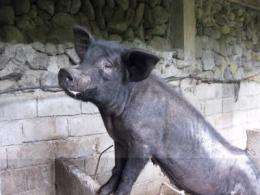
Several species of native wild boar are found in the Philippines, though all domestic pigs, including this one, were originally domesticated in East Asia and introduced by incoming farmers. Credit: Image courtesy of Michael Herrara

Modern-day Chinese pigs are directly descended from ancient pigs which were the first to be domesticated in the region 10,000 years ago, a new archaeological and genetic study has revealed.

An international team of researchers, led by Durham University (UK) and the China Agricultural University, in Beijing, say their findings suggest a difference between patterns of early and movement of in Europe and parts of East Asia.

The research, published today (Monday, April 19) in the USA, looked at the of more than 1,500 modern and 18 ancient pigs.

Lead author Dr Greger Larson, in the Department of Archaeology, at Durham University, said: "Previous studies of European domestic pigs demonstrated that the first pigs in Europe were imported from the Near East. Those first populations were then completely replaced by pigs descended from European wild boar.

"However, despite the occurrence of genetically distinct populations of wild boar throughout modern China, these populations have not been incorporated into domestic stocks.
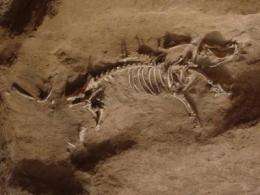
The remains of a 4,000-year-old pig found at the Chinese archaeological site of Taosi. The descendants of this domestic pig are now found all over the world. Credit: Image courtesy of Jing Yuan

"The earliest known Chinese domestic pigs have a direct connection with modern Chinese breeds, suggesting a long, unbroken history of pigs and people in this part of East Asia."

The finding is part of a wider research project into pig domestication and early human migration in East Asia.

The study also uncovered multiple centres of pig domestication and a complex picture of human migration across East Asia.

After pigs were incorporated into domestic stocks in Southeast Asia, the animals then migrated with people south and east to New Guinea, eventually reaching the remote Pacific, including Hawai'i, Tahiti, and Fiji, the researchers said.

The also found that wild boar were probably domesticated in many places including India and peninsular Southeast Asia several thousand years ago.

As current interpretations of archaeological records in these regions do not yet support these findings, the group has referred to them as "cryptic domestications".

They suggest that additional archaeological digs and new analytical techniques may help to resolve the problem.
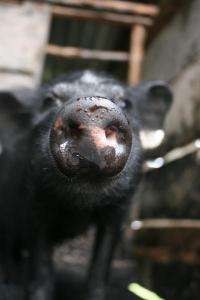
Though pigs are not native to New Guinea, since being introduced by people from Southeast Asia, they are now a dominant part of the culture. Credit: Image courtesy of Will Millard

Dr Larson added: "Our evidence suggests an intriguingly complex pattern of local domestication and regional turnover and calls for a reappraisal of the archaeological record across South and East Asia.

"We may even find additional centres of pig domestication when we take a closer look at the picture in that part of the world."

The research is part of an ongoing research project based at Durham University which aims to re-evaluate the archaeological evidence for pig domestication and husbandry and explore the role of animals in reconstructing ancient , trade and exchange networks.

The DNA testing was carried out at the China Agricultural University and was analysed at Durham University and Uppsala University, Sweden.

Explore further: CU-Boulder helps tap crowds to digitize museum records of bugs and plants

More information: Patterns of East Asian pig domestication, migration, and turnover revealed by modern and ancient DNA, Greger Larson et al, Proceedings of the National Academy of Sciences USA, 19-23 April 2010, DOI:10.1073/pnas.0912264107

Related Stories

Pig study forces rethink of Pacific colonisation

Mar 15, 2007

A survey of wild and domestic pigs has caused archaeologists to reconsider both the origins of the first Pacific colonists and the migration routes humans travelled to reach the remote Pacific.

Guinea pigs not 'dumbed down' by domestication

Mar 24, 2010

Despite reductions in brain size, domestication has not reduced the ability of guinea pigs to navigate a water maze. Researchers writing in BioMed Central's open access journal Frontiers in Zoology tested domesticated and wi ...

Michigan wants hunters to shoot feral pigs

Jan 30, 2008

Feral pigs have become such a problem in Michigan that the state Department of Natural Resources has asked deer hunters in 51 counties to shoot any they see.

Recommended for you

Bittersweet: Bait-averse cockroaches shudder at sugar

2 hours ago

Sugar isn't always sweet to German cockroaches, especially to the ones that avoid roach baits. In a study published May 24 in the journal Science, North Carolina State University entomologists show the ne ...

White tiger mystery solved

4 hours ago

White tigers today are only seen in zoos, but they belong in nature, say researchers reporting new evidence about what makes those tigers white. Their spectacular white coats are produced by a single change ...

Scientists announce Top 10 New Species from 2012

11 hours ago

An amazing glow-in-the-dark cockroach, a harp-shaped carnivorous sponge and the smallest vertebrate on Earth are just three of the newly discovered top 10 species selected by the International Institute for ...

User comments : 0

More news stories

Scientists discover how rapamycin slows cell growth

University of Montreal researchers have discovered a novel molecular mechanism that can potentially slow the progression of some cancers and other diseases of abnormal growth. In the May 23 edition of the prestigious journal ...

White tiger mystery solved

White tigers today are only seen in zoos, but they belong in nature, say researchers reporting new evidence about what makes those tigers white. Their spectacular white coats are produced by a single change ...

NASA head views progress on asteroid lasso mission

Surrounded by engineers, NASA chief Charles Bolden inspected a prototype spacecraft engine that could power an audacious mission to lasso an asteroid and tow it closer to Earth for astronauts to explore.

Solar Kettle allows for boiling water off the grid

(Phys.org) —A company called Contemporary Energy has unveiled a new device it calls the Solar Kettle. It looks very much like a normal coffee thermos, but has flaps on one side that open to allow for collecting ...

Ferrets, pigs susceptible to H7N9 avian influenza virus

Chinese and U.S. scientists have used virus isolated from a person who died from H7N9 avian influenza infection to determine whether the virus could infect and be transmitted between ferrets. Ferrets are often used as a mammalian ...