Scientists reveal new 2D material for next generation high-speed electronics
Jan 04, 2013
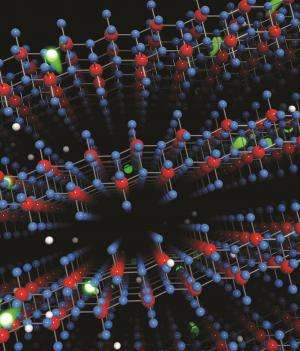
Artist impression of high carrier mobility through layered molybdenum oxide crystal lattice. Credit: Dr Daniel J White, ScienceFX

(Phys.org)—Scientists at CSIRO and RMIT University have produced a new two-dimensional material that could revolutionise the electronics market, making "nano" more than just a marketing term.

The material – made up of layers of crystal known as molybdenum oxides – has that encourage the of electrons at ultra-high speeds.

In a paper published in the January issue of materials science journal , the researchers explain how they adapted a known as graphene to create a new conductive nano-material.

Graphene was created in 2004 by scientists in the UK and won its inventors a in 2010. While supports high speed electrons, its physical properties prevent it from being used for high-speed electronics.

The CSIRO's Dr Serge Zhuiykov said the new nano-material was made up of layered sheets – similar to graphite layers that make up a pencil's core.

"Within these layers, electrons are able to zip through at high speeds with minimal scattering," Dr Zhuiykov said.

"The importance of our breakthrough is how quickly and fluently electrons – which conduct electricity – are able to flow through the new material."

RMIT's Professor Kourosh Kalantar-zadeh said the researchers were able to remove "road blocks" that could obstruct the electrons, an essential step for the development of high-speed electronics.

"Instead of scattering when they hit road blocks, as they would in , they can simply pass through this new material and get through the structure faster," Professor Kalantar-zadeh said.

"Quite simply, if electrons can pass through a structure quicker, we can build devices that are smaller and transfer data at much higher speeds.

"While more work needs to be done before we can develop actual gadgets using this new 2D nano-material, this breakthrough lays the foundation for a new electronics revolution and we look forward to exploring its potential."

In the paper titled 'Enhanced Charge Carrier Mobility in Two-Dimensional High Dielectric Molybdenum Oxide,' the researchers describe how they used a process known as "exfoliation" to create layers of the material ~11 nm thick.

The material was manipulated to convert it into a semiconductor and nanoscale transistors were then created using molybdenum oxide.

The result was electron mobility values of >1,100 cm2/Vs – exceeding the current industry standard for low dimensional silicon.

Explore further: Researcher explores the potential of graphene

Related Stories

Researcher explores the potential of graphene

Oct 11, 2012

Research by Victoria University Professor Uli Zuelicke is contributing to the global race to unlock the potential of graphene, a new material taken from graphite that scientists say could be a game changer for new electronic ...

Graphene's 'Big Mac' creates next generation of chips

Oct 09, 2011

The world's thinnest, strongest and most conductive material, discovered in 2004 at the University of Manchester by Professor Andre Geim and Professor Kostya Novoselov, has the potential to revolutionize material ...

Recommended for you

Hybrid material as gold-leaf substitute

Jun 18, 2013

(Phys.org) —A team of researchers headed by Professor Raffaele Mezzenga has created a hybrid material out of gold and milk proteins that looks like a wafer-thin gold leaf. Thanks to its properties, it could ...

Antioxidant with a long shelf life

Jun 17, 2013

(Phys.org) —Scientists from ETH Zurich have developed a nanomaterial that protects other molecules from oxidation. Unlike many such active substances in the past, the ETH-Zurich researchers' antioxidant ...

Fast pollutant degradation by nanosheets

Jun 17, 2013

(Phys.org) —Waste from textile and paint industries often contains organic dyes such as methylene blue as pollutants. Photocatalysis is an efficient means of reducing such pollution, and molybdenum trioxide ...

Unzipped nanotubes unlock potential for batteries

Jun 13, 2013

(Phys.org) —Researchers at Rice University have come up with a new way to boost the efficiency of the ubiquitous lithium ion (LI) battery by employing ribbons of graphene that start as carbon nanotubes.

Nanoparticle opens the door to clean-energy alternatives

Jun 13, 2013

(Phys.org) —Cheaper clean-energy technologies could be made possible thanks to a new discovery. Research team members led by Raymond Schaak, a professor of chemistry at Penn State University, have found ...

User comments : 8

Adjust slider to filter visible comments by rank

Display comments: newest first

Whydening Gyre
2 / 5 (4) Jan 04, 2013
Evolution (of ALL things) is amazing, isn't it...
Trenchant
not rated yet Jan 04, 2013
Electrons conduct electricity? Perhaps a mistatement...
Lurker2358
5 / 5 (2) Jan 04, 2013
Electrons conduct electricity? Perhaps a mistatement...


Insert "Carry electric charge"?!
Rob
not rated yet Jan 04, 2013
These materials strike me as extremely difficult to find a manufacturing process for. Unless by some miracle once can exfoliate ( or transfer through mechanical contact) a 300 or 450mm piece of this reliably, how can you manufacture a monolayer in bulk on wafers?
cyberCMDR
1 / 5 (3) Jan 04, 2013
Graphene was created in 2004? What were pencils made of before this? ;-)
ValeriaT
not rated yet Jan 04, 2013
Graphene << graphite Molybdenium oxide may be better than the graphene, because it's not so conductive (wider-gap material).(article)
Capissen38
3 / 5 (2) Jan 04, 2013
cyberCMDR: Graphite, which is a much more disordered form of carbon than graphene.
Parsec
not rated yet Jan 05, 2013
Graphene was created in 2004? What were pencils made of before this? ;-)

Same thing they are made up of now... Graphite.

More news stories

Hybrid nanostructures: Getting to the core

Material scientists expect the new multifunctional properties of hybrid nanostructures will transform the development of high-performance devices, including batteries, high-sensitivity sensors and solar cells. ...

Sweet solutions for detecting disease

Based at the Institute of Chemistry in the Slovak Academy of Sciences, Ján Tkáč's research combines glycomics – the study of sugars in organisms – with biochip sensors based on nanoparticles and nanotubes. ...

3D printing tiny batteries

(Phys.org) —3D printing can now be used to print lithium-ion microbatteries the size of a grain of sand. The printed microbatteries could supply electricity to tiny devices in fields from medicine to communications, ...

Multiview 3-D photography made simple

Computational photography is the use of clever light-gathering tricks and sophisticated algorithms to extract more information from the visual environment than traditional cameras can.

Laughing gas does not increase heart attacks

(Medical Xpress)—Nitrous oxide—best known as laughing gas—is one of the world's oldest and most widely used anesthetics. Despite its popularity, however, experts have questioned its impact on the risk ...