First car ferry powered by electric drive system
Jan 11, 2013

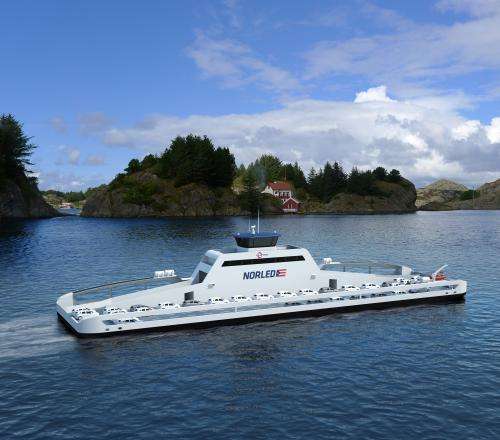
Together with the Norwegian shipyard Fjellstrand, Siemens has developed the world's first electrically powered car ferry. The 80-meter vessel can carry 120 cars and 360 passengers. From 2015 onward, it will serve the route between Lavik and Oppedal, across the Sognefjord. The ship's batteries will be recharged in the breaks between crossings, a procedure which only takes 10 minutes. The vessel currently serving this route uses on average one million liters of diesel a year and emits 570 metric tons of carbon dioxide and 15 metric tons of nitrogen oxides. The electrically powered ferry was developed for submission to a competition organized by Norway's Ministry of Transport. As a reward for winning the competition, the shipping company Norled has been granted the license to operate the route until 2025.

The ferry has been specially designed to accommodate the requirements of an electric drive system. As a with two slim hulls, it offers less resistance in the water than a conventional vessel. Furthermore, the hulls are made of aluminum instead of steel, which is conventionally used. Rather than a diesel engine, the ferry is equipped with electric motors to drive the ship's two screws. These motors are powered by a battery weighing 10 metric tons. All in all, the new vessel weighs only half as much as a ferry of conventional design. This saving has a direct impact on the specifications of the drive system. Whereas the ferry currently serving the route has an engine with an output of 1,500 kilowatts (kW) or more than 2000 horsepower, the battery in the new vessel will have an output of 800 kW. In normal conditions, operating at a speed of 10 knots, of 400 kW will suffice.

The crucial feature of the new ferry is that it only takes 10 minutes to recharge the batteries. In the two small villages linked by the ferry, however, the local grid is not equipped to deliver such a large amount of power in such a short space of time. To deal with this problem, batteries have been installed at each port. These serve to recharge the 's battery during turnaround and are then themselves slowly recharged from the local grid.

Hundreds of ferries link Norway's mainland to the islands off its coast and provide routes across its many fjords. Using today's battery and recharging technology, all crossings of up to 30 minutes in duration could be served by electrically powered vessels.

Explore further: First gas-powered passenger ferry handed over in Finland

add to favorites email to friend print save as pdf

Related Stories

Japanese firm plans zero-emission ferry

Oct 15, 2009

A Japanese shipmaker said Thursday it planned to launch the world's first large electric ferry -- the latest innovation aimed at reducing greenhouse gas emissions.

Lithium-ion battery is fast-charged in minutes

Aug 17, 2012

(Phys.org) -- A lithium-ion battery that can charge 120 times faster than normal is reportedly the work of scientists from Korea at the Ulsan National Institute of Science and Technology (UNIST) The scientists ...

Ferry 'hits whales' in Sydney Harbour

Aug 06, 2012

A humpback whale and its calf were injured on Monday after apparently being hit by a ferry in Sydney Harbour, with witnesses saying the animals had ugly gashes and cuts.

World's first aircraft with serial hybrid electric drive

Jun 24, 2011

Together with partners, Siemens has built the world’s first aircraft with a serial hybrid electric drive system. The two-seater motor glider DA36 E-Star is presented by Siemens, Diamond Aircraft and EADS ...

Jaguar’s new electric concept supercar -- the C-X75

Oct 04, 2010

(PhysOrg.com) -- The new Jaguar C-X75 supercar concept model unveiled last week is primarily a plug-in electric car but with the added power and performance of micro gas turbines (jet engines) that would make ...

Recommended for you

The long road to the 2000-watt society

14 hours ago

The vision of a society in which each inhabitant of the earth manages to consume only 2000 watts has already been around for 15 years. During this time, there has been a steady increase in environmental awareness ...

Germany must spread cost of energy shift fairly: IEA

15 hours ago

The International Energy Agency said Friday that Germany must shield its consumers from paying too much of the cost of its ambitious switch from nuclear power and fossil fuels toward renewable energy.

Solar Kettle allows for boiling water off the grid

May 23, 2013

(Phys.org) —A company called Contemporary Energy has unveiled a new device it calls the Solar Kettle. It looks very much like a normal coffee thermos, but has flaps on one side that open to allow for collecting ...

User comments : 1

Adjust slider to filter visible comments by rank

Display comments: newest first

djr
not rated yet Jan 12, 2013
I wonder about the issue of total range. If the ship was forced to re-route for some reason - how long would the baterries last - I am sure they have done a lot of prep work - and have their safety procedures pretty tight. At this point in time - what is the longest crossing this kind of ship is able to handle. It looks like a very promising development.

More news stories

Google eyes emerging markets networks

Google has become deeply involved in a series of projects to build and operate wireless networks in emerging markets including sub-Saharan Africa and Southeast Asia, a report said Friday.

Facial-recognition technology proves its mettle

(Phys.org) —In a study that evaluated some of the latest in automatic facial recognition technology, researchers at Michigan State University were able to quickly identify one of the Boston Marathon bombing ...

Drones may violate international law

(Phys.org) —As President Obama gives a speech on national security—including defending U.S. use of drones to combat terrorism—Leila Sadat, JD, international law expert and professor of law at Washington University in ...

Galaxies fed by funnels of fuel

(Phys.org) —Computer simulations of galaxies growing over billions of years have revealed a likely scenario for how they feed: a cosmic version of swirly straws.