S. Korea restarts troubled nuclear reactor
Dec 31, 2012
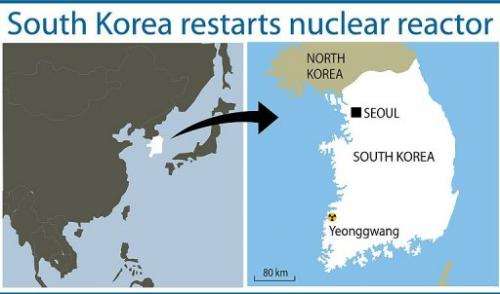
Map locating the showing the Yeonggwang nuclear reactor site in South Korea. South Korea on Monday restarted one of three nuclear reactors shut down for safety reasons, easing fears of power shortages during the harsh winter.

South Korea on Monday restarted one of three nuclear reactors shut down for safety reasons, easing fears of power shortages during the harsh winter.

Half of the six reactors at Yeonggwang, one of the country's largest nuclear power complexes, were shut down in November, two of them to replace "non-core" parts that had been provided with forged quality and safety warranties.

The Ministry of Knowledge Economy said operators restarted one reactor at Yeonggwang in the evening following approval by the and Security Commission.

"Another reactor is expected to pass our safety checks soon for normal operations," said commission spokeswoman Shim Eun-Jung.

A third reactor was closed after minor cracks were found during maintenance work on control rod tubes.

Although operators insisted there had never been any threat of a radiation leak, the incidents stoked safety concerns heightened by last year's at Fukushima in Japan.

South Korea has 23 reactors nationwide, which generate around 35 percent of the country's electricity.

The government has vowed to stick to its nuclear power programme despite the crisis, and plans to build an additional 16 reactors by 2030.

Explore further: S.Korea predicts power cuts as nuke reactors shut

add to favorites email to friend print save as pdf

Related Stories

S.Korea predicts power cuts as nuke reactors shut

Nov 05, 2012

South Korea was forced to shut down two nuclear reactors on Monday to replace components that had not been properly vetted, a minister said, warning of "unprecedented" power shortages to follow.

Japan approves nuclear reactor restart

Aug 17, 2011

Japan on Wednesday approved the full resumption of commercial operations of an atomic reactor for the first time since the March 11 quake and tsunami sparked the Fukushima nuclear accident.

80% in Japan 'support nuclear phase-out'

Mar 18, 2012

Eighty percent of Japanese want to phase out the country's reliance on nuclear power and eventually eliminate it, a poll said Sunday, a year after Japan was hit by a massive nuclear disaster.

Small fire stops Swedish nuclear reactor

Oct 23, 2011

A small fire in a turbine hall shut down a Swedish nuclear reactor overnight but the blaze was swiftly extinguished, nuclear power plant officials said Sunday.

Recommended for you

The long road to the 2000-watt society

14 hours ago

The vision of a society in which each inhabitant of the earth manages to consume only 2000 watts has already been around for 15 years. During this time, there has been a steady increase in environmental awareness ...

Germany must spread cost of energy shift fairly: IEA

15 hours ago

The International Energy Agency said Friday that Germany must shield its consumers from paying too much of the cost of its ambitious switch from nuclear power and fossil fuels toward renewable energy.

Solar Kettle allows for boiling water off the grid

May 23, 2013

(Phys.org) —A company called Contemporary Energy has unveiled a new device it calls the Solar Kettle. It looks very much like a normal coffee thermos, but has flaps on one side that open to allow for collecting ...

User comments : 9

Adjust slider to filter visible comments by rank

Display comments: newest first

Pkunk_
4 / 5 (8) Dec 31, 2012
South Korea has 23 reactors nationwide, which generate around 35 percent of the country's electricity. The government has vowed to stick to its nuclear power programme despite the Fukushima crisis, and plans to build an additional 16 reactors by 2030.

Surrounded on all sides by hostile neighbors , you have to admire the success that South Korea has had in the tech world. Those are some very intelligent people , and like intelligent people they've made the right decision . Nuclear power is very productive and cost-effective and one of the least polluting modes as long as the right people and correct reactor designs are involved.
ValeriaT
1 / 5 (8) Dec 31, 2012
Nuclear power is very productive and cost-effective and one of the least polluting modes as long as the right people and correct reactor designs are involved
Which often aren't and the consequences are undeniable - after all, like at the case of all technologies, the global safety of which depends on the unreliable human factor. Wouldn't be cheaper, safer and more effective to invest into cold fusion research? Even Einstein had an explantion and motivation for it before fifty years! The incompetence of mainstream physics is striking.
dschlink
5 / 5 (3) Dec 31, 2012
Funny how people cling to their myths (cold fusion), even after the original investigators admitted they were wrong.
kochevnik
2.1 / 5 (7) Dec 31, 2012
But if N. Korea does this the Americans get very scared!
VendicarD
2 / 5 (4) Dec 31, 2012
Odd. I thought South Korea was surrounded on 3 sides by an ocean.

"Surrounded on all sides by hostile neighbors" - Pkunk

Ah. I see... The Hostile nation of Japan is to the east and the Hostile nation of Australia to the south.
VendicarD
2.7 / 5 (7) Dec 31, 2012
That is because America is a hypocrite nation and has one set of rules for itself, and another set for those who refuse to follow American dictates.

"But if N. Korea does this the Americans get very scared!" - Kochevnik
VendicarD
5 / 5 (4) Dec 31, 2012
Research? Why? I was promised that I could purchase a working LENR home heating system by Martini and Rossi.

Did that promise evaporate? Where is the factory that was claimed to be producing those units?

What happened?

"Wouldn't be cheaper, safer and more effective to invest into cold fusion research? " - ValeriaT

Where is my Rossi E-Cat?
ValeriaT
1 / 5 (4) Dec 31, 2012
Why the deniers of cold fusion are asking for E-Cat? Andrea Rossi never published any scientific publication about cold fusion and no details about his work, whereas thousands of serious scientists did. It's like to deny the existence of Higgs boson with Stephen Hawking, who claims, the Higgs boson doesn't exist, although he never did any publication or experiment regarding Higgs boson (and he actually did lost all his bets).
ValeriaT
1 / 5 (3) Dec 31, 2012
We can see, when some experimental finding plays well for scientific community, then the opinion of crackpots is ignored heartily (Higgs boson as an example). But at the moment, when some finding could threat the jobs in many other areas of research of energy production/conversion/transport/storage, then the unverified proclamations suddenly become more important for dismissal of this finding, than the thousands of serious publications about it. It just illustrates, how both scientists, both laymans actually value and respect the scientific method, when it doesn't play well with their own selfish expectations. It's all just about politics and religion, not science. I'm just pointing it here to illustrate, how the human society actually works.

More news stories

Google eyes emerging markets networks

Google has become deeply involved in a series of projects to build and operate wireless networks in emerging markets including sub-Saharan Africa and Southeast Asia, a report said Friday.

Facial-recognition technology proves its mettle

(Phys.org) —In a study that evaluated some of the latest in automatic facial recognition technology, researchers at Michigan State University were able to quickly identify one of the Boston Marathon bombing ...

Drones may violate international law

(Phys.org) —As President Obama gives a speech on national security—including defending U.S. use of drones to combat terrorism—Leila Sadat, JD, international law expert and professor of law at Washington University in ...

Galaxies fed by funnels of fuel

(Phys.org) —Computer simulations of galaxies growing over billions of years have revealed a likely scenario for how they feed: a cosmic version of swirly straws.