Stained glass solar windows for the Swiss Tech Convention Center
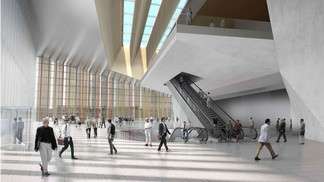
As a World's first, no less than 300m2 of dye sensitized solar cells will be integrated to the facade of the EPFL's Convention Center. This prototype will constitute the first application of such technology to a public building. The translucent panels are constructed and assembled by local SMEs and make use of an invention conceived by EPFL researcher Michael Graetzel. This project is embedded within the framework of the partnership established in 2009 between EPFL and Romande Energie - whose aim is to create one of the largest solar energy parks in Switzerland.
The west facade of EPFL's future Convention Center, currently under construction, will certainly be an eye-catcher. The silk-screened glass blinds that had been initially planned for the building will be replaced with translucent and colored photovoltaic panels, also known as "Graetzel cells" after their inventor. In a partnership between the EPFL and Romande Energie, this decision was made with the collaboration of the building architects, the Center owner and the constructors.
The new element of the facade will be manufactured by Solaronix (Aubonne, Switzerland), the first company to acquire the rights to the EPFL patent license in 1994. The SME will assemble 1500 modules of 35x50cm on a surface of 300m2. Thanks to a recent technological breakthrough and after a sequence of intensive tests, the company has confidence on having reached a sufficient level of reliability that will enable them to move from lab to reality. "I am very pleased to see this technology used in a major architectural project," said Michael Graetzel. This is an important step towards a large scale distribution of dye sensitized solar cells, whose principle is based on plant photosynthesis, explained the researcher.
A work of art and architecture
Unlike opaque solar cells made of silicon, Graetzel units are transparent. The cells at the Convention Center will exhibit shades of red and orange, as designed by the artist Catherine Bolle from Lausanne. They will simultaneously accomplish two functions: protection from solar radiation on the glass facade so as to regulate the temperature inside the building, as well as production of renewable electricity.
A step towards industrialization
The production of electricity, estimated at 8,000 kilowatt hours (kWh) per year, only represents a minor part of the overall building consumption. In fact, these types of sensors are less efficient than silicon cells. However, they perform well with diffuse light. In the case of the Convention Center, the cells will be placed vertically facing the west so their use will be optimized. Moreover, the industrialization of this technology forecasts for a good cost/efficiency ratio as the manufacturing process does not require high temperatures – which are energy consuming – or rare materials.
"What we are doing with this Convention Center is a display of technology, a platform intended to draw attention to a remarkable device invented at our labs, to full-scale test this technology and to demonstrate its significant architectural potential," said Francis-Luc Perret, Vice President for Planning and Logistics at EPFL.
Provided by Ecole Polytechnique Federale de Lausanne


