Toyota shows off all solid state lithium superionic conductor based prototype battery
Sep 26, 2012 by Bob Yirka weblog
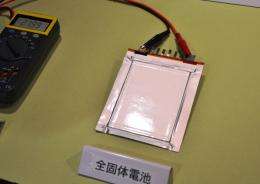
The all-solid-state battery prototype. Credit: Tech-on

(Phys.org)—It's no secret that Toyota has been hard at work trying to improve on current battery technology to power electric vehicles, last year the company described a prototype solid state lithium superionic conductor battery in an article in the journal Nature Materials that was based on a three dimensional framework. And just this month the company announced plans to introduce several new lines of hybrid and all electric vehicles over the next three years (after also announcing that the Prius hybrid now accounts for ten percent of all sales). The sticking point has been and remains, the batteries used in such vehicles which can account for up to half their cost to consumers.

At the heart of current batteries for use in electric vehicles are liquid electrolytes, which by their very nature present fire safety hazards. Adding technology to reduce the fire hazard adds to the cost of the battery, thus a battery based on a solid electrolyte would be cheaper and safer. Up till now however, such electrolytes have only been practical at the 50–80 °C range which obviously isn't workable for an electric vehicle. The new prototype is an attempt to overcome that restriction.

The new battery, first described last year, uses Li10GeP2S12 in a layered three dimensional framework where cells are sandwiched together to create a stack of seven tiers with each having a voltage of four volts for a total of twenty eight at normal temperatures. The result, they say is a battery with five times the output density of previous varieties. To demonstrate its progress in refining the battery, the prototype was demonstrated recently to a group attending a seminar as a power source for an .

The battery is sulfide based and differs from previous prototypes in that germanium was added to the mix to bring a more refined structure to the material. It boasts improved conductivity to 1 x 10⁻²S/cm-1, which is on a par with liquid electrolyte based batteries, though the company readily acknowledges that there is still a lot more work to do before such a battery could be used in for sale. They are shooting for a 2015 to 2020 timeframe, at which point, the hope is that a way will have been found to dramatically reduce production costs, which are at this point, apparently far too high to allow for use as a commercial battery.

Explore further: Startup creates new type of electrolyte for better and cheaper lithium ion battery

More information:

via Tech-on

Related Stories

New Hitachi Li-ion batteries to last ten years

Apr 09, 2010

(PhysOrg.com) -- Hitachi has announced they may be able to double the life of rechargeable lithium-ion (Li-ion) batteries through the development of a new cathode material. The material was developed in conjunction ...

Charging up the auto industry

Feb 21, 2012

This year's iconic North American International Auto Show featured a wave of new hybrid and electric cars that suggest the vehicles have truly come into their own. But what's the future for the technology needed to power ...

Details of new type of electric car battery released

May 27, 2011

(PhysOrg.com) -- After being spun off from parent company A123 Systems last year; the new offspring, 24M has published a paper in Advanced Energy Materials, ending months of speculation about what it has be ...

Recommended for you

German energy shift faces headwinds

5 hours ago

Tense engineers have their eyes peeled on complex colour-coded diagrams on a wall-sized screen that makes their control room look like the inside of a spaceship.

Morocco to harness the wind in energy hunt

May 18, 2013

Morocco is ploughing ahead with a programme to boost wind energy production, particularly in the southern Tarfaya region, where Africa's largest wind farm is set to open in 2014.

Energy-positive with natural ventilation

May 17, 2013

Buildings can be air-conditioned using entirely natural means, without mechanical ventilation systems. This is the claim made by 78-year-old Benjamin Bronsema, who will be awarded his PhD for his thesis on the subject at ...

User comments : 8

Adjust slider to filter visible comments by rank

Display comments: newest first

GSwift7
3.8 / 5 (4) Sep 26, 2012
at which point, the hope is that a way will have been found to dramatically reduce production costs, which are at this point, apparently far too high to allow for use as a commercial battery


It sure sounds like they are gambling a lot of money on a long shot. I wonder if they are also pursuing metal-air battery designs in parallel with the one above?

When someone eventually makes a breakthrough with either batteries or super-capacitors, it'll be a world-changing event. There are so many different things currently being limited by batteries.
Mike_Massen
1 / 5 (2) Sep 26, 2012
There are so many different things currently being limited by batteries.
Like being able to waste power without thinking about it or finding ways to be more power efficient etc...

Lets go to your perspective though GSwift7

What are the top 5 'things' which are really practically limited ?

ValeriaT
not rated yet Sep 26, 2012
Germanium is rather expensive ($1000 /kg) for being used in large scale electromobility. This particularly applies to Japan, which depends on import of all rare metals completely. If it would be possible to replace the germanium with silicone, then the situation would be quite different.
VendicarD
not rated yet Sep 26, 2012
How can this be when just 4 days ago ParkerTard proclaimed to the world that Toyota was getting out of the electric car business?

SteveL
not rated yet Sep 26, 2012
What are the top 5 'things' which are really practically limited ?

GSwift7 likely his his own list, but I would suggest domestic energy storage for solar or wind energy generation systems, electric automobiles, electric motorcycles, industrial trucks (lift trucks) and portable electronics. All of which could use improved and cheaper energy storage.
Argiod
1 / 5 (1) Sep 27, 2012
By the time they have this commercially viable and affordable, I'll be shopping for a coffin and gravesite.
antialias_physorg
not rated yet Sep 27, 2012
All of which could use improved and cheaper energy storage.


- Space exploration for places where power is only imtermittently available (which basically means all planet/moonside endeavours)
- Submarine operations (research and military)
- Remote sensors of all kinds (from tsunami buoys to earthquake sensors)
- home lighting/appliances if you want to go off grid or at least drop your bill by using energy you harvest through your own power generators (photovoltaics or whatever)
- transportation
- grid buffers
- further miniaturization of sensors

The list is practically endless.
Mike_Massen
1 / 5 (1) Sep 27, 2012
Obviously I should have qualified the list with the term "comparatively cost efficient"... in the appropriate context and do I have to be "that" explicit to an audience I expect to have already considered that differential !

More news stories

German energy shift faces headwinds

Tense engineers have their eyes peeled on complex colour-coded diagrams on a wall-sized screen that makes their control room look like the inside of a spaceship.

Internet in 'coma' as Iran election looms

Iran is tightening control of the Internet ahead of next month's presidential election, mindful of violent street protests that social networkers inspired last time around over claims of fraud, users and ...

China police billions spell profit opportunity

Mannequins in riot gear, armoured cars and drones line a police equipment and "anti-terrorism technology" trade fair in Beijing as vendors seek to profit from China's huge internal security budget.

Bold action, big money needed to curb Asia floods

Asia's flood-prone megacities should fund major drainage, water recycling and waste reduction projects to stem deluges and secure clean supply for their booming populations, experts said Sunday.