Unique salt allows energy production to move inland
Mar 01, 2012
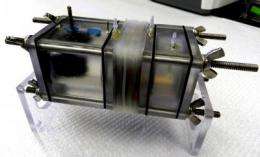
This is a microbial reverse-dialysis cell created by Bruce Logan, Penn State, and his team. Credit: Bruce Logan, Penn State

Production of energy from the difference between salt water and fresh water is most convenient near the oceans, but now, using an ammonium bicarbonate salt solution, Penn State researchers can combine bacterial degradation of waste water with energy extracted from the salt-water fresh-water gradient to produce power anywhere.

"We are taking two technologies, each having limitations, and putting them together," said Bruce E. Logan, Kappe Professor of Environmental Engineering. "Combined, they overcome the limitations of the individual technologies."

The technologies Logan refers to are (MFC)-- which use wastewater and naturally occurring bacteria to produce electricity -- and reverse electrodialysis (RED) -- which produces electricity directly from the salinity gradient between salty and fresh . The combined technology creates a microbial reverse-electrodialysis cell (MRC). The researchers describe MRCs in today's edition of .

RED stacks extract energy from the ionic difference between and . A stack consists of alternating ion exchange membranes -- positive and negative -- with each RED membrane pair contributing additively to the electrical output. Unfortunately, using only RED stacks to produce electricity is difficult because a large number of membranes is required when using water at the , due to the need for water electrolysis.

Using exoelectrogenic bacteria -- bacteria found in wastewater that consume and produce an -- reduces the number of stacks needed and increases electric production by the bacteria.

Logan, working with Roland Cusick, graduate student in environmental engineering, and postdoctoral fellow Younggy Kim, placed a RED stack between the electrodes of an MFC to form the MRC.

While the researchers previously showed that an MRC can work with natural seawater, the organic matter in water will foul the membranes without extensive precleaning and treatment of the water. Seawater use restricts MRC operation to coastal areas, but food waste, domestic waste and animal waste contain about 17 gigawatts of power throughout the U.S. One nuclear reactor typically produces 1 gigawatt.
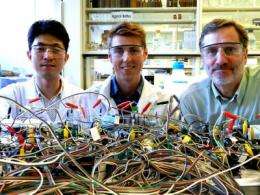
Postdoctoral fellow Younggy Kim, Roland Cusick, graduate student in environmental engineering, and Bruce E. Logan, Kappe Professor of Environmental Engineering, Penn State behind a series of microbial reverse-dialysis cells and accompanying wiring. Credit: Bruce Logan, Penn State

Rather than rely on seawater, the researchers used ammonium bicarbonate, an unusual salt. An ammonium bicarbonate solution works similarly to seawater in the MRC and will not foul the membranes. The ammonium bicarbonate is also easily removed from the water above 110 degrees Fahrenheit. The ammonia and carbon dioxide that make up the salt boil out, and are recaptured and recombined for reuse.

"Waste heat makes up 7 to 17 percent of energy consumed in industrial processes," said Logan. "There is always a source of waste heat near where this process could take place and it usually goes unused."

The researchers tested their ammonium bicarbonate MRC and found that the initial production of electricity was greater than that from an MRC using seawater.

"The bacteria in the cell quickly used up all the dissolved organic material," said Logan. "This is the portion of wastewater that is usually the most difficult to remove and requires trickling filters, while the particulate portion which took longer for the bacteria to consume, is more easily removed."

The researchers tested the MRC only in a fill and empty mode, but eventually a stream of wastewater would be run through the cell. According to Logan, MRCs can be configured to produce electricity or hydrogen, making both without contributing to greenhouse gases like carbon dioxide. The MRC tested produced 5.6 watts per square meter.

Logan also notes that not having to process wastewater would save about 60 gigawatts.

Explore further: Energy-positive with natural ventilation

More information: "Energy Capture from Thermolytic Solutions in Microbial Reverse-Electrodialysis Cells," by R.D. Cusick et al. Science (2012).

Related Stories

Bacteria -- energy producers of the future? (w/ video)

Aug 22, 2011

All of us use water and in the process, a lot of it goes to waste. Whether it goes down drains, sewers or toilets, much of it ends up at a wastewater treatment plant where it undergoes rigorous cleaning before it flows back ...

Wastewater produces electricity and desalinates water

Aug 06, 2009

A process that cleans wastewater and generates electricity can also remove 90 percent of salt from brackish water or seawater, according to an international team of researchers from China and the U.S.

Microbes turn electricity directly to methane

Mar 30, 2009

(PhysOrg.com) -- A tiny microbe can take electricity and directly convert carbon dioxide and water to methane, producing a portable energy source with a potentially neutral carbon footprint, according to a ...

Renewable hydrogen production becomes reality at winery

Sep 29, 2009

(PhysOrg.com) -- The first demonstration of a renewable method for hydrogen production from wastewater using a microbial electrolysis system is underway at the Napa Wine Company in Oakville. The refrigerator-sized hydrogen ...

Recommended for you

Morocco to harness the wind in energy hunt

3 hours ago

Morocco is ploughing ahead with a programme to boost wind energy production, particularly in the southern Tarfaya region, where Africa's largest wind farm is set to open in 2014.

Energy-positive with natural ventilation

May 17, 2013

Buildings can be air-conditioned using entirely natural means, without mechanical ventilation systems. This is the claim made by 78-year-old Benjamin Bronsema, who will be awarded his PhD for his thesis on the subject at ...

CTRL+P: Printing Australia's largest solar cells

May 16, 2013

(Phys.org) —The printer has allowed researchers from the Victorian Organic Solar Cell Consortium (VICOSC) – a collaboration between CSIRO, The University of Melbourne, Monash University and industry partners ...

User comments : 2

Adjust slider to filter visible comments by rank

Display comments: newest first

Bob_Kob
1 / 5 (2) Mar 02, 2012
So we'll waste our very limited fresh water for a little bit of electricitY?
anonperson
5 / 5 (3) Mar 02, 2012
So we'll waste our very limited fresh water for a little bit of electricitY?


They mention waste water over 10 times as the source of the water... the water gets cleaned along the way:
"The bacteria in the cell quickly used up all the dissolved organic material," said Logan. "This is the portion of wastewater that is usually the most difficult to remove and requires trickling filters, while the particulate portion which took longer for the bacteria to consume, is more easily removed."

More news stories

Morocco to harness the wind in energy hunt

Morocco is ploughing ahead with a programme to boost wind energy production, particularly in the southern Tarfaya region, where Africa's largest wind farm is set to open in 2014.

US seizes Bitcoin operator accounts

US authorities seized the accounts of a Bitcoin digital currency exchange operator, claiming it was functioning as an "unlicensed money service business," court documents showed Friday.

Yahoo Japan suspects 22 million IDs stolen

Yahoo Japan Corp. has said it suspects up to 22 million user IDs may have been stolen during an unauthorised attempt to access the administrative system of its Yahoo! Japan portal.

Galaxy's Ring of Fire

Johnny Cash may have preferred this galaxy's burning ring of fire to the one he sang about falling into in his popular song. The "starburst ring" seen at center in red and yellow hues is not the product of ...

Alaska volcano shoots ash 15,000 feet into the air

(AP)—One of Alaska's most restless volcanoes has shot an ash cloud 15,000 feet into the air in an ongoing eruption that has drawn attention from a nearby community but isn't expected to threaten air traffic.