Thousands protest against nuclear power in Japan
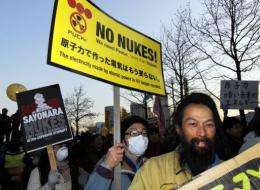
Anti-nuclear activists hold placards during a rally against nuclear energy in Yokohama. About 2,000 demonstrators hit the streets of Yokohama on Saturday calling for an end to nuclear energy in Japan after the March 11 disaster that sparked the worst atomic crisis since Chernobyl.
About 2,000 demonstrators hit the streets of Yokohama on Saturday calling for an end to nuclear energy in Japan after the March 11 disaster that sparked the worst atomic crisis since Chernobyl.
They marched in the port city southwest of Tokyo chanting in chorus: "We don't need nuclear power. Give back our hometown. Protect our children."
The protest, organised by several anti-nuclear and environmental groups, also saw residents evacuated from areas outside the Fukushima Daiichi plant take part.
Japan had previously aimed to use nuclear power to generate around 50 percent of its energy needs by 2030 in a bid to reduce greenhouse gas emissions and enhance the energy independence of the resource-poor archipelago.
But sentiment has shifted since the quake and tsunami crippled the plant's cooling systems, sparking reactor meltdowns that spewed radiation into the environment forcing tens of thousands to evacuate from a 20-kilometre radius.
Radiation fears have become part of daily life in Japan after cases of contaminated water, beef, vegetables, tea and seafood. The government has been at pains to stress the lack of an "immediate" health risk.
(c) 2012 AFP
-
From lemons to lemonade: Reaction uses carbon dioxide to make carbon-based semiconductor,
32 comments
-
Thioridazine kills cancer stem cells in human while avoiding toxic side-effects of conventional cancer treatments,
3 comments
-
SpaceX private rocket blasts off for space station (Update),
42 comments
-
Climate scientists say they have solved riddle of rising sea,
31 comments
-
SpaceX capsule has 'new car' smell, astronauts say (Update),
4 comments
-
Need a rigid insulation material???
20 hours ago
-
magnets or EMF in car bumpers to protect from fender bender
May 26, 2012
-
length of wire in a coil of known dimensions?
May 25, 2012
-
India Engineering Powerhouse
May 25, 2012
-
electromagnet core dereference between hard and soft iron
May 25, 2012
-
Measuring water pressure in an open tank
May 24, 2012
- More from Physics Forums - General Engineering
More news stories
Browser wars flare in mobile space
The browser wars are heating up again, but this time the fight is for dominance of the mobile Internet.
13 hours ago |
5 / 5 (2) |
3
Probability of contamination from severe nuclear reactor accidents is higher than expected: study
Catastrophic nuclear accidents such as the core meltdowns in Chernobyl and Fukushima are more likely to happen than previously assumed. Based on the operating hours of all civil nuclear reactors and the number ...
Technology / Energy & Green Tech
May 22, 2012 |
3.6 / 5 (25) |
56
|
HyperSolar shows dirty water no barrier to power world
(Phys.org) -- The Santa Barbara, California, company, HyperSolar, is set to transparently share the ups and downs of its research experiences toward the companys ultimate vision, successfully producing ...
SpotterRF debuts Radar Backpack Kit (w/ Video)
(Phys.org) -- SpotterRF has announced a special radar backpack kit designed to enhance situational awareness for soldiers on the ground. The company says its special radar is designed for warfighters as part ...
Tesla to launch electric sedan in US on June 22
Tesla Motors said Tuesday it would begin deliveries of "the world's first premium electric sedan" on June 22, slightly ahead of schedule.
Technology / Energy & Green Tech
May 22, 2012 |
4.5 / 5 (12) |
18
Stunning image of smallest possible five-ringed structure
Scientists have created and imaged the smallest possible five-ringed structure about 100,000 times thinner than a human hair and you'll probably recognise its shape.
'Unzipped' carbon nanotubes could help energize fuel cells, batteries
Multi-walled carbon nanotubes riddled with defects and impurities on the outside could replace some of the expensive platinum catalysts used in fuel cells and metal-air batteries, according to scientists at ...
Change in developmental timing was crucial in the evolutionary shift from dinosaurs to birds: study
At first glance, it's hard to see how a common house sparrow and a Tyrannosaurus Rex might have anything in common. After all, one is a bird that weighs less than an ounce, and the other is a dinosaur that ...
Computer model used to pinpoint prime materials for efficient carbon capture
When power plants begin capturing their carbon emissions to reduce greenhouse gases and to most in the electric power industry, it's a question of when, not if it will be an expensive undertaking.
T cells 'hunt' parasites like animal predators seek prey, study shows
By pairing an intimate knowledge of immune-system function with a deep understanding of statistical physics, a cross-disciplinary team at the University of Pennsylvania has arrived at a surprising finding: T cells use a movement ...
Land and sea species differ in climate change response: study
(Phys.org) -- Marine and terrestrial species will likely differ in their responses to climate warming, new research by Simon Fraser University and Australia’s University of Tasmania has found.
Jan 15, 2012
Rank: 2.1 / 5 (7)
TEPCO lawyers say the radioactive cesium that blights the world isn't their problem. TEPCO's lawyers used the arcane legal principle of res nullius to argue the emissions that escaped after the tsunami and earthquake triggered a meltdown were no longer its responsibility.
Jan 15, 2012
Rank: 3.3 / 5 (7)
I smell BS, no link with Fukushima can be inferred.
Jan 15, 2012
Rank: 3.9 / 5 (7)
A relatively insignificant number of people blown out of proportion by the media in order to make money.
Radiation exposure can be a serious health issue but one has to weigh the danger to benefits to society as a whole. No risks no benefits.
Jan 15, 2012
Rank: 4.3 / 5 (4)
I don't know why it is not placed here as top news ;)
If we take assumption that protest about nuclear energy makes valid news in category of technology related to nuclear energy why on earth protest of underpaid (at least in their view) prison guards, fire fighters, etc. does not make a valid in social policy category?
Not mentioning that these journalist here should concentrate on EU farmers - they are guaranteed to have plenty of "scientific" news about farmers convinced that we don't donate farming heavy enough.
Jan 15, 2012
Rank: 1 / 5 (5)
Jan 15, 2012
Rank: 2.7 / 5 (3)
Jan 15, 2012
Rank: 3 / 5 (5)
Jan 15, 2012
Rank: 2.1 / 5 (7)
What a jerk. Your health is the most important thing you have. The cost of treating radiation cancers of the population in and around Fukushima will grow exponentially as time goes on. The projected numbers of radiation related illness won't be contained to a handful of "rabble rousers". In the U.S., there will be deaths due to radioactive particulates carried by the wind from Fukushima. This "bottom line" doublespeak of yours is vile. What if your child, niece, or nephew became ill? Would you step over them to benefit your society?
Jan 15, 2012
Rank: 1 / 5 (4)
I smell BS, no link with the scientific method can be inferred from your post. You believe in effects without causes.Mainstream physicists don't know the mean free electron path. So they build bigger and hotter furnaces when in fact the energy is available for free.
Jan 16, 2012
Rank: 3.7 / 5 (3)
Other types of energy production aren't safer. So. The costs of ending nuclear power would ironically be health and safety.
Jan 16, 2012
Rank: 5 / 5 (2)
Plentiful carbon-free energy, and possibly the safest one per kWh produced.
Nor does your link. You believe in unproven (and highly dubious) causes of effects.
Jan 16, 2012
Rank: 3.7 / 5 (3)
There is a thousandfold bigger chance that they will become ill due to coal-fired power plants, and there is a comparable chance they would become ill due to ice from a wind turbine falling on their head. The chance is insignificant. Peak oil or climate change will be a much much bigger threat for my family than nuclear will ever be.
Jan 16, 2012
Rank: 1 / 5 (1)
For Japan this is significant - not in numbers as a percentage of population, but that people are on the streest at all. We should not compare this to "2000 people march through Washington streets to protest (insert name of war here)" by numbers alone. Japan has a very different strike/protest culture than from other countries.
If people in Japan are taking to the streets then this is a SERIOUS indication that the poulation is miffed.
False dichotomy. Shutting down a nuclear reactor does not mean that you must build a COAL power plant to replace it. Japan has plenty of coasts (for wave energy) and a lot of mountains (for wind or solar).
Jan 16, 2012
Rank: not rated yet
It does mean that:
http://depletedcr...il-fuel/
http://nextbigfut...020.html
Jan 16, 2012
Rank: 3 / 5 (2)
Renewables in this case include dangerous and ecologically devastating "old" renewables such as burning wood and big dams. The figure for interminent "new" renewables, those that modern pseudogreen movements get a boner for, is around 3 %. Good luck with that.
Nuclear power will be absolutely crucial for averting the horrible impacts of climate change and peak oil in 21st century. Even if there could be a chance that we will theoretically meet our energy needs with new renewables sometime in far future, it is EXTREMELLY stupid to rely on such conclusion and not pursue nuclear.
Jan 16, 2012
Rank: 1 / 5 (2)
Jan 16, 2012
Rank: not rated yet
I think you missed that germany has upped it's electricity from renewables/alternative energy sources to 17% in 2010.
Nuclear furnishes 22%. The last reactor will go offline by 2022. Even moderate extrapolation will result in a complete replacement of those 22% by alternativ means. Not one additional coal power plant will have to be built (although there are still a few for which old contracts have been signed)
Nuclear furnishes ONLY electricity - so we have to look at the numbers of electricity producing alternatives (which are basically all of them). Renewables do include biogas powerlants, but those are a LOT cleaner than coal power plants.
uclear is such a small part of the energy mix thatits impact is negligible in the short, medium, or long term. Especially if we want to look at the 'bang per buck' as we go green.
Jan 16, 2012
Rank: 1 / 5 (1)
I did not miss it. Germany is one of the wealthiest countries and most commited for renewables in the world. Yet 17 % is too little and too late. It will not be enough to avert climate change and peak oil by far.
It can also supply heat.
Not in the long term. Getting rid of fossil fuels will be extremelly hard. Getting rid of fossil fuels and nuclear is impossible to do
Jan 16, 2012
Rank: 1 / 5 (1)
Jan 16, 2012
Rank: not rated yet
Is that supposed to be an argument that it shouldn't be done at all?
We've seen an increase in the alternative energy contingent between 1 and 2% per year(!). At only a fraction of the subsidies that coal or nuclear are getting, to boot. (Nuclear and coal have ben getting about 200bn Euros each to date, whereas alternative energies have been getting less than 30bn )
The point is: It's doable. It isn't expensive (quite the contrary - the switchover will amount to vast savings on subsidies in the energy sector). And the realy question is: why isn't everyone doing it?
It isn't used for that. But then again: what is someone to stop from using something like solar thermal from supplying heat?
Jan 16, 2012
Rank: not rated yet
Who is saying that it needs to stop once nuclear has been replaced? We just decided to get rid of nuclear first. Coal will follow - never fear.
And with the changeover to cars which run on either electricity or some sort of generated fuel (artificial hydrocarbons or hydrogen) then the dependence on oil imports can be reduced.
But in the end it will be a mix of replacing all of the above at the same time rather than replacing one after the other.
there's no tehnical hurdle. There's no economic hurdle. We're doing it, and up until now it's working.
With no world government individual countries just have to decide to do it themselves.
Jan 16, 2012
Rank: 1 / 5 (3)
I would rather breathe soot than radiation. You are wrong about nuclear safety. As long as there are humans at the controls, nuclear is completely UNSAFE. Ask those living near Chernobyl if you don't want to address Fukushima, who were at a complete loss as to how to control their disaster. On top of that, the reactors were run despite the fact that they were flawed which management knew and paid people to keep quiet. Then there's the problem of spent fuel rods. How about you storing them in your backyard? Radiation inflicts irreversible damage to your DNA, the very blueprints of what we are.
Jan 16, 2012
Rank: 1 / 5 (2)
Thousandfold chance? Where do you get these numbers? These aren't statistics, they're the product of nuclear industry doublespeak sucked up by the uneducated.
Jan 16, 2012
Rank: 5 / 5 (2)
http://nextbigfut...rce.html
Jan 16, 2012
Rank: 5 / 5 (2)
Nope, I am in favor of renewables. But also nuclear.
Yes, it is. Plenty of towns are heated by nuclear stations.
Because it is too expensive when compared per TWh produced, and interminent energy sources are not practical.
Jan 16, 2012
Rank: 4 / 5 (1)
Too little, too late. There is a reason for fear, and it is not nuclear. The reason is called climate change and peak oil.
And electricity needs will skyrocket.
Massive technical and economic hurdles are there. Which is why only wealthy countries that can afford and are willing to burn taxpayer money will have substantial renewable generation, and still it wont be enough.
Jan 16, 2012
Rank: 1 / 5 (1)
"A total of about $400 million for the more effective air pollution technologies for Sulfur dioxide, nitrogen oxides and particulates.
So it is perfectly feasible and economic to retrofit existing coal plants to prevent most of the air pollution and the damage that they cause. The costs is far less than what is required to deal with carbon dioxide (pipes to capture and put it all into large places underground). China has about 650 GWe of coal power installed in 2011. It would probably be cheaper for China to do the particulate retrofits (say $30 million per GWe). Therefore $20 billion would enable a 99.5% reduction in particulates. The United States has 315 GWe of coal power installed in 2011. It would cost about $16 billion for electrostatic precipitators on all coal plants in the United States."
And the lobbyists from your beloved nuclear industry keep yammering into the ears of legislators that it's too costly to do anything but nuclear.
Jan 16, 2012
Rank: 3.7 / 5 (3)
Soot is radioactive.
It is relatively very safe per energy produced. You are not thinking rationally. Chernobyl and Fukushima were old designs. There will be nuclear accidents, the death rate is really negligible, and will only go down.
Fine. Much more toxic chemicals are stored around routinely, yet it is not EVIL NUCULAR, so uneducated masses do not care.
So do countless other carcinogens.
Jan 16, 2012
Rank: 1.3 / 5 (14)
Coal is going to run out LONG before nuclear fuels. In the long run nuclear is far cheaper.
Jan 16, 2012
Rank: 1 / 5 (2)
Not for me and my relatives. I'm of the generation that drank strontium-90 tainted milk from cows grazing on grass that had radioactive fallout from atomic bomb tests. Incidence of human cancers increased as a result.
Jan 16, 2012
Rank: not rated yet
And the cost of human lives? Is that far cheaper, too?
Jan 16, 2012
Rank: 5 / 5 (1)
Atomic bomb tests are not nuclear power plants.
Compared to coal power or lack of power, which kill far more people, it is preferable.
Jan 16, 2012
Rank: 5 / 5 (1)
Jan 16, 2012
Rank: 5 / 5 (1)
Jan 16, 2012
Rank: 3 / 5 (2)
Risk is a component of almost any activity. We measure risk/reward ratios and determine if the risk is worth taking. As far as cars, airplanes, and nuclear plants are concerned sane rational people consider the risk to be worth the reward.
Jan 16, 2012
Rank: not rated yet
There are new environmental laws on the books that penalize contractors for the mishandling of lead dust in old paint and asbestos on pipes and old floor tiles. The fines for exposing the dwellers is $5,000 to the contractor and another $5,000 to the owner. When there are multiple exposures, the fines now run into hundreds of thousands of dollars. Lead and asbestos are innocuous toxins compared to radiation poisoning. The taxpayer will have to pick up the tab not only to clean up a nuclear disaster site, but also the multi-millions of dollars the government will be sued for in a class action suit filed by radiation victims. Still the cheapest way to go?
Jan 16, 2012
Rank: 5 / 5 (1)
I didn't say it was the cheapest... I said it was the safest. Going by deaths per watt-hour of electricity generated nuclear is the safest form of mass energy production. You didn't even address anything I said, but instead attacked a straw man, and poorly at that.
Jan 16, 2012
Rank: 5 / 5 (1)
http://www.world-...f06.html
Jan 16, 2012
Rank: not rated yet
Um...have you got the numbers for cumulative years of coal power plant operations and kWh produced (since the industrial revolution)? That's ORDERS of magnitude higher.
and really: No one is arguing that coal power plants are a good alternative to nuclear power plants. You're arguing a false dichotomy here. Just because people want to get rid of nuclear does not mean that anyone wants more coal.
Jan 16, 2012
Rank: not rated yet
Pardon me, Deathclock, I meant to address the other knucklehead. We simply are not ready or capable of controlling this deadly technology. Remember Three Mile Island? You think the operators of that plant released perfume into the atmosphere? And the Japanese government are notorious liars, and their people are sick of being lied to. The Indian Point nuclear facility is located on a fault line. What if the fracking upstate sends tremors along that fault? Whose fault would that be?
Jan 16, 2012
Rank: 5 / 5 (1)
Yes I do. There have been 8 deaths from nuclear power per terawatt-year, compared to 342 deaths from coal power per terawatt-year.
883 deaths per terawatt-year of hydro power, and 85 deaths per terawatt-year of natural gas power.
Jan 16, 2012
Rank: 5 / 5 (1)
No deaths have been directly linked to three mile island, and only 1 or 2 additional cancer deaths were attributed to the incident in the decades following.
Jan 16, 2012
Rank: 1 / 5 (1)
It is very hard to link cancer/mutation/infant deaths with nuclear disasters plus the secretive and banned reports by governments.
http://en.wikiped...bstances
http://en.wikiped...ccidents
http://en.wikiped...isasters
http://en.wikiped...bstances
http://en.wikiped...ccidents
http://en.wikiped..._uranium
http://www.thewe....ans.html
http://www.hcn.or...m-mining
http://www.johnst...nts.html
these lists are small there is more but i cant find atm. plus char limit.
Jan 18, 2012
Rank: not rated yet
You were nowhere near the character limit, LMAO.
In any case, I gave you my sources, take it up with them.