Oerlikon Solar works to pull down PV costs in 2014
December 7, 2011 by Nancy Owano report

Oerlikon Solar works to pull down PV costs in 2014

Enlarge

(PhysOrg.com) -- Switzerland-based Oerlikon Solar, kingpins in thin film silicon solar module equipment, has announced that it has reached a milestone in reducing the cost of production for its thin-film silicon photovoltaic panels. Oerlikon Solar describes its business as one that designs and manufactures equipment and turnkey manufacturing lines for the mass production of environmentally sustainable thin film silicon solar modules. The company said it is to realize a module manufacturing cost of 0.35 euro ($0.47) per watt in 2014.

The significance of this announcement is seen by observers as an industry marker that (1) PV generation might turn out to be cheaply priced in 2014 and (2) that the is going to see some recalibrations of price points not seen before.

The Oerlikon Solar company said the price advantage being announced, however, is not a given if certain conditions are not met. The manufacturing cost of 0.35 euro per watt will be possible, according to the company, only if production takes place in some regions in China where labor costs are low and where production lines are in full operation.

Oerlikon Solar, which is headquartered in Trubbach, Switzerland, does business in 13 locations worldwide. The company’s key mission has been to achieve cost reductions, and the company forged key partnerships to make that happen.

Oerlikon Solar has teamed up with two major players in photovoltaics, Air Liquide, gas suppliers, and Linde Electronics. Air Liquide is in the business of gases for industry, health and the environment. The company produces air gases (oxygen, nitrogen, argon, rare gases) and other gases including hydrogen. Linde Electronics supplies gases, chemicals and technologies to solar cell manufacturers.

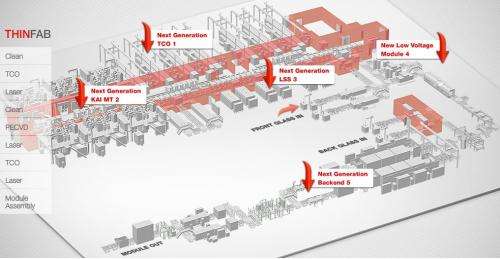
The two partners will support Oerlikon’s lines ("Thinfab") with infrastructure and customer supply-chain requirements. The three are aligned to a strategy to bring costs down. One approving body will be the EU-funded PEPPER project, which focuses on thin film silicon solar research.

PEPPER’s stated goal similarly is to see decreased costs of thin film silicon PV modules within the next three years.

Project supporters emphasize photovoltaics as an emerging power source carrying significant environmental and economic benefits. PV systems are touted as safe, reliable, having a constantly decreasing payback time, and potentially able to create thousands of jobs. At the same time, its weakness at present is easily acknowledged: It continues to be a more expensive approach than grid-supplied electricity produced from conventional sources.

More information: http://www.oerliko … lar/thinfab/

© 2011 PhysOrg.com

4.1 /5 (8 votes)  

Filter


Move the slider to adjust rank threshold, so that you can hide some of the comments.


Display comments: newest first

Dane
Dec 07, 2011

Rank: 1.7 / 5 (6)
"The Oerlikon Solar company said the price advantage being announced, however, is not a given if certain conditions are not met. The manufacturing cost of 0.35 euro per watt will be possible, according to the company, only if production takes place in some regions in China where labor costs are low and where production lines are in full operation."

So only if Chinese labor wages remain very low will this become reality.
Wages are rising in China so I'll bet this will never become as cheap as they claim.

Go nuclear instead...
Shootist
Dec 07, 2011

Rank: 1.6 / 5 (5)
Any way to structure the manufacturing so that the process doesn't pollute (far) more than the burning of an equivalent amount of soft coal?
antialias_physorg
Dec 07, 2011

Rank: 5 / 5 (5)
Any way to structure the manufacturing so that the process doesn't pollute (far) more than the burning of an equivalent amount of soft coal?

What do you mean? That creating a 1W panel should produce less CO2 than burning 0.35 cents worth of coal? Unlikely.

But that's not the point. The point is that over the lifetime of that 1W panel it will produce so much energy that - if you were to burn the enough coal to get the same amount of energy - you would produce a LOT more pollution.
Nanobanano
Dec 07, 2011

Rank: 4.3 / 5 (6)
But that's not the point. The point is that over the lifetime of that 1W panel it will produce so much energy that - if you were to burn the enough coal to get the same amount of energy - you would produce a LOT more pollution.


Much like Glenn Beck, that idiot doesn't get that.

$0.47 per WATT is the projected price of the panel,s o if you had a 220 Watt panel, that would only be $103.40.

But electricity currently cost as much as 15 cents per kilowatt-hour.

So I mean, even if you only get 4 hours of peak output, this panel will pay for itself at current energy costs in 26 months, ignoring hours of partial output...

With an expected product life span of probably 25 to 30 years, this means the final cost of electricity throughout the lifespan of the product will only be around 1 cent per kilowatt-hour, which is so much cheaper compared to grid power that it's laughable...Even by the time you count install and maintenance, it's 2 cent per KWH long term...
Nanobanano
Dec 07, 2011

Rank: 4 / 5 (7)
Now by comparison, if you had an IDEAL internal combustion engine generator running on gasoline, it would take exactly 221 gallons of gasoline to have the same energy value in Joules as 4 hours worth of power from these panels through their expected life span, again, neglecting the ~8 hours per day of partial power.

221 gallons of gasoline at current prices is $700.

But wait, generators aren't anywhere near ideal, they are about 30% efficient, which means you'd really need 3.3333 times as much gasoline to make as much electricity for 25 years, so let's up the ante to737 gallons gasoline, which would cost around $2333.

So for a generator to make this much electricity for 25 years costs, at todays's prices:

$2333 for fuel.
$2000 for the generator

But the generator will probably break down several times, requiring maintenance, repairs, or replacement,s o add another $2000...

yeah, them fossil fuel electricity is "sooo" much better than solar...not...
kochevnik
Dec 07, 2011

Rank: 3.6 / 5 (10)
Go nuclear instead...
Solar IS nuclear powered. Fusion specifically.
Neurons_At_Work
Dec 07, 2011

Rank: 4.5 / 5 (2)
Go nuclear instead...
Solar IS nuclear powered. Fusion specifically.

Okay, that's pretty good. Brevity IS the soul of wit.
Vendicar_Decarian
Dec 07, 2011

Rank: 2 / 5 (4)
"Go nuclear instead..." - Dane

Where do you propose to place the 200,000 nuclear reactors that you will be forcd to build?

RobMF
Dec 07, 2011

Rank: not rated yet
First Solar is on track to deliver .45 cents per watt in 2015. That's with US and European production lines.

Be careful about the rhetoric here. There's a huge push by Chinese firms to kill the US solar industry and dominate this critical market. Recent dumping by Chinese firms in the US has resulted in an investigation which will likely result in tariffs. Furthermore, the cost of production primarily hinges on the bulk cost of glass/silicon. With wages rising in China, the price of labor is likely to mean little, if anything.

The real drivers in solar panel prices going forward will be:

1. The cost of panel production (falling rapidly)
2. The cost of installed capacity (set to fall -- average for utilities is about $3.00 per watt including labor etc and about $6.00 per watt residential)
3. The degree to which governments incentivize this new industry through subsidies, rebates, and other programs.
Vendicar_Decarian
Dec 08, 2011

Rank: 1 / 5 (1)
By 2020 I estimate that I will be using 5Kwh per day of electricity. So 10Kw installed will cost me probably $3,000.

Very nice.
MarkyMark
Dec 08, 2011

Rank: not rated yet
Go nuclear instead...
Solar IS nuclear powered. Fusion specifically.

Sorry meant to give you five stars for the witty post. I myself am considering solar for the long term benifits as well. And the benifits can be pretty good.
Dane
Dec 08, 2011

Rank: not rated yet
"Go nuclear instead..." - Dane

Where do you propose to place the 200,000 nuclear reactors that you will be forcd to build?


You don't need 200,000 reactors. How did come up with such a ridiculous number?
Current total world power need is 14,000 GW which makes around 14,000 1GW reactors, plus 10% back-up (availability factor is 90 % for modern reactors). Makes 15,400 reactors...

I suppose we would have plenty of space not having to cover millions of square miles with PV panels...

Oh BTW, how do we get power from the PV panels at night?
Don't tell me it's going to be battery driven...
antialias_physorg
Dec 08, 2011

Rank: 5 / 5 (2)
Oh BTW, how do we get power from the PV panels at night?
Don't tell me it's going to be battery driven...

Electricity to hydrogen and back
Electricity to hdyropower and back
Solar thermal to molten salt and back
Electricity to pressurized gas and back
...

The possibilities are endless.
Vendicar_Decarian
Dec 11, 2011

Rank: 1 / 5 (1)
200,000 is the number of reactors needed globally to power a
global population of 15 billion people powered strictly by nuclear and consuming energy at U.S. levels of waste.

Feel free to provide your own estimates based on the above criterion, or explain to us why the above criterion are not valid.

"You don't need 200,000 reactors. How did come up with such a ridiculous number?" - Dane
Vendicar_Decarian
Dec 11, 2011

Rank: 1 / 5 (1)
"Oh BTW, how do we get power from the PV panels at night?" - Dane

Some systems capture thermal photons via PV.

But I don't propose using PV at night. Why do you presume I would, or even presume that doing so is necessary?

Are you suffering from a case of terminal stupidity?
Eikka
Dec 11, 2011

Rank: 5 / 5 (1)

But I don't propose using PV at night. Why do you presume I would, or even presume that doing so is necessary?


Logically, one would assume that anyone who advocates grid scale photovoltaic power would also have an answer to the question of what happens at night when the sun don't shine, but people are still using electricity. Or frankly, at any time before 9 AM and after 3 PM when the solar output drops considerably.

PV may be getting cheaper, but how many Hoover Dams would you need to build for a grid buffer to actually use it, and how much would it cost per kWh? And how much would it cost in terms of the environment?

Without grid scale buffering, photovoltaics can only produce between 10-20% of the whole lot because of the low capacity factor due to the limited production hours.
Nanobanano
Dec 11, 2011

Rank: not rated yet
The answer is you have to do some of everything.

Do what works best where you are.

Use as much wind as possible where wind is available.

Use as much solar as possible where solar is available.

And quit crying over every fricken gnat or lizard that dies from a solar boiler plant; coal and other fossil fuels are clearly doing a hell of a lot worse to the ocean life and other environments.
antialias_physorg
Dec 11, 2011

Rank: 5 / 5 (1)
PV may be getting cheaper, but how many Hoover Dams would you need to build for a grid buffer

Another technology furnished an estimate for that: The idea was to create a granite piston 500 meters wide. Water could be pumped underneath with excess electricity during the day and then released at night or when power drops due to cloud cover and low wind.

3 such systems are estimated to be enough to cover all variabilities in a country like germany (at a possible elevation of the piston of 200 meters)

Yes, this is a massive undertaking, but not all that technically complicated. Drilling shafts isn't spectacularly difficult.
Callippo
Dec 11, 2011

Rank: 1 / 5 (1)
Go nuclear instead...
Go cold fusion instead and all the above discussion will remain useless.
Electricity to hydrogen and back
Electricity to hdyropower and back
Solar thermal to molten salt and back
Electricity to pressurized gas and back
Yes, but why all of this? Why not to produce the energy where we are need it and when we need it? Why the one half civilization must be engaged in energy production, transport and storage? Don't we have better things to do? How do you want to colonize the Universe with such approach?
antonima
Dec 11, 2011

Rank: not rated yet
So only if Chinese labor wages remain very low will this become reality.
Wages are rising in China so I'll bet this will never become as cheap as they claim.

Go nuclear instead...


Yes, it means the plants will be running 24 hours a day. Of course, this will be done at the expense of the Chinese. Its efficient though, isn't it mate? ;)

I believe the solution to the energy crisis will come from the enormous amount of thermal energy present everywhere on earth - recycling energy is really the best way to go about things, since it does not require an input of energy into the system and doesn't draw sunlight which is required for photosynthesis.
antialias_physorg
Dec 12, 2011

Rank: 5 / 5 (1)
Don't we have better things to do?

You mean except keeping Earth habitable for the human species? Becuase if we don't do all those things then we won't have an Earth to live on.

Those powerplants which can produce the energy where and when we need it are mostly the kind that will destroy the climate (or at least shift it in a direction that will not allow humanity to survive at current levels).

Biogas is an exception - but it alone cannot supply the amount of energy needed. Fusion might be a way out if we can get it to work. (No, don't even start on the cold fusion hoax)

How do you want to colonize the Universe with such approach?

With any other approach we'll be far too busy dealing with one flood, draught, storm after another to even think about such endeavours.
Vendicar_Decarian
Dec 12, 2011

Rank: 3.7 / 5 (3)
I on the other hand believe in the laws of physics, of which thermodynamics are a part.

"I believe the solution to the energy crisis will come from the enormous amount of thermal energy present everywhere on earth - recycling energy is really the best way to go about things" - anton
kaasinees
Dec 12, 2011

Rank: 1 / 5 (1)
Without grid scale buffering, photovoltaics can only produce between 10-20% of the whole lot because of the low capacity factor due to the limited production hours.

20% solar.
20% hydro.
20% wind.
20% thermal.

One can kick in where the other fails.
maybe some natural gas backup generators just in case.

Maybe some bio-reactors that can capture heat from bio-process then when the bio-process reaches a certain level return biomass to agriculture.

problem?
rawa1
Dec 12, 2011

Rank: 1 / 5 (1)
You mean except keeping Earth habitable for the human species? Becuase if we don't do all those things then we won't have an Earth to live on.
Of course, but there are smarter things how to do it. With cold fusion we could have unlimited source of energy built into every appliance. No wires, no wireless transfer, no batteries, no grid, no power plants, no mines and oil fields in underwater, no oil tankers, no fossil fuel wars. 99% of utilities will remain useless in this paradigm - we will save a much more, than just an energy, but many materials, raw sources and human lifes too. The problem of solar cells is in their economy: even with cold fusion the production of pure silicon and installation will remain as expensive as by now.

Briefly speaking, the ignorance of cold fusion by contemporary civilization is one of the most tragicomic and decadent approaches, which we ever met in human history.
antialias_physorg
Dec 12, 2011

Rank: 5 / 5 (1)
With cold fusion we could have unlimited source of energy

And with magic we could have unlimited energy. Or we could pray for it. Cold fusion is about on the same level of credibility. Putting all your money on that horse is the same as living without power altogether.

So why haven't you invested ina startup for cold fusion yet? Since you're so sure that it will pan out you could be assured of an immense return on investment.

If even proponents like you don't invest - then it's gotta be a hoax.
Rank 4.1 /5 (8 votes)
Relevant PhysicsForums posts

More news stories

Browser wars flare in mobile space

The browser wars are heating up again, but this time the fight is for dominance of the mobile Internet.

Technology / Software

created 13 hours ago | popularity 5 / 5 (2) | comments 3

Probability of contamination from severe nuclear reactor accidents is higher than expected: study

Catastrophic nuclear accidents such as the core meltdowns in Chernobyl and Fukushima are more likely to happen than previously assumed. Based on the operating hours of all civil nuclear reactors and the number ...

Technology / Energy & Green Tech

created May 22, 2012 | popularity 3.7 / 5 (23) | comments 56 | with audio podcast

HyperSolar shows dirty water no barrier to power world

(Phys.org) -- The Santa Barbara, California, company, HyperSolar, is set to transparently share the ups and downs of its research experiences toward the company’s ultimate vision, successfully producing ...

Technology / Energy & Green Tech

created May 24, 2012 | popularity 4.8 / 5 (16) | comments 17 | with audio podcast report

SpotterRF debuts Radar Backpack Kit (w/ Video)

(Phys.org) -- SpotterRF has announced a special radar backpack kit designed to enhance situational awareness for soldiers on the ground. The company says its special radar is designed for warfighters as part ...

Technology / Hi Tech & Innovation

created May 26, 2012 | popularity 5 / 5 (5) | comments 13 | with audio podcast report

Tesla to launch electric sedan in US on June 22

Tesla Motors said Tuesday it would begin deliveries of "the world's first premium electric sedan" on June 22, slightly ahead of schedule.

Technology / Energy & Green Tech

created May 22, 2012 | popularity 4.5 / 5 (12) | comments 18


'Unzipped' carbon nanotubes could help energize fuel cells, batteries

Multi-walled carbon nanotubes riddled with defects and impurities on the outside could replace some of the expensive platinum catalysts used in fuel cells and metal-air batteries, according to scientists at ...

Change in developmental timing was crucial in the evolutionary shift from dinosaurs to birds: study

At first glance, it's hard to see how a common house sparrow and a Tyrannosaurus Rex might have anything in common. After all, one is a bird that weighs less than an ounce, and the other is a dinosaur that ...

Computer model used to pinpoint prime materials for efficient carbon capture

When power plants begin capturing their carbon emissions to reduce greenhouse gases – and to most in the electric power industry, it's a question of when, not if – it will be an expensive undertaking.

T cells 'hunt' parasites like animal predators seek prey, study shows

By pairing an intimate knowledge of immune-system function with a deep understanding of statistical physics, a cross-disciplinary team at the University of Pennsylvania has arrived at a surprising finding: T cells use a movement ...

Land and sea species differ in climate change response: study

(Phys.org) -- Marine and terrestrial species will likely differ in their responses to climate warming, new research by Simon Fraser University and Australia’s University of Tasmania has found.

Yale study concludes public apathy over climate change unrelated to science literacy

Are members of the public divided about climate change because they don't understand the science behind it? If Americans knew more basic science and were more proficient in technical reasoning, would public consensus match ...