Student unleashes electrical power of microbes
November 14, 2011 By Victoria Martinez

Student unleashes electrical power of microbes

Enlarge

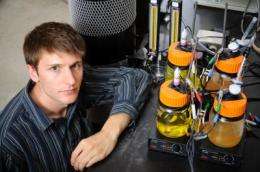
U of S master's student Jonathan Godwin studies electrical fuel cells in his microbial fuel cell lab. Credit: Scott Bell

Jonathan Godwin, a University of Saskatchewan master's student, is improving a new “green” energy source — creating electrical fuel cells from everyday microbes.

“I thought it was fascinating that you could get electricity from a living thing,” Godwin said. “It doesn’t seem possible at first glance.”

It is in fact already possible to generate electrical energy from microbes in fuel cells, but Godwin, under the supervision of chemical engineering professor Richard Evitts, hopes to improve the new technology.

Microbe-based fuel cells are a tantalizing green energy solution — all you need to make one is a circuit, a microbe such as yeast, food for the microbe and chemicals to turn them into an electrical source. The system is so flexible that any organic material, from jelly to garbage, could be used as food for the .

Since biological processes work by passing electrons — it takes energy for microbes to digest food, for example — they all have the potential to create electricity.

Normally, the electrical energy is redirected into a circuit by mixing chemicals called mediators into the food and microbe mixture to allow the harvest of electricity.

But chemical mediators are expensive and often toxic — potentially making toxic all the byproducts of electricity-microbes.

But since “green” and “toxic” can’t exist in the same technology, Godwin is working on a kind of fuel cell that avoids mixing in the dangerous mediators. “Jon has managed to coat electrodes with the mediators so there could be a more direct way of harnessing the electricity,” Evitts said.

In the fuel cell, yeast grows on the chemical-coated electrode. The electricity is collected as a byproduct while the yeast goes through its normal processes of digesting sugar and producing alcohol.

This way, the chemicals don’t turn normal microbial processes into toxic ones. Once researchers master gathering electricity from everyday using coated electrodes, the same principles should be applicable in a variety of microbiological systems.

For example, alcohol-producing yeast can be used for brewing and to produce electricity at the same time. The University of Queensland together with Foster’s Brewing in Australia has already tested a pilot version of a microbial fuel cell set up.

“We’re trying to use systems that produce an already useful byproduct,” Godwin said.

But there is one major drawback to this kind of microbial fuel cell: Mediator-coated electrodes produce a lot less electricity than simply mixing the mediators into the solution.

To amp up the electrical power in their cells, Godwin and Evitts are using another naturally occurring process: Photosynthesis, the process plants use to turn sunlight into energy. In this case, they are adding green microalgae to the system.

“The electrons aid in photosynthesis, which is an energy-intensive process,” Godwin said.

The coated electrode takes electrons from the yeast and sends them through a circuit to the micro-algae, which then use the electrons in photosynthesis. Once this technology is developed, the electrical current flowing through the circuit could be used to power electrical devices.

“This is a fairly new area of research,” he said, adding that high-energy coated fuel cells are still years away from being used on a large scale.

To help pursue his research, Godwin was awarded a graduate teaching fellowship from the U of S engineering college. Evitts is part of a group of researchers awarded a strategic project grant from the Canadian funding agency NSERC to work in the area.

Provided by University of Saskatchewan

4.8 /5 (4 votes)  

Filter


Move the slider to adjust rank threshold, so that you can hide some of the comments.


Display comments: newest first

Isaacsname
Nov 14, 2011

Rank: not rated yet
They could try increasing the surface area of the electrodes by using a coated lattice instead ?
Eikka
Nov 14, 2011

Rank: 5 / 5 (1)
Next, do it the other way around. Make microbes make more microbes using electricity and basic chemicals as the source.

Why? Because then you can grow food using a windmill, and press pellets that are transportable, storable and useful as fuel.
antonima
Nov 14, 2011

Rank: not rated yet
Next, do it the other way around. Make microbes make more microbes using electricity and basic chemicals as the source.

Why? Because then you can grow food using a windmill, and press pellets that are transportable, storable and useful as fuel.


I concur
FMA
Nov 17, 2011

Rank: not rated yet
It takes a lot of energy to stir the wastewater treatment reactors, I don't think the microbes can generate enough energy to offset all the energy input but if it can make 50% of the required energy for stirring, it is still a good news.
Rank 4.8 /5 (4 votes)
Relevant PhysicsForums posts

More news stories

Browser wars flare in mobile space

The browser wars are heating up again, but this time the fight is for dominance of the mobile Internet.

Technology / Software

created 12 hours ago | popularity 5 / 5 (2) | comments 3

Probability of contamination from severe nuclear reactor accidents is higher than expected: study

Catastrophic nuclear accidents such as the core meltdowns in Chernobyl and Fukushima are more likely to happen than previously assumed. Based on the operating hours of all civil nuclear reactors and the number ...

Technology / Energy & Green Tech

created May 22, 2012 | popularity 3.6 / 5 (22) | comments 56 | with audio podcast

HyperSolar shows dirty water no barrier to power world

(Phys.org) -- The Santa Barbara, California, company, HyperSolar, is set to transparently share the ups and downs of its research experiences toward the company’s ultimate vision, successfully producing ...

Technology / Energy & Green Tech

created May 24, 2012 | popularity 4.8 / 5 (16) | comments 17 | with audio podcast report

SpotterRF debuts Radar Backpack Kit (w/ Video)

(Phys.org) -- SpotterRF has announced a special radar backpack kit designed to enhance situational awareness for soldiers on the ground. The company says its special radar is designed for warfighters as part ...

Technology / Hi Tech & Innovation

created May 26, 2012 | popularity 5 / 5 (5) | comments 13 | with audio podcast report

Tesla to launch electric sedan in US on June 22

Tesla Motors said Tuesday it would begin deliveries of "the world's first premium electric sedan" on June 22, slightly ahead of schedule.

Technology / Energy & Green Tech

created May 22, 2012 | popularity 4.5 / 5 (12) | comments 18


Nvidia trumpets Tegra 3 phone design wins for 2012

(Phys.org) -- Nvidia’s competitive war paint has a name, Tegra 3. On the heels of Nvidia announcements about lowering costs of its Tegra 3 processors and Nvidia-enabled tablets running Android Ice Cream ...

'Unzipped' carbon nanotubes could help energize fuel cells, batteries

Multi-walled carbon nanotubes riddled with defects and impurities on the outside could replace some of the expensive platinum catalysts used in fuel cells and metal-air batteries, according to scientists at ...

T cells 'hunt' parasites like animal predators seek prey, study shows

By pairing an intimate knowledge of immune-system function with a deep understanding of statistical physics, a cross-disciplinary team at the University of Pennsylvania has arrived at a surprising finding: T cells use a movement ...

Computer model used to pinpoint prime materials for efficient carbon capture

When power plants begin capturing their carbon emissions to reduce greenhouse gases – and to most in the electric power industry, it's a question of when, not if – it will be an expensive undertaking.

Change in developmental timing was crucial in the evolutionary shift from dinosaurs to birds: study

At first glance, it's hard to see how a common house sparrow and a Tyrannosaurus Rex might have anything in common. After all, one is a bird that weighs less than an ounce, and the other is a dinosaur that ...

Land and sea species differ in climate change response: study

(Phys.org) -- Marine and terrestrial species will likely differ in their responses to climate warming, new research by Simon Fraser University and Australia’s University of Tasmania has found.