SideBySide projection system enables projected interaction between mobile devices
Oct 19, 2011
SideBySide projection system enables projected interaction between mobile devices
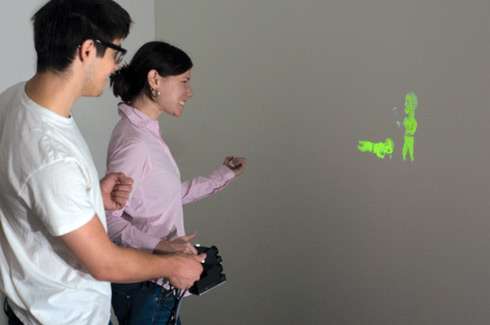
Two-player boxing using the SideBySide system.

Researchers at Disney Research, Pittsburgh, and Carnegie Mellon University have devised a system called SideBySide that enables animated images from two separate handheld projectors to interact with each other on the same surface.

The system, suitable for games, education and a variety of other applications, is self-contained in special . No external cameras or other sensors are required, which enables people to use the projectors to interact with each other anywhere and at anytime. SideBySide also can be used to exchange contact information, or even share data files. The technology can spur a more participatory and intimate style of interaction than is possible with computers or overhead projectors.

"Smartphones have made it possible for us to communicate, play games and retrieve information from the Web wherever we might be, but our interaction with the devices remains a largely solitary, single user experience," said Karl D.D. Willis, a Ph.D. candidate in computational design at Carnegie Mellon and a lab associate at Disney Research. "Now that handheld projectors have become a reality, we finally have a technology that allows us to create a new way for people to interact in the real world."

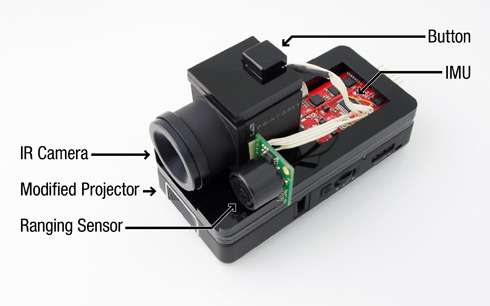
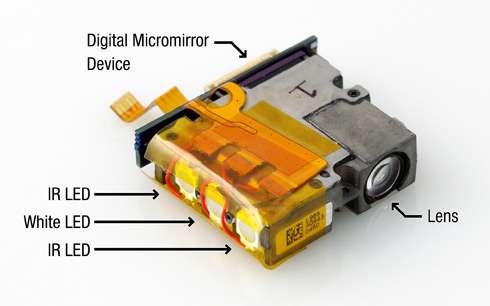
The handheld projectors are hybrid devices that emit both visible and and contain a camera for monitoring the projected images, a ranging sensor and an inertial measurement unit.
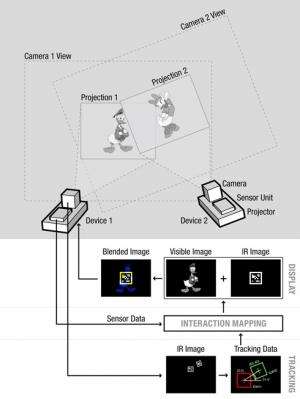
The SideBySide system overview.

The infrared channel plays a key role in enabling interaction. It is used to project markers that help the system recognize when the images are moving or overlapping and to communicate information between the devices.
SideBySide projection system enables projected interaction between mobile devices
The SideBySide prototype device

The researchers have developed a number of applications to demonstrate the capabilities of the technology. Games include Boxing, in which matches are performed without a ring; Cannon, in which players knock a stack of bricks off a platform by firing a cannon ball from one screen to another; and Gorilla, in which one player uses a plane and a net to catch the other player's gorilla. They also have developed a 3D viewer, which allows two users to control and explore a 3D model together, and applications for exchanging contact information and transferring files. A question & answer application can be used to teach basic vocabulary to young children.
SideBySide projection system enables projected interaction between mobile devices
The SideBySide projection engine.

Willis will discuss SideBySide on Wednesday, Oct. 19 at the Association for Computing Machinery's Symposium on User Interface Software and Technology (UIST) in Santa Barbara, Calif. Conference organizers already have presented SideBySide with UIST's best paper and best demonstration awards. In addition to Willis, the SideBySide development team included Ivan Poupyrev and Moshe Mahler of Disney Research and Scott Hudson, professor in Carnegie Mellon's Human-Computer Interaction Institute.

Explore further: Inventor creates Card Beams with 3D printer

More information: www.disneyresearch.com/research/projects/hci_sidebyside_drp.htm

Related Stories

Casio shows off bulbless 3D-capable projectors

Jun 15, 2011

(PhysOrg.com) -- Casio is currently showing off a line of lamp free projectors, designed for work in corporate and educational settings. The system eliminates the lamp by relying on a system that combines ...

3D, 360-degree fog display shown off (w/ video)

Mar 18, 2011

(PhysOrg.com) -- Any fan of Star Trek knows about the joys of the holodeck. The idea of a 3D, 360-degree immersive digital environment, projected on demand, is an enticing one that has thus far been confined ...

Perfect projections on surfaces of any shape

Aug 29, 2007

Projecting brilliantly sharp images as a single picture onto curved surfaces has previously been a very elaborate and expensive process. Now a new software system automatically calibrates the projectors needed so that the ...

Recommended for you

Inventor creates Card Beams with 3D printer

7 hours ago

What are card beams, you may ask? They are the building toy that allows you to build gravity-defying houses of cards with the help of friction, gravity, and two types of beams - the cap and the connector.

With high-tech guns, users could disable remotely

May 21, 2013

A high-tech startup is wading into the gun control debate with a cellphone controller that would allow gun owners to know when their weapon is being moved—and disable it remotely.

Game system castAR debuts at Maker Faire

May 21, 2013

(Phys.org) —Two tech talents, formerly employees at video game publisher Valve, have been working on their own vision in the form of game-ready glasses. Their company, Technical Illusions, will seek to ...

China police billions spell profit opportunity

May 19, 2013

Mannequins in riot gear, armoured cars and drones line a police equipment and "anti-terrorism technology" trade fair in Beijing as vendors seek to profit from China's huge internal security budget.

User comments : 0

More news stories

Google Drive sports new view and scan enhancements

(Phys.org) —Google Drive has a new look and functions. The makeover in Google Drive features scanning and interface enhancements that put the user into "card" mode. The enhancements make it easy for the ...

Solar Kettle allows for boiling water off the grid

(Phys.org) —A company called Contemporary Energy has unveiled a new device it calls the Solar Kettle. It looks very much like a normal coffee thermos, but has flaps on one side that open to allow for collecting ...

Review: Google music plan solid, serendipitous

Google's new music service offers a lot of eye candy to go with the tunes. The song selection of around 18 million tracks is comparable to popular services such as Spotify and Rhapsody, and a myriad of playlists ...

Controlling mood through the motions of mitochondria

(Medical Xpress)—Regulating the distribution of power in neurons is done by a system that makes the national electric grid look simple by comparison. Each neuron has several thousand mitochondria confined ...