Breakthrough furnace can cut solar costs
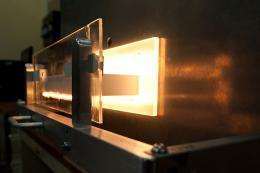
(PhysOrg.com) -- Solar cells, the heart of the photovoltaic industry, must be tested for mechanical strength, oxidized, annealed, purified, diffused, etched, and layered.
Heat is an indispensable ingredient in each of those steps, and that's why large furnaces dot the assembly lines of all the solar cell manufacturers. The state of the art has been thermal or rapid-thermal-processing furnaces that use radiant or infrared heat to quickly boost the temperature of silicon wafers.
Now, there's something new.
A game-changing Optical Cavity Furnace developed by the U.S. Department of Energy's National Renewable Energy Laboratory uses optics to heat and purify solar cells at unmatched precision while sharply boosting the cells' efficiency.
The Optical Cavity Furnace (OCF) combines the assets that photonics can bring to the process with tightly controlled engineering to maximize efficiency while minimizing heating and cooling costs.
NREL's OCF encloses an array of lamps within a highly reflective chamber to achieve a level of temperature uniformity that is unprecedented. It virtually eliminates energy loss by lining the cavity walls with super-insulating and highly reflective ceramics, and by using a complex optimal geometric design. The cavity design uses about half the energy of a conventional thermal furnace because in the OCF the wafer itself absorbs what would otherwise be energy loss. Like a microwave oven, the OCF dissipates energy only on the target, not on the container.
Different configurations of the Optical Cavity Furnace use the benefits of optics to screen wafers that are mechanically strong to withstand handling and processing, remove impurities (called impurity gettering), form junctions, lower stress, improve electronic properties, and strengthen back-surface fields.
Making 1,200 Highly Efficient Solar Cells per Hour
NREL researchers continue to improve the furnace and expect it to be able soon to hike the efficiency by 4 percentage points, a large leap in an industry that measures its successes a half a percentage point at a time. "Our calculations show that some material that is at 16 percent efficiency now is capable of reaching 20 percent if we take advantage of these photonic effects," NREL Principal Engineer Bhushan Sopori said. "That's huge."
Meanwhile, NREL and its private-industry partner, AOS Inc., are building a manufacturing-size Optical Cavity Furnace capable of processing 1,200 wafers an hour.
At about a quarter to half the cost of a standard thermal furnace, the OCF is poised to boost the solar cell manufacturing industry in the United States by helping produce solar cells with higher quality and efficiency at a fraction of the cost.
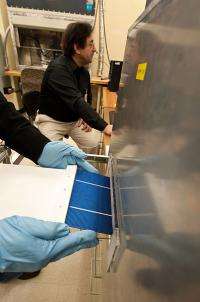
The furnace's process times also are significantly shorter than conventional furnaces. The Optical Cavity Furnace takes only a few minutes to process a solar wafer.
NREL has cooperative research and development agreements with several of the world's largest solar-cell manufacturers, all intrigued by the OCF's potential to boost quality and lower costs.
R&D 100 Award Winner
NREL and AOS shared a 2011 R&D 100 Award for the furnace. The awards, from R&D Magazine, honor the most important technological breakthroughs of the year.
Billions of solar cells are manufactured each year. A conventional thermal furnace heats up a wafer by convection; a Rapid-Thermal-Processing furnace uses radiative heat to boost the temperature of a silicon wafer up to 1,000 degrees Celsius within several seconds.
In contrast to RTP furnaces, the Optical Cavity Furnace processing involves wafer heating at a relatively slower rate to take advantage of photonic effects. Slower heating has an added advantage of significantly lowering the power requirements and the energy loss, so it can boost efficiency while lowering costs.
"With all solar cells, optics has a big advantage because solar cells are designed to absorb light very efficiently," NREL Principal Engineer Bhushan Sopori said. "You can do a lot of things. You can heat it very fast and tailor its temperature profile so it's almost perfectly uniform."
In fact, the OCF is so uniform, with the help of the ceramic walls, that when the middle of the wafer reaches 1,000 degrees Celsius, every nook and cranny of it is between 999 and 1,001 degrees.
"The amazing thing about this is that we don't use any cooling, except some nitrogen to cool the ends of the 1-kilowatt and 2-kilowatt lamps," Sopori said. That, of course, dramatically lowers the energy requirements of the furnace.
The use of photons also allows junctions to be formed quicker and at lower temperatures.
As America strives to reach the goal of 80 percent clean energy by 2035, the White House and the U.S. Department of Energy are challenging the solar industry to reach the goal of $1 per watt for installed solar systems. To reach that goal, manufacturers need better, less expensive ways to make solar cells. At $250,000, the Optical Cavity Furnace can do more, do it quicker, and do it at a lower capital cost than conventional furnaces.
Twenty Years of Great Ideas
For more than two decades, Sopori had great ideas for making a better furnace.
He knew that incorporating optics could produce a furnace that could heat solar cells, purify them, ease their stress, form junctions and diffuse just the right amount of dopants to make them more efficient.
"It's always easy on paper," Sopori said recently, recalling the innovations that worked well on paper and in the lab, but not so well in the real world. "There are moments … you realize that no one has ever done something like this. Hopefully it will work, but there are always doubts."
Trouble was, he'd come up with some elegant theoretical solutions involving optics, but wasn't able to combine them with the optimal geometry and materials of a furnace. "We've had a whole bunch of patents (12) to do these things, but what we were missing was an energy-efficient furnace to make it possible," Sopori said.
And then, combining his expertise in optics with some ingenious engineering with ceramics, he had his ah-ha moment:
NREL's Optical Cavity Furnace uses visible and infrared light to uniformly heat crystalline silicon wafers, especially at the edges, which are prone to cooling or heat loss, at unprecedented precision. The rays heat the sample, but the wafer never physically contacts the lamps.
The Optical Cavity Furnace is versatile. Each step in the solar cell manufacturing process typically requires a different furnace configuration and temperature profile. However, with the OCF, a solar cell manufacturer simply tells a computer (using NREL proprietary software) what temperature profile is necessary for processing a solar cell.
So, the OCF can perform five different process steps without the retooling and reconfiguration required by the furnaces used today, all the while incrementally improving the sunlight-to-electricity conversion efficiency of each solar cell.
Provided by National Renewable Energy Laboratory


