Toyota three-wheeler does 80.3 mph on compressed air
September 24, 2011 by Nancy Owano report

Toyota three-wheeler does 80.3 mph on compressed air

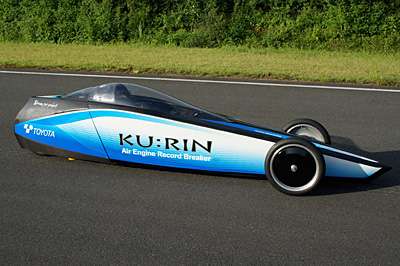
(PhysOrg.com) -- Toyota Industries intends to apply for a Guiness World record for the fastest car driven by a compressed-air engine, after its Ku:Rin, as the vehicle is called, reached 129.2km/h (80.3 mph)on a test run earlier this month. This is a three-wheel, one-seater vehicle that broke the speed record for compressed air-powered vehicles at the Japan Automobile Research Institute test facility.

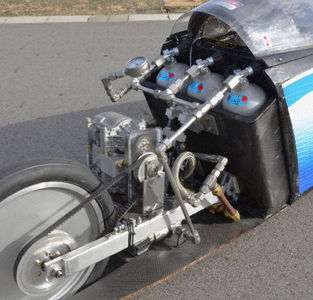
The Ku:Rin is yet another attempt to explore environmentally friendly modes of transport. The tank was filled using a conventional air-conditioner compressor manufactured by Toyota.

The was developed at the company’s Dream Car Workshop, where its engineers made use of the principle of compressed air, which Toyota knows more than a little about. The company is recognized for its expertise in compressors that are part of air conditioners. Toyota turns out about 20 million compressors for car air-conditioners per year; the company is the world's largest supplier of car air- conditioner compressors, in addition to making automobiles, engines and electronics components.
Toyota three-wheeler does 80.3 mph on compressed air
Toyota staged a media viewing of the car earlier this week at a factory in Aichi Prefecture. The car is described by observers as a "sleek rocket," or "a pencil-shaped rocket," and, maybe not as kindly, an "eco-friendly tricycle." The vehicle is said to be interesting but not practical. The driving range is a key reason why skeptics say it is impractical, at least under its present stage of development.

The car offers a driving range of only 2 miles (3.2 km). As with battery powered cars, the marketable barrier remains range, or what is being more frequently called range jitters. The distance the Ku:Rin can go would only be 2 miles without replenishing the air in the cylinders.

This video is not supported by your browser at this time.

According to reports, a number of companies, besides Toyota, are working on air-powered cars but they are all in the research phase. Likewise, the Ku:Rin was designed and built by a group of engineers at the Dream Car Workshop, which is a Toyota sandbox/incubator for innovative ideas.

Company engineers gather there outside work hours to engage in development projects. One of the engineers, Kenta Nakauchi, told NHK TV that they are not thinking about putting the car into production. Instead, they want to use their expertise to design unique cars. At the same time, they are not walking away from the challenge of drawbacks.

said it will keep working on extending the travel distance.

© 2011 PhysOrg.com

4.8 /5 (10 votes)  

Filter


Move the slider to adjust rank threshold, so that you can hide some of the comments.


Display comments: newest first

CHollman82
Sep 24, 2011

Rank: 3 / 5 (2)
Yeah but how many miles per gallon does it get?
Isaacsname
Sep 24, 2011

Rank: 3.7 / 5 (3)
Sounds like a bunch of hot air to me :)
italba
Sep 24, 2011

Rank: not rated yet
0.8 meters ARE NOT 9.6 inches! Anyway, last week a bicycle reached about the same speed... Toyota advertising?
ubavontuba
Sep 24, 2011

Rank: not rated yet
This could be adapted for use on bikes and vehicles to conserve deceleration and down hill energy.

And, shock absorbers could be used as little compressors to conserve rough ride energy.
Newbeak
Sep 24, 2011

Rank: not rated yet
Compressed air powered cars are old news:http://www.youtub...wropRMME
Norezar
Sep 25, 2011

Rank: 1 / 5 (2)
Maybe we could put all the politicians and clowns whining over "Global Warming" to work at "gas stations" for fueling these vehicles.
Rank 4.8 /5 (10 votes)
Relevant PhysicsForums posts

More news stories

Browser wars flare in mobile space

The browser wars are heating up again, but this time the fight is for dominance of the mobile Internet.

Technology / Software

created 11 hours ago | popularity 5 / 5 (1) | comments 3

Probability of contamination from severe nuclear reactor accidents is higher than expected: study

Catastrophic nuclear accidents such as the core meltdowns in Chernobyl and Fukushima are more likely to happen than previously assumed. Based on the operating hours of all civil nuclear reactors and the number ...

Technology / Energy & Green Tech

created May 22, 2012 | popularity 3.6 / 5 (22) | comments 56 | with audio podcast

HyperSolar shows dirty water no barrier to power world

(Phys.org) -- The Santa Barbara, California, company, HyperSolar, is set to transparently share the ups and downs of its research experiences toward the company’s ultimate vision, successfully producing ...

Technology / Energy & Green Tech

created May 24, 2012 | popularity 4.8 / 5 (16) | comments 17 | with audio podcast report

SpotterRF debuts Radar Backpack Kit (w/ Video)

(Phys.org) -- SpotterRF has announced a special radar backpack kit designed to enhance situational awareness for soldiers on the ground. The company says its special radar is designed for warfighters as part ...

Technology / Hi Tech & Innovation

created May 26, 2012 | popularity 5 / 5 (5) | comments 13 | with audio podcast report

Tesla to launch electric sedan in US on June 22

Tesla Motors said Tuesday it would begin deliveries of "the world's first premium electric sedan" on June 22, slightly ahead of schedule.

Technology / Energy & Green Tech

created May 22, 2012 | popularity 4.5 / 5 (12) | comments 18


Land and sea species differ in climate change response: study

(Phys.org) -- Marine and terrestrial species will likely differ in their responses to climate warming, new research by Simon Fraser University and Australia’s University of Tasmania has found.

'Unzipped' carbon nanotubes could help energize fuel cells, batteries

Multi-walled carbon nanotubes riddled with defects and impurities on the outside could replace some of the expensive platinum catalysts used in fuel cells and metal-air batteries, according to scientists at ...

T cells 'hunt' parasites like animal predators seek prey, study shows

By pairing an intimate knowledge of immune-system function with a deep understanding of statistical physics, a cross-disciplinary team at the University of Pennsylvania has arrived at a surprising finding: T cells use a movement ...

Computer model used to pinpoint prime materials for efficient carbon capture

When power plants begin capturing their carbon emissions to reduce greenhouse gases – and to most in the electric power industry, it's a question of when, not if – it will be an expensive undertaking.

Change in developmental timing was crucial in the evolutionary shift from dinosaurs to birds: study

At first glance, it's hard to see how a common house sparrow and a Tyrannosaurus Rex might have anything in common. After all, one is a bird that weighs less than an ounce, and the other is a dinosaur that ...

Nvidia trumpets Tegra 3 phone design wins for 2012

(Phys.org) -- Nvidia’s competitive war paint has a name, Tegra 3. On the heels of Nvidia announcements about lowering costs of its Tegra 3 processors and Nvidia-enabled tablets running Android Ice Cream ...