Antonov creates a 3-speed transmission for electric cars
July 5, 2011 by Katie Gatto weblog

Antonov creates a 3-speed transmission for electric cars

(PhysOrg.com) -- There are a surprising number of designs out there for electric cars. Most of the design innovations are about creating a more efficient design. While this has meant, for the most part, that design innovations have focused on the creation of better batteries or other fuel cells to power the car but those are not the only ways to improve the electric engines.

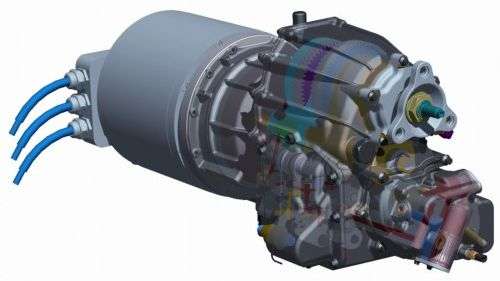
Recently Antonov Plc, a U.K. based engineering firm has decided to take a look at a different system on the electric vehicle and give the transmission an update. They have created a 3-speed transmission that is designed specifically for electric vehicles, which are designed to bring gains in the area of . The transmissions design details were shared at a presentation at the IDTechEX Electric vehicles conference that took place in Stuttgart this week.

You may wonder why one would want to use a 3-speed transmission in an electric vehicle? While most electric engines reach their full torque at 0 rpm, which has lead the majority of developers to believe that only one speed is needed, the efficiency of electric motors still varies at different speeds and variable efficiency. So while the engine may be a peek efficient when it reaches 90%, at lower speeds the engine may be working at 70% or even 60% of capacity. This means a multi-speed transmission can optimize the at different speeds.

This design change has taken the IDTechEx Land Sea Air "Technology Award" for the most significant EV technical development in the past two years. No word yet on when this innovation will show up in a consumer ready car.

More information: http://www.antonov … ransmissions
via Gizmag

© 2010 PhysOrg.com

4.8 /5 (9 votes)  

Filter


Move the slider to adjust rank threshold, so that you can hide some of the comments.


Display comments: newest first

_nigmatic10
Jul 05, 2011

Rank: 4.2 / 5 (5)
Such an innovation shouldn't be limited to EV's. Every electric motor in the world could benefit from the design. Better and more efficient fans, etc. If there is an optimal speed of the motor that uses less electricity while supplying a higher gain, then this should change everything. Imagine a standard oscillating fan that runs at setting 1(low) power consumption while putting out setting 3(high) speed, as an example.
Decimatus
Jul 05, 2011

Rank: not rated yet
Is that a purely electircal transmission or gear based?
EWH
Jul 05, 2011

Rank: 5 / 5 (4)
There are some typos in the article. "a peek efficient when it reaches 90%" should be "at peak efficiency when it reaches 90%". It is not clear whether this means 90% of maximum RPM or 90% is the maximum efficiency. Also "Technology Award" should not be in quotes.
Doug_Huffman
Jul 05, 2011

Rank: 5 / 5 (2)
Imagine a ... fan that runs at setting 1(low) power consumption while putting out setting 3(high) speed, as an example.
That's not how pumps and fans work and not what this transmission is intended to accomplish. See the Affinity Laws, see the definition of gain.
mrlewish
Jul 05, 2011

Rank: 3 / 5 (2)
I suspect that this will be like chasing a greasy pig. While yes there is some difference in electric motors at different speed and that 90% max speed it about the maximum efficiency I suspect that the extra weight and loss of energy that occurs when energy is transferred through more gears plus the extra cost of a more complex system will eat up any energy savings envisioned by a transmission.
trylogic
Jul 06, 2011

Rank: 5 / 5 (1)
Having a mechanically multi geared electric motor for driving electric vehicles makes sense to me. As mentioned in the article, electric motors are more efficient at higher speeds (say 1500 to 3500 rpm), which is difficult to match with the rpm of vehicle wheels at various and extended driving conditions.
I am driving an electric bicycle with a hub motor incorporating a single planetary gear with a gear ratio of 1 to 4.8. The motor (including gear) is more efficient and half the weight of direct drive bicycle hub motors with similar power output.
antialias_physorg
Jul 06, 2011

Rank: 5 / 5 (1)
As always this needs to be weighed carefully. For cars I can see that this makes a lot of sense.
For other applications it might not make sense. Weight and increased frequency of service/repairs might eat up the savings through better efficiency.
As always this need sto be evaluated on a case-by-case basis.
finitesolutions
Jul 06, 2011

Rank: 4 / 5 (1)
Now you have to worry about changing gears too. If this is automatic and reliable I have no problems with it.
It does make sense to run the electrical engine at a constant most efficient rpm and increase the speed of vehicle with gear ratios. Makes lots of sense.
Thus the main purpose of this interposed gearbox is to save energy otherwise wasted by the electrical engine running at a less efficient rpm.
tadchem
Jul 06, 2011

Rank: not rated yet
"the efficiency of electric motors still varies at different speeds and variable efficiency"
???
tadchem
Jul 06, 2011

Rank: not rated yet
"a peek efficient "?
Could someone take a second look at the copy before going online with it?
RJS
Jul 06, 2011

Rank: not rated yet
Typos aside, gears can make sense.
I have a one speed NEV; if it had 3 and the 2nd was the current final ratio it could climb steeper hills (slower, but at least possible) and go faster on the flats (it winds out). Final ratio X torque ultimately defines the steepest hill possible, while power defines the speed at which you climb. And, at high speed, all motors have an RPM limit, and drop-off in efficiency. Top gear should match the motor's maximum _power_ with max vehicle speed at that power. Lower gears enhance hill climb and acceleration.
The Tesla motor has no tranny as it is cooled, electronically controlled, revs to 14000RPM, and its performance meets design goals. They admitted it was quicker with the original 2 speed.
krundoloss
Jul 06, 2011

Rank: 5 / 5 (2)
It seems that putting the motor in the wheels is much more intelligent and intuitive. Why are we still centralizing the motor? It is much simpler to make the wheel itself the motor and not mess with all this other stuff.
Temple
Jul 06, 2011

Rank: not rated yet
When I think about the massive amount of energy needed by the infrastructure and the mining the material for these components, add that to the energy required to build, install, and maintain them, and finally factor in all the energy required to operate the inherently lossy gearing and not to mention push around the added weight of these transmissions, it really makes me wonder just how much energy is being saved by their higher efficiency.
CapitalismPrevails
Jul 06, 2011

Rank: not rated yet
"most electric engines reach their full torque at 0 rpm" ? I don't get it. I thought having torque meant having pulling power.
antialias_physorg
Jul 07, 2011

Rank: not rated yet
It seems that putting the motor in the wheels is much more intelligent and intuitive. Why are we still centralizing the motor?

This has been done (and yes, it is good from an efficiency standpoint). However, it is not good from a weight distribution standpoint. The driving characteristics suffer. So currently the centralized approach seems best.

With the advent of lighter electric motors that might change again.

"most electric engines reach their full torque at 0 rpm" ? I don't get it. I thought having torque meant having pulling power.

Electric engines that reach their full torque at 0rpm simply exert the strongest force from a standing start.
Combustion engines usually perform pretty badly at that point. (This is why over the quarter mile electric cars can outperform even the most high powered drag racers)
Objectivist
Jul 10, 2011

Rank: not rated yet
Why not focusing on designing a viable CVT instead?
Vendicar_Decarian
Jul 10, 2011

Rank: not rated yet
"Why are we still centralizing the motor?" - whomever

Because it is safer in that it doesn't require close monitoring of the speed differentials of multiple motors with steering compensation.

Vendicar_Decarian
Jul 10, 2011

Rank: not rated yet
"Why not focusing on designing a viable CVT instead?" - Objectivist

No need. There are several designs already available, and in common use.

http://www.youtub...=related

http://www.youtub...=related
Eikka
Jul 10, 2011

Rank: 5 / 5 (1)
I suspect that this will be like chasing a greasy pig. While yes there is some difference in electric motors at different speed and that 90% max speed it about the maximum efficiency I suspect that the extra weight and loss of energy that occurs when energy is transferred through more gears plus the extra cost of a more complex system will eat up any energy savings envisioned by a transmission.


Electric motors get the best efficiency at their nominal speed, from where it goes down to about 60-70% at around 25% of the nominal speed, and then drops all the way down to zero towards zero RPM.

The standstill full torque is zero efficiency because the motor is using power, but the car is not moving - yet.

When you have only one gear to go 80 mph at the nominal speed, you will spend a great deal of your time in the 25% speed region when driving around the city.

A single extra gear contact loses 3-5% points in efficiency at top speed, but gains up to 20-30% points at low speeds.
macsglen
Jul 10, 2011

Rank: not rated yet
"Why are we still centralizing the motor?" - whomever

Because it is safer in that it doesn't require close monitoring of the speed differentials of multiple motors with steering compensation.

There's a better answer above, but just to add my own 2 cents worth -- I believe that the speed differentials could very easily be handled by microprocessor control. The only problem I could foresee in that case would be if the motors had a lot of inertia (massive rotors) causing a lag in response time between signal and speed change. And that, of course, would be solved by using a geared motor which would respond more rapidly to demands for speed change.
RJS
Jul 11, 2011

Rank: not rated yet
Motors in the wheels (heavy wheels) ride like a tank.
Suspension response is the Ratio of sprung/unsprung weight.
I have a light van with 80lb wheels/drums and a Mercedes with 20 lb magnesium wheels/disks; the difference when hitting a speed bump is night and day.
Jaguar puts their disks in next to the diff for that reason, it rides even nicer.
Eikka
Jul 11, 2011

Rank: not rated yet
Why not in-wheel motors:

- worse power-to-weight ratio
- more mass for the suspension to deal with
- makes ride quality worse
- single-speed -> efficiency issues
- more fragile
- more expensive

In-wheel motors are relatively low speed motors, which requires the use of strong magnetics and thick copper wirings to make enough torque to make enough power to make it move, and electric motors are actually bad at making torque despite the fact that they can.

It's because it's very inefficient to maintain a magnetic field with an electric current. After the coil current reaches its maximum, it's simply turning into heat without adding any more energy to the magnetic field, and thus no more work is added to the spinning rotor.
Objectivist
Jul 12, 2011

Rank: not rated yet
"Why not focusing on designing a viable CVT instead?" - Objectivist

No need. There are several designs already available, and in common use.

http://www.youtub...=related
HSD != CVT
Rank 4.8 /5 (9 votes)
Relevant PhysicsForums posts

More news stories

Browser wars flare in mobile space

The browser wars are heating up again, but this time the fight is for dominance of the mobile Internet.

Technology / Software

created 3 hours ago | popularity 5 / 5 (1) | comments 2

Probability of contamination from severe nuclear reactor accidents is higher than expected: study

Catastrophic nuclear accidents such as the core meltdowns in Chernobyl and Fukushima are more likely to happen than previously assumed. Based on the operating hours of all civil nuclear reactors and the number ...

Technology / Energy & Green Tech

created May 22, 2012 | popularity 3.6 / 5 (21) | comments 56 | with audio podcast

SpotterRF debuts Radar Backpack Kit (w/ Video)

(Phys.org) -- SpotterRF has announced a special radar backpack kit designed to enhance situational awareness for soldiers on the ground. The company says its special radar is designed for warfighters as part ...

Technology / Hi Tech & Innovation

created May 26, 2012 | popularity 5 / 5 (5) | comments 12 | with audio podcast report

HyperSolar shows dirty water no barrier to power world

(Phys.org) -- The Santa Barbara, California, company, HyperSolar, is set to transparently share the ups and downs of its research experiences toward the company’s ultimate vision, successfully producing ...

Technology / Energy & Green Tech

created May 24, 2012 | popularity 4.8 / 5 (15) | comments 17 | with audio podcast report

Tesla to launch electric sedan in US on June 22

Tesla Motors said Tuesday it would begin deliveries of "the world's first premium electric sedan" on June 22, slightly ahead of schedule.

Technology / Energy & Green Tech

created May 22, 2012 | popularity 4.5 / 5 (11) | comments 18


Nvidia trumpets Tegra 3 phone design wins for 2012

(Phys.org) -- Nvidia’s competitive war paint has a name, Tegra 3. On the heels of Nvidia announcements about lowering costs of its Tegra 3 processors and Nvidia-enabled tablets running Android Ice Cream ...

Scientist: Evolution debate will soon be history

(AP) -- Richard Leakey predicts skepticism over evolution will soon be history. Not that the avowed atheist has any doubts himself.

Dell tablet leak: 10.1-inch display, two-battery choice

(Phys.org) -- Headline after headline talks about vendors’ tablets in the wings as likely number-one contenders for the iPad. Such claims have justifiably been taken with a grain of salt, considering ...

Keep food safety in mind this memorial day weekend

(HealthDay) -- Picnics, parades and cookouts are as much a part of Memorial Day weekend as tributes to the United States' war veterans.

Family history of Alzheimer's affects functional connectivity

(HealthDay) -- Cognitively normal individuals with a family history of late-onset Alzheimer's disease (AD) may display lower resting state functional connectivity in the default mode network (DMN) of the brain, ...

Social welfare cuts ultimately come with heavy price, researchers say

(Phys.org) -- Slashing government funding for Medicaid, food stamps and other programs that serve the poor – while politically popular with some lawmakers and many conservatives – may do more harm ...