Large Hadron Collider smashes another record
May 23, 2011

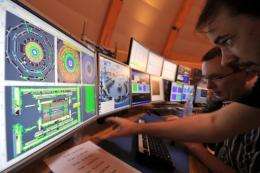
Scientists look at computer screens to examine activity in the Large Hadron Collider

Enlarge

European Organization for Nuclear Research (CERN) scientists look at computer screens showing traces on the Atlas experiment of the first protons injected in the Large Hadron Collider (LHC) during its switch-on operation in 2008 near Geneva. It set a new record early Monday, a feat that should accelerate the quest to pinpoint the elusive particle known as the Higgs Boson.

The world's biggest particle collider set a new record early Monday, a feat that should accelerate the quest to pinpoint the elusive particle known as the Higgs Boson, a senior physicist said.

"Last night, a symbolic frontier was crossed," said Michel Spiro, president of the board of the European Organisation for (), explaining that the rate of sub-atomic smashups in its vast machine had multiplied 10-fold in the space of a month.

CERN's Large Hadron Collider (LHC) is housed in a 27-kilometre (16.9-mile) ring-shaped tunnel 100 metres (325 feet) below ground, straddling the French-Swiss border.

It is designed to accelerate beams of to nearly the in contra-rotating directions.

Then, using magnets, the beams are then directed into labs where some of the protons collide while others escape.

Detectors record the seething sub-atomic debris, hoping to find traces of particles that can strengthen fundamental understanding of physics.

A month ago, the LHC set a record of 10 million collisions per second.

Director General of the European Organization for Nuclear Research (CERN), Rolf-Dieter Heuer
Enlarge

The director general of the European Organization for Nuclear Research (CERN), Rolf-Dieter Heuer, speaks to journalists in May 2011. CERN runs the world's biggest particle collider, located on the outskirts of Geneva. It set a new record, a feat that should accelerate the quest to pinpoint the elusive particle known as the Higgs Boson, a senior physicist said.

"This is now 100 million collisions per second," Spiro said at a conference in Paris on the "infinitely small and the infinitely big."

Among the puzzles that physicists are seeking to answer is the existence of the Higgs, which has been dubbed "the " for being mysterious yet ubiquitous.

If found, it would explain the nature of mass, filling a major piece of the theoretical construct of physics known as the .

In London last week, CERN physicists said they believed that by the end of 2012 they could determine once and for all whether the Higgs existed or not.

Spiro said that this search would certainly be helped by the stepped-up pace of collision, which is the equivalent to sifting more earth in search of nuggets of gold.

"If we're lucky, and it (the Higgs) is in the right zone for expected mass, we may be able to find it this summer," he said. "On the other hand, ruling it out will take us to the end of next year."

To provide a confirmation would require notching up "at least 15" detections, he said.

The first proton collisions at the occurred on September 10, 2008. The smasher then had to endure a 14-month shutdown to fix technical problems.

It had been due to shut down in early 2012 for work enabling it to crank up to full power. But a decision was made several weeks ago to delay closure for a year to help the Higgs hunt.

(c) 2011 AFP

4.8 /5 (27 votes)  

Filter


Move the slider to adjust rank threshold, so that you can hide some of the comments.


Display comments: newest first

Yellowdart
May 23, 2011

Rank: 1.3 / 5 (42)
"This is now 100 million collisions per second," Spiro said at a conference in Paris on the "infinitely small and the infinitely big."
Among the puzzles that physicists are seeking to answer is the existence of the Higgs, which has been dubbed "the God particle" for being mysterious yet ubiquitous.


When you do most things 100 million times without results...at least the results your looking for, most people quit.

Isn't this the definition of insanity? Doing it over and over, expecting different results?

Sounds eerily like "Hey let's just build this tower taller so we can reach heaven..."
sirachman
May 23, 2011

Rank: 4.8 / 5 (5)
It would be nice to have a link to the video discussed in the article.
SemiNerd
May 23, 2011

Rank: 4.4 / 5 (29)
"This is now 100 million collisions per second," Spiro said at a conference in Paris on the "infinitely small and the infinitely big."
Among the puzzles that physicists are seeking to answer is the existence of the Higgs, which has been dubbed "the God particle" for being mysterious yet ubiquitous.


When you do most things 100 million times without results...at least the results your looking for, most people quit.

Isn't this the definition of insanity? Doing it over and over, expecting different results?

Sounds eerily like "Hey let's just build this tower taller so we can reach heaven..."

Please respond with scientific criticism. This is a science forum. I understand you have no idea what the article is about, but your criticisms are not rational.
Yellowdart
May 23, 2011

Rank: 1.5 / 5 (35)
Please respond with scientific criticism. This is a science forum. I understand you have no idea what the article is about, but your criticisms are not rational.


This is actually a science news webpage with a comment section.

Which I'm free to comment freely on. My criticism does not have to be "science" related. It can be journalism related or even simply logically related.

For this article, I'm merely asking at what point do they quit chasing it or try something else, because so far, the more than trillions of collisions haven't produced the Higgs.

At what point do we declare it's a dead horse or stop beating it? I think that's a valid question.
Nanoparticler
May 23, 2011

Rank: 4.6 / 5 (22)

For this article, I'm merely asking at what point do they quit chasing it or try something else, because so far, the more than trillions of collisions haven't produced the Higgs.

At what point do we declare it's a dead horse or stop beating it? I think that's a valid question.


There are some very intelligent people who, over the course of our civilization, have built some very reliable and also complex statistical models for how to determine when data is significant, and when it's just background noise. The trillions of collisions produced thus far have not yet ruled the Higgs particle as "definitely there" nor "definitely not there" by these rigorous statistical standards. Have confidence that when they announce that the Higgs either does exist or doesn't, the annoucement will have the full agreement of these statistical models behind them.
Yellowdart
May 23, 2011

Rank: 1.4 / 5 (18)
Now see, Nano offers a very polite, well reasoned reply. Take notes Nerd so you can graduate to a "Full"Nerd.

Nanoparticler
May 23, 2011

Rank: 4.8 / 5 (21)
Another way to think of it: if a Higgs Boson only appears once in every trillion trillion proton collisions, that doesn't mean it doesn't exist, it just means it's very, very difficult to produce. 100 million collisions sounds like a lot, but it's important to remember that numers we think of as huge (things like 'a billion' or 'a trillion'), are not so huge at the atomic and subatomic levels. To give you an idea, an 8 ounce glass of water has about 8 trillion trillion (8x10^24) molecules of water in it. You can drink that in just a few seconds. 100 million proton collisions by comparison seems pretty puny, despite it being a new record. It's tough to comprehend the scales, both large and small, that this kind of research exists on.
Skultch
May 23, 2011

Rank: 3.9 / 5 (12)
Isn't this the definition of insanity? Doing it over and over, expecting different results?


That is the WORST definition of insanity and I hate it. I've met many dozens of schizophrenics and none of them do this. Ever. You just defined /stupidity/, not insanity. I don't know who came up with that retarded definition (pun intended) but they were stupid; as is the act of repeating things without thinking first.

Sorry, I ain't madatcha, Yellow; just using your comment to vent. If the LHC really was doing the same thing repeatedly, for no good reason (they aren't), then they would be stupid, not insane.

/rant

Just curious: Why was your question framed that way instead of framing it like a question from ignorance. It's as if you assumed experienced physicists are either stupid or crazy instead of assuming you just didn't have all the facts. I would have merely asked, "why do they need so many attempts?"
spectator
May 23, 2011

Rank: 2.9 / 5 (15)
What is likely to happen is that even if they find something that explains mass, there will probably be some discrepancy which will then need to be explained by yet another "fundamental" particle, ad nauseum.
spectator
May 23, 2011

Rank: 3.2 / 5 (10)
I don't know who came up with that retarded definition (pun intended) but they were stupid;


Insanity: doing the same thing over and over again and expecting different results.
Albert Einstein

Heard that Einstein fellow was pretty smart...
Silverhill
May 23, 2011

Rank: 5 / 5 (9)
@Yellowdart
so far, the more than trillions of collisions haven't produced the Higgs.

At what point do we declare it's a dead horse or stop beating it? I think that's a valid question.
It's a good thing that the Curies kept on trying until they were able to isolate 1 gram of radium salts from 7 tons of pitchblende, eh? That's 1 part in 7 million rather than 100 million, but you get the point, I hope. They could tell that *something* was there, even though it was heart- (and back-)breakingly difficult to reach. Similarly (say I), the Higgs searchers believe that *something* is there, at the bottom of that mysterious property called mass, but that it will be quite difficult to properly detect.
Silverhill
May 23, 2011

Rank: 4.3 / 5 (6)
@spectator
What is likely to happen is that even if they find something that explains mass, there will probably be some discrepancy which will then need to be explained by yet another "fundamental" particle, ad nauseum.[sic]
"Probably"? What is your estimate of this probability, please? (Upon what do you base this dismissal?)
Skultch
May 23, 2011

Rank: 5 / 5 (3)
Insanity: doing the same thing over and over again and expecting different results.
Albert Einstein

Heard that Einstein fellow was pretty smart...


Also heard that he wasn't a psychiatrist? Try again. Einstein was also a quote machine, not Webster.
anomalousmammal
May 23, 2011

Rank: 5 / 5 (10)
Einstein was a genius, but no expert on insanity. In my decidedly unprofessional opinion, doing the same thing again and again and expecting a new result is merely one possible manifestation of insanity and not the definition of said condition.

Furthermore, the article clearly states that only a portion of the protons in the collider actually collide. If
some of the protons are not involved in collisions, it is reasonable to assume that the angle of incidence
in each collision is unpredictible. I base this assumption on the fact that the results of each and every
collision are not identical to each and every other collision. If the results of each collision are unique
and unpredictable, then are they really doing the same thing over and over? I would have to say no.

Yellowdart based their comment on some that was NOT happening each time without giving consideration to what actually WAS happening each time.
But what do I know? I'm just a construction worker.
spectator
May 23, 2011

Rank: 1.8 / 5 (5)
"Probably"? What is your estimate of this probability, please? (Upon what do you base this dismissal?)


Obviously the fact that in the past each time a new particle was discovered it never quite answered anything, and ended up requiring yet another particle or force to explain the discrepancy.

Same pattern; why would it change now?
Occupodies
May 23, 2011

Rank: 1.8 / 5 (5)
To all the comments above, I like to masturbate too.
JIMBO
May 24, 2011

Rank: 4 / 5 (4)
Perhaps PhysOrg could set an example for the scientific media at large, & dispense with any further references to Leon Lederman's 20yr-old attempt to sell his book, via the moniker, `the god particle'. Religion is utterly irrelevant to scientific discovery, & makes a sham of all scientific inquiry and journalism. Let's can the `god particle' moniker once & for all ! It has NOTHING to do with `god' !!!
Deesky
May 24, 2011

Rank: 3.4 / 5 (5)
Religion is utterly irrelevant to scientific discovery, & makes a sham of all scientific inquiry and journalism. Let's can the `god particle' moniker once & for all ! It has NOTHING to do with `god' !!!

It's even worse than that. By associating the Higgs with god it implies that the Higgs isn't real (like god), whereas there is credible evidence for the Higgs mechanism and method for its detection.
Baseline
May 24, 2011

Rank: 5 / 5 (2)
Yellowdart

In case you may have missed this in the article.

"It had been due to shut down in early 2012 for work enabling it to crank up to full power. But a decision was made several weeks ago to delay closure for a year to help the Higgs hunt."

My understanding would be that these collisions are extremely fast and the LHC uses several instrument packages to study the collisions. The more collisions they have the more data they can collect to verify the results match the models predictions.

After the LHC is shutdown again for maintenance it will begin operating at higher energy levels until it gets to 7 TeV for combined 14 TeV collisions. Since the LHC will be operating at energy levels previously not reached it is reasonable to conclude that new physics may be discovered. Or more interestingly existing theories proven wrong. Either way we should discover another piece of the puzzle.
c0y0te
May 24, 2011

Rank: 5 / 5 (1)
Regarding insanity "definition" - is then quantum mechanics insane? :P
PobVdB
May 24, 2011

Rank: 5 / 5 (6)
"This is now 100 million collisions per second," Spiro said at a conference in Paris on the "infinitely small and the infinitely big."
Among the puzzles that physicists are seeking to answer is the existence of the Higgs, which has been dubbed "the God particle" for being mysterious yet ubiquitous.


When you do most things 100 million times without results...at least the results your looking for, most people quit.

Isn't this the definition of insanity? Doing it over and over, expecting different results?

Sounds eerily like "Hey let's just build this tower taller so we can reach heaven..."


The first observation of the W bosons was due to 5 particular events out of many months of running the experiment (UA1, Cern) with 10,000 collisions per second. Similar numbers apply to the discovery of the Z boson.
ac04605
May 24, 2011

Rank: not rated yet
It really drives me crazy how many times I've read the "definition of crazy" on these forums. That being said, I think its very cool that they can definitively say whether or not the particle exists in a year; pretty sweet deductive skills.
Mahal_Kita
May 24, 2011

Rank: not rated yet
@Yellowdart
so far, the more than trillions of collisions haven't produced the Higgs.

At what point do we declare it's a dead horse or stop beating it? I think that's a valid question.
It's a good thing that the Curies kept on trying until they were able to isolate 1 gram of radium salts from 7 tons of pitchblende, eh? That's 1 part in 7 million rather than 100 million, but you get the point, I hope. They could tell that *something* was there, even though it was heart- (and back-)breakingly difficult to reach. Similarly (say I), the Higgs searchers believe that *something* is there, at the bottom of that mysterious property called mass, but that it will be quite difficult to properly detect.


This is the best comment I have read so far on encouraging scientific endeavour.
eachus
May 24, 2011

Rank: 5 / 5 (2)
First, on the luminosity issue. The detectors can't record all collisions. There are complex triggers built into the detector. Part of searching for the Higgs is tuning these triggers to look for the Higgs at masses in the predicted range. If you are looking at one in a million collisions, or one in a billion, improved luminosity increases the speed at which they can rule out specific masses for the Higgs.

If they do find the Higgs soon, then it is likely that the detectors at Fermilab--if it is still running, will be able to confirm it. Once you know what you are looking for it is a lot easier to find it.

Second, on "new physics." There have been many times in the past century when the particle zoo was thought to be complete, then a particle outside the standard model, or more often some experiment that required a new particle or new family of particles started the hunt over again.

Right now dark matter needs to be explained, and it has to be outside the standard model.
El_Nose
May 24, 2011

Rank: not rated yet
Regarding insanity "definition" - is then quantum mechanics insane? :P


well if your experiment isn't precise enough you could do something a whole lot of time in QM and get wildly different results -- its a feat to get anything boiled down to jsut a range in that field
that_guy
May 24, 2011

Rank: 5 / 5 (4)

At what point do we declare it's a dead horse or stop beating it? I think that's a valid question.

it would be a valid question if all particles appeared with the same energy, at the same ratio as all other particles. Your comment shows a clear lack of understanding of the underlying fundamentals.

Basically:
1. They need to have energy levels high enough to even produce the higgs by itself.
2. The higgs, if it is there, will only appear a very small percentage of the time, even for collisions that are at the right energy.
3. Sorting through billions or trillions of collisions takes a lot of computational power.
4. They need to replicate the results with enough reliability before they can be sure.

And trust me, this is a very very light scratching of the surface.
that_guy
May 24, 2011

Rank: not rated yet
Regarding insanity "definition" - is then quantum mechanics insane? :P


Is this a trick question? Sometimes quantum mechanics makes me want to go insane. It's probably much easier for schizophrenics to pick up.

@spectator - Finding the higgs is unlikely to ad other missing particles. It is theorized to fill a spot in the standard model...there are a handful of spots unfilled, but I think they have a pretty good handle on what they're looking for.
kosmikkowboy
May 24, 2011

Rank: 5 / 5 (4)
Einstein was a genius, but no expert on insanity. In my decidedly unprofessional opinion, doing the same thing again and again and expecting a new result is merely one possible manifestation of insanity and not the definition of said condition. The fact that the results of each and every
collision are not identical to each and every other collision...are unique and unpredictable, then are they really doing the same thing over and over? I would have to say no.


Sir, you may be "just a construction worker" but you obviously have either a good education/understanding of quantum mechanics or else remarkably sharp intuitive grasp of the basics of this discipline. Either way, you have nailed one very important aspect of these expirments: quantum uncertainty plays an extremely important roles in experiments involving atomic (and sub-atomic) particles than most would realize. Combine that with the expected very low density of these particles and even 100mil is small qty of test runs
vacuum-mechanics
May 24, 2011

Rank: not rated yet
We have learned that Higgs particle was born from Higgs field. Is the Higgs field the same thing as the old aether?
orgon
May 24, 2011

Rank: 1 / 5 (1)
Is the Higgs field the same thing as the old aether?
In certain sense yes. Neither Higgs mechanism, neither old aether were exactly defined.

http://www.ingent...lexandra

The search for Higgs is analogous to attempts for detection of presence of water particles with clashing of water surface ripples. It's not just problem of sensitivity, but conceptual problem: you cannot detect/observe the existence of underwater with surface waves, because just this underwater serves as an environment for surface wave spreading. The same object cannot serve as both as subject, both mean of observation.
impZ
May 25, 2011

Rank: 1 / 5 (7)
We should really try and smash some other "stuff" together . The "higgs" particle IS present in any and all matter at all times , so wy is it that hard to pin point it ? The solution obviously lies in the human "soul" , rather then in "one proton"(or several billion millions of aether) .
DavidMcC
May 26, 2011

Rank: 1 / 5 (1)
"This is now 100 million collisions per second," Spiro said at a conference in Paris on the "infinitely small and the infinitely big."
Among the puzzles that physicists are seeking to answer is the existence of the Higgs, which has been dubbed "the God particle" for being mysterious yet ubiquitous.


When you do most things 100 million times without results...at least the results your looking for, most people quit.

Except when you've spent enough money on it to fund a small country for a year!
Johannes414
May 28, 2011

Rank: 1.6 / 5 (7)
The Higgs boson is a fudge factor for the standard model predicated upon the idea that (quantum) gravity only is responsible for the existence of the universe.

Since that assumption could well be false, it is quite possible that the Higgs will not be found, effectively ending the standard model.
Daak
May 29, 2011

Rank: 5 / 5 (1)
Perhaps PhysOrg could set an example for the scientific media at large, & dispense with any further references to Leon Lederman's 20yr-old attempt to sell his book, via the moniker, `the god particle'. Religion is utterly irrelevant to scientific discovery, & makes a sham of all scientific inquiry and journalism. Let's can the `god particle' moniker once & for all ! It has NOTHING to do with `god' !!!


AMEN to that!
The idea that the Higgs is ubiquitous and mysterious does link it to some aspects associated with God. Fine, it's a fair conceit. But the media loves to run away with that sort of thing, and now the expression "The God Particle" is blown way out of proportion.
Please Physorg, Let's not encourage the practice.
Dan_K
May 30, 2011

Rank: not rated yet
"At what point do we declare it's a dead horse or stop beating it? I think that's a valid question."

And it's answered in the article: "If we're lucky, and it (the Higgs) is in the right zone for expected mass, we may be able to find it this summer," he said. "On the other hand, ruling it out will take us to the end of next year."

Please read the article before starting a flame war.
Yellowdart
Jun 02, 2011

Rank: not rated yet
100 million collisions sounds like a lot, but it's important to remember that numers we think of as huge (things like 'a billion' or 'a trillion'), are not so huge at the atomic and subatomic levels. To give you an idea, an 8 ounce glass of water has about 8 trillion trillion (8x10^24)
molecules of water in it.


I deal with ppb and ppm and ppt all the time. Your still doing COLLISIONS at 100 mil/s which times 3600 is 360 bil/hr. So as someone else posted, the computational speed is the bottleneck. I understand that.

But as Baseline points out:

After the LHC is shutdown again for maintenance it will begin operating at higher energy levels until it gets to 7 TeV for combined 14 TeV collisions.


If the energy level is being shown to be inefficient as they've had no detections, much less 15, I see no point in delaying bumping it up to full power.
Yellowdart
Jun 02, 2011

Rank: not rated yet
Furthermore, the article clearly states that only a portion of the protons in the collider actually collide.


And the article clearly states 100 million collisions/second. Not 100 mil particles/second in the system.
Yellowdart
Jun 02, 2011

Rank: not rated yet
Your comment shows a clear lack of understanding of the underlying fundamentals.

Basically:
1. They need to have energy levels high enough to even produce the higgs by itself.
2. The higgs, if it is there, will only appear a very small percentage of the time, even for collisions that are at the right energy.
3. Sorting through billions or trillions of collisions takes a lot of computational power.
4. They need to replicate the results with enough reliability before they can be sure.


Either 1 isn't enough, or 2 lacks the capability to detect. As if I understand it correctly, the more appropriate way to phrase #2 is not that it doesn't appear, but that it isn't detected or doesn't appear to our instruments. Upgrading sounds the way to go either way.
Although, sounds like if our detection sucks, then upgrading to the higher energy level may also be useless until #2 is addressed.
Yellowdart
Jun 02, 2011

Rank: 1 / 5 (1)
@Dan,

I did. What part of "lucky" do you appreciate when either the energy level is wrong or detection ability has been incapable?

Let me put this in perspective. Over the last year at 100mil/s that equates to a total of 3,153,600,000,000,000 collisions...(if you prefer the 10mil/s it's just an order of magnitude). So your Higgs is currently 0 fer 3,153,600,000,000,000.

Rank 4.8 /5 (27 votes)
Relevant PhysicsForums posts
  • distribution of molecules throughout the atmosphere
    created1 hour ago
  • The Global Positioning System !
    created2 hours ago
  • A Question relating Power
    created3 hours ago
  • Writing a book so im learning about things, i have some general questions please read
    created6 hours ago
  • Question about induced E field.
    created7 hours ago
  • Charging a capacitor in a tesla coil
    created7 hours ago
  • More from Physics Forums - General Physics

More news stories

Is a classical electrodynamics law incompatible with special relativity?

(Phys.org) -- The laws of classical electromagnetism that were developed in the 19th century are the same laws that scientists use today. They include Maxwell’s four equations along with the Lorentz la ...

Physics / General Physics

created May 24, 2012 | popularity 4.7 / 5 (16) | comments 42 | with audio podcast feature

Landmark calculation clears the way to answering how matter is formed

(Phys.org) -- An international collaboration of scientists, including Thomas Blum, associate professor of physics, is reporting in landmark detail the decay process of a subatomic particle called a kaon – ...

Physics / General Physics

created May 25, 2012 | popularity 4.2 / 5 (21) | comments 47 | with audio podcast

Lying in wait for WIMPs: Researchers seek to dramatically increase sensitivity of Large Underground Xenon detector

Although it's invisible, dark matter accounts for at least 80 percent of the matter in the universe. No one knows what it is, but most scientists would bet on weakly interacting massive particles, or WIMPs.

Physics / General Physics

created May 23, 2012 | popularity 4 / 5 (7) | comments 15 | with audio podcast

Hawaii lab turns laser-powered bubbles into microrobots

(Phys.org) -- A team of scientists from the University of Hawaii are working on microrobots created from bubbles of air in a saline solution. The bubbles take on their title of “robots” as a laser ...

Physics / General Physics

created May 23, 2012 | popularity 5 / 5 (4) | comments 2 | with audio podcast weblog

Sound increases the efficiency of boiling

Scientists at the Georgia Institute of Technology achieved a 17-percent increase in boiling efficiency by using an acoustic field to enhance heat transfer. The acoustic field does this by efficiently removing vapor bubbles ...

Physics / Soft Matter

created May 24, 2012 | popularity 5 / 5 (2) | comments 2


Nvidia trumpets Tegra 3 phone design wins for 2012

(Phys.org) -- Nvidia’s competitive war paint has a name, Tegra 3. On the heels of Nvidia announcements about lowering costs of its Tegra 3 processors and Nvidia-enabled tablets running Android Ice Cream ...

Browser wars flare in mobile space

The browser wars are heating up again, but this time the fight is for dominance of the mobile Internet.

Scientist: Evolution debate will soon be history

(AP) -- Richard Leakey predicts skepticism over evolution will soon be history. Not that the avowed atheist has any doubts himself.

Dell tablet leak: 10.1-inch display, two-battery choice

(Phys.org) -- Headline after headline talks about vendors’ tablets in the wings as likely number-one contenders for the iPad. Such claims have justifiably been taken with a grain of salt, considering ...

SpotterRF debuts Radar Backpack Kit (w/ Video)

(Phys.org) -- SpotterRF has announced a special radar backpack kit designed to enhance situational awareness for soldiers on the ground. The company says its special radar is designed for warfighters as part ...

SpaceX capsule has 'new car' smell, astronauts say (Update)

SpaceX's Dragon cargo vessel smells like a new car, said astronauts at the International Space Station after opening the hatches Saturday following the spacecraft's landmark mission to the orbiting lab.