EU nuclear safety sweep accused of soft-pedalling
May 9, 2011 by Christian Spillmann

EU to conduct nuclear power reactor safety sweep

Enlarge

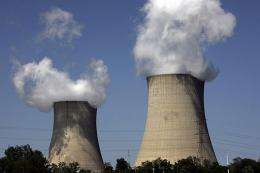
Shown here are nuclear reactors at a US power plant. Europe on Wednesday will draw up stress-test parameters for a safety sweep of its nuclear power reactors like these, promised after Japan's Fukushima No.1 disaster, but already the focus of bitter disputes.

Europe on Wednesday will draw up stress-test parameters for a safety sweep of its nuclear power reactors, promised after Japan's Fukushima No.1 disaster, but already the focus of bitter disputes.

For experts stand accused of turning a blind eye to the risk of terror attacks or aircraft accidents -- and of being in thrall to the powerful industry lobby governing their career prospects.

The European Nuclear Safety Regulators Group (ENSREG) has been entrusted with the job of checking whether ageing power plants can withstand the sort of natural disaster that triggered the meltdown in Japan.

It was the EU's 27 heads of state and government who opted to hand the design of the tests to their domestic regulators. ENSREG will meet in Brussels on Wednesday to agree on the criteria.

But the meeting comes as anti-nuclear politicians and campaigners object that the industry lobby, backed by the biggest players in France and Britain, have secured an easy ride.

The EU's energy commissioner Gunther Oettinger has also made it clear he will not settle for a watered-down set of tests.

"I will not put my signature to a which does not live up to my expectations nor to those of the broader public," Oettinger, of Germany, warned in an interview with the German weekly Spiegel.

"I do not agree with the fact that man-made disasters should be tested on a voluntary basis only," he added.

But Oettinger insists he is prepared to lodge new legislative proposals this year in a bid to force a tougher safety regime.

The commissioner drew the ire of the industry after the March quake and tsunami in Japan when he claimed the world was staring at a "apocalypse."

On Tuesday, he plans to meet with pressure groups and figures seeking backing for that position.

If Oettinger spoke out it was partly because lobby group the Western European Nuclear Regulators Association (WENRA) wants to exclude plane crashes and deliberate attacks from the test criteria.

Opponents fear they will manage to push through testing criteria that while raising test limits for plants' resistance to earthquakes, floods or severe systems failures breakdowns, exclude these kinds of man-made catastrophes.

WENRA members Italy and Sweden, which have abandoned nuclear energy, and Germany, which is going to, are among those backing their western partners on the issue.

But France and Britain, which between them account for more than half the 143 nuclear power plants in service in the European Union, are thought to be leading the charge.

Paris and London "are refusing the idea of including a deliberate plane crash, because no European plant would be able to stand up to that and therefore they would all have to close," said European Greens energy expert Michel Raquet.

The French authorities have dismissed the criticism: one of their officials in Brussels insisted that every eventuality would be covered in the stress tests, including the failure of the cooling system which proved so catastrophic at Fukushima.

Other EU countries however, share the fears of anti-nuclear campaigners.

In anti-nuclear Austria, Environment minister Nikolaus Berlakovich has openly criticised European plants' exposure to cyber-attacks.

And Belgium's energy minister Paul Magnette sparked weekend headlines when he argued in a debate with trade unionists that plants there could be mothballed ahead of schedule.

Lithuania, meanwhile, is anxiously looking over its shoulder at non-EU neighbour Belarus as the latter builds a new plant. The Baltic state wants its EU partners to develop national evacuation strategies in the event of a worst-case scenario, Brussels officials say.

"Based on the current plans for these tests, the European Union is falling well short of the necessary rigour," Greens EU lawmaker Yannick Jadot warned.

"If this is a success for the authorities in London and France, who have pulled this off through intensive lobbying to strip down the tests' specifications, it's a failure for all our citizens," he warned.

(c) 2011 AFP

Filter


Move the slider to adjust rank threshold, so that you can hide some of the comments.


Display comments: newest first

Lftrsuk
May 10, 2011

Rank: not rated yet
Nuclear safety is paramount in the public's mind and offering a reactor many times safer than widely used LWRs would secure the future of the nuclear industry and pave the way for a safe, green future for coming generations.

Liquid Fluoride Thorium Reactors (LFTRs) operate at atmospheric pressure, using stable fluoride salts of low reactivity. So there is no pressure or high chemical-reactivity 'driver' to expel radioactive substances into the environment. The fissioning fuel is in liquid form and is 'used up' 100%, so there is no need for cooling pools and subsequent fuel reprocessing. The amount of waste produced is less than one-thirtieth of that from an LWR and decays to background radiation levels in 300 years (easily, cheaply and safely storable).

LFTRs can 'burn-up' existing nuclear waste, as start-up fuel and therefore will get rid of the need for storage of such waste for hundreds of thousands of years.

Sell the safety improvements that can secure our green future.
Rank not rated yet
Relevant PhysicsForums posts

More news stories

Browser wars flare in mobile space

The browser wars are heating up again, but this time the fight is for dominance of the mobile Internet.

Technology / Software

created 1 hour ago | popularity 5 / 5 (1) | comments 1

SpotterRF debuts Radar Backpack Kit (w/ Video)

(Phys.org) -- SpotterRF has announced a special radar backpack kit designed to enhance situational awareness for soldiers on the ground. The company says its special radar is designed for warfighters as part ...

Technology / Hi Tech & Innovation

created 22 hours ago | popularity 5 / 5 (5) | comments 12 | with audio podcast report

Probability of contamination from severe nuclear reactor accidents is higher than expected: study

Catastrophic nuclear accidents such as the core meltdowns in Chernobyl and Fukushima are more likely to happen than previously assumed. Based on the operating hours of all civil nuclear reactors and the number ...

Technology / Energy & Green Tech

created May 22, 2012 | popularity 3.6 / 5 (21) | comments 56 | with audio podcast

HyperSolar shows dirty water no barrier to power world

(Phys.org) -- The Santa Barbara, California, company, HyperSolar, is set to transparently share the ups and downs of its research experiences toward the company’s ultimate vision, successfully producing ...

Technology / Energy & Green Tech

created May 24, 2012 | popularity 4.8 / 5 (15) | comments 17 | with audio podcast report

Tesla to launch electric sedan in US on June 22

Tesla Motors said Tuesday it would begin deliveries of "the world's first premium electric sedan" on June 22, slightly ahead of schedule.

Technology / Energy & Green Tech

created May 22, 2012 | popularity 4.5 / 5 (11) | comments 18


Nvidia trumpets Tegra 3 phone design wins for 2012

(Phys.org) -- Nvidia’s competitive war paint has a name, Tegra 3. On the heels of Nvidia announcements about lowering costs of its Tegra 3 processors and Nvidia-enabled tablets running Android Ice Cream ...

Scientist: Evolution debate will soon be history

(AP) -- Richard Leakey predicts skepticism over evolution will soon be history. Not that the avowed atheist has any doubts himself.

Dell tablet leak: 10.1-inch display, two-battery choice

(Phys.org) -- Headline after headline talks about vendors’ tablets in the wings as likely number-one contenders for the iPad. Such claims have justifiably been taken with a grain of salt, considering ...

SpaceX capsule has 'new car' smell, astronauts say (Update)

SpaceX's Dragon cargo vessel smells like a new car, said astronauts at the International Space Station after opening the hatches Saturday following the spacecraft's landmark mission to the orbiting lab.

Thousands of shellfish found dead in Peru

Thousands of crustaceans were found dead off the coast of Lima following the mystery mass death of dolphins and pelicans, the Peruvian Navy said Friday.

Australia hails surprise super-telescope decision

Australia has hailed a surprise decision giving it a role in a radio telescope project aimed at revolutionising astronomy, vowing to draw on its decades of experience in space science.