Cells send dirty laundry home to mom
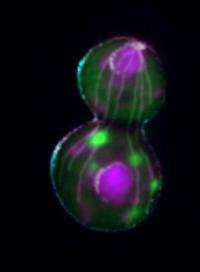
Understanding how aged and damaged mother cells manage to form new and undamaged daughter cells is one of the toughest riddles of ageing, but scientists now know how yeast cells do it. In a groundbreaking study researchers from the University of Gothenburg, Sweden, show how the daughter cell uses a mechanical "conveyor belt" to dump damaged proteins in the mother cell.
"This ensures that the daughter cell is born without age-related damage," says professor Thomas Nyström from the Department of Cell and Molecular Biology.
Thomas Nyström is a professor of microbiology at the University of Gothenburg and one of Sweden's leading researchers in the field of cellular and molecular biology. His research group has published countless scientific discoveries about cell ageing which have provided a new understanding of aging and age-related diseases. Now he and his colleagues have identified a key piece in the ageing puzzle.
Mechanic transport
In a study published as a feature article in the scientific journal Cell, two collaborating research groups at the Department of Cell and Molecular Biology have been able to show how newly formed yeast cells transport damaged and aged proteins back to the mother cell, guaranteeing that the new cell is born young and healthy.
Mother dustbin
"Previously it was believed that these structures allowed only one-way traffic of proteins and organelles from mother cell to daughter cell," says Nyström. "We can now show that damaged proteins are transported in the opposite direction. In principle, this means that the daughter cell uses the mother cell as a dustbin for all the rubbish resulting from the ageing process, ensuring that the newly formed cell is born without age-related damage."
Conveyor belt
In the study, the researchers show that this transportation is mechanical, using conveyor-like structures called actin cables. A special gene which controls the rate of ageing, called SIR2, is needed for these cables to form properly. Previous research has shown that changing the SIR2 gene can markedly extend the life-span of an organism.
Longer life
"Increased SIR2 activity means a longer life, whereas a damaged SIR2 gene accelerates ageing," says Nyström. "This has been demonstrated in studies of yeast, worms, flies and fish, and may also be the case in mammals."
Future treatment
This knowledge of how age-damaged proteins are transported from daughter cell to mother cell could eventually be used in the treatment of age-related diseases caused by protein toxicity in humans, but Nyström says that it is too early to say how.
The first step
"The first step is to study whether this transportation of damaged proteins also occurs in the cells of mammals, including humans, for example in the formation of sex sells and stem cells."
More information: The article The Polarisome Is Required for Segregation and Retrograde Transport of Protein Aggregates was published in Cell on 22 January.
Provided by University of Gothenburg


